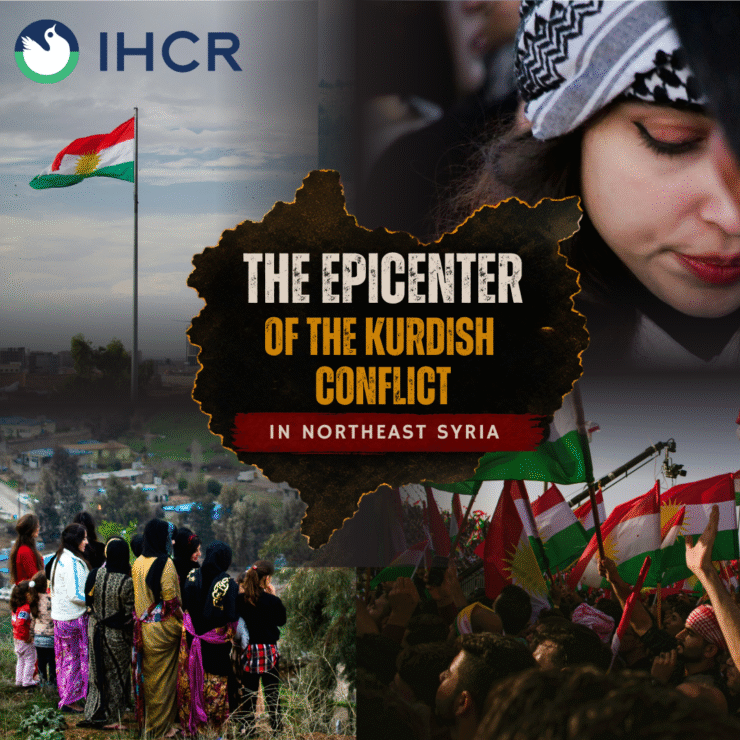
The Epicenter of Conflict in Northeast Syria

Kurds have suffered a century of betrayal and abuse. Sheik Said launched the Kurdish resistance movement against the Turkish Republic in 1925. Kurdish fighters gained control of Bingöl, Diyarbakır, Erzurum, Mus and Urfa. However, they faced an overwhelming force and were defeated. Sheik Said and his associates were sentenced to death on June 28, 1925. Turkish authorities executed Sheik Said, hanging him from a lamppost and concealing his burial place.
Northeast Syria, known as “Rojava”, is populated by Kurds and other ethnic and religious minorities including Chaldean Christians. Since the outbreak of the Syrian civil war in 2012, Kurds have run it as a self-declared autonomous region, protected by Kurdish-led armed forces. The Islamic State group (IS) swept through in 2014, capturing cities and villages with little resistance until it reached the city of Kobane, next to the Turkish border. Atrocities were widespread such as beheading, torture, and sexual violence. Ethnic cleaning occurred in the villages surrounding Kobani, IS seized 80 percent of Kobani and imposed a brutal siege that lasted for months. Supported by the US-led military coalition, Kurds fought heroically and broke the siege in early 2015.
The Islamic State group’s crimes were notorious including the mutilation of the Kurds in the Women’s Protection Units (YPJ). Farida Khalaf, a Yazidi woman, was abducted by IS as a teenager in 2014 and sold into slavery as part of the Yazidi genocide. Kurdish politicians and civil leaders, including some who espoused reconciliation with Turkey, were murdered by the Syrian National Army (SNA).
The SNA launched military operations against the Kurdish-led Syrian Democratic Forces (SDF) controlled territories beginning in 2016. It captured a swathe of territory running along hundreds of kilometers of the border between Turkey and Syria. SDF fought valiantly, repelled IS, and declared victory in 2019.
Turkey considers the largest component in the SDF – the People’s Protection Units (YPG) – an extension of the Kurdistan Workers’ Party (PKK), which has fought for Kurdish rights in Turkey for decades and is listed by Ankara as a terrorist organization. As the Assad regime collapsed in late 2024, the Turkish-backed SNA launched a new offensive to capture territory west of the River Euphrates from the SDF. Operation Peace Spring seized territory from the SDF to create a “safe zone,” displacing tens of thousands of Kurds. Power stations, refineries, telecommunications, and critical infrastructure near the Tishrin Dam were destroyed by Turkish drones and warplanes.
Both sides accused each other of war crimes. Turkey claimed that the SDF sent civilians to conflict-ridden areas as human shields. It accused the SDF of using “violence and terror” to pursue “its own separatist agenda.” On November 30, 2024, the SNA announced Operation Dawn of Freedom, aiming to expand Turkish-controlled territory, weaken the SDF, prevent Kurdish autonomy in post-Assad Syria, and support the Turkish initiative to establish a 30-kilometer-deep buffer zone in the north from al-Bab to Tel-Rifaat. Around 100,000 Kurdish civilians fled SNA-occupied territories throughout Aleppo governorate, which resulted in a humanitarian crisis. The remaining SDF-controlled towns in the northern Aleppo countryside were besieged and cut off from communication.
According to the Syrian Observatory for Human Rights (SOHR), more than 200,000 Syrian Kurds were driven from al-Shahbaa and other parts of Aleppo. Turkish airstrikes supported the SNA offensive, targeting SDF positions in Aleppo, Al-Hasakah, and Mambij. On December 6, 2024, the SNA launched an offensive targeting the city of Manbej, the last SDF-controlled area west of the Euphrates. Residents of Manbij and Kobani were deprived of water and electricity. Civilians in Shehba experienced robbery and extortion from SNA forces. According to SOHR, tens of injured combatants were extrajudicially executed by Turkish-backed forces. In April 2025, Kurdish forces withdrew to the eastern bank of the Euphrates River while government security forces deployed to the Tishrin Dam to establish a barrier between SDF and SNA forces.
About 40,000 IS family members and up to 10,000 jihadist fighters were held in SDF-controlled camps and prisons in the northeast. SDF Commander Mazloum Abdi indicated, “If Turkey attacks, we will have no choice but to redirect our forces”. Chaos accompanied the SDF’s withdrawal from al-Hol camp, with IS exploiting the disorder resulting from the transition. A security vacuum resulted as the IS declared a “new phase” against Syria’s authorities. The IS branded the government and al-Sharaa “apostate”.
Arab tribal forces sympathetic to Damascus rose up in Raqqa, Aleppo and Hasaka. They accused the Autonomous Administration of North and East Syria of abusing Arab rights in education and local administration. When the SNA attacked on January 4, 2026, fifteen years of self-rule ended in a fortnight. In an attempt to appease Syria’s Kurdish community, Al-Sharra issued a decree recognizing Kurdish identity and language rights, restoring citizenship to Kurds stripped of nationality, and declaring Nowruz a national holiday on January 16. It led to an integration agreement on January 30 combining a permanent ceasefire with a phased plan to fold the northeast’s military and civilian institutions into the state.
These measures represented Syria’s first formal recognition of Kurdish national rights since its independence in 1946. The announcement read, “The Syrian Ministry of Local Governance is granting significant authority to governors, including the hiring and firing of employees, approving investments and deals. The decision is the outcome of negotiations with the SDF, which requested greater decentralization. The northeast is vital to Syria. It holds Syria’s most consequential oil and gas resources, grain-producing land, and key cross-border routes.
The agreement was supported by the Trump administration’s envoy, Tom Barrack. Kurds felt betrayed when the US withdrew its support. Without US assistance, the SDF could not continue as an autonomous project. Beginning in January 2026, the AANES lost 70 percent of its territory and at least 1,000 fighters. Many Kurds were displaced and other minorities were left vulnerable. The US withdrew its support in December 2025. Without US air power and weapons, the SDF was overwhelmed by jihadis working with the Syrian Armed Forces. On January 29, SDF Commander Mazloum Abdi and Syria’s interim president, Al-Sharra, signed an integration agreement. It requires the SDF to integrate into all Syria’s security and civilian structures. The SDF cannot rely on Damascus’s goodwill. A US-led monitoring mechanism is needed to ensure compliance with these commitments. The US may also consider a fund for disarmament. demobilization and reintegration benefiting Kurds and other minorities such as Druze and Alawites who were victims of state-sponsored violence.
Defeat is a lesson in humility. The Kurds are not going to give up their way of life, but they must adjust to the new reality of an emboldened Turkey and an Islamist Syria. Kurdish self-criticism includes a critique of Murray Boochkin’s theories, which served as the ideological basis for the PKK and the Rojava revolution. Bookchin espoused libertarian principles and values of equality, freedom and sustainability. He envisioned a society linked through highly decentralized self-governing institutions, with power distributed to entities at the local level.
Kurds in Rojava envisioned a system of self-government based on Boochkin’s ideas, which emphasized decentralization, ecological justice and gender parity in local administration. In March 2005, Öcalan issued the ‘‘Declaration of Democratic Confederalist in Kurdistan”, which called for grassroots “democracy without the state.” Tribal elites announced the creation of the “Council for Cooperation and Coordination in Jazira and the Euphrates” in April, aimed at unifying tribal voices against what they called the SDF “hegemony”.
Boochkin’s romantic ideals had broad appeal to Öcalan, the PKK, and the SDF. However, the Rojava revolution proved impractical and premature. The demise of the Autonomous Administration in North and East Syria marked the end of the democratic confederation, or at least a delay in its realization.
Society in the Middle East has not yet evolved to embrace decentralization and grass-roots democracy. For Arabs and Turks, federalism is a bridge too far.
Kurds have suffered betrayal and abuse from the Treaty of Lausanne to the present. Their national aspirations have repeatedly been denied and their identity suppressed. While Kurds would prefer to exercise their right to self-determination, this is not possible under the current conditions. Instead, they are forced to seek a modus vivendi with Damascus and accommodation with their Arab neighbors in Syria.
The January 29 agreement between al-Sharaa and Mazloum should be closely monitored by evaluating its 14 points. This can be carried out by the Kurds themselves in cooperation with representatives of the international community who are sympathetic to their cause. The evaluation process could take place over six months, with a final and periodic reports.
Damascus is already dragging its feet in fulfilling its obligations, so without continuous evaluation and implementation reviews, the Kurds may find their interests betrayed again. The United States does not appear inclined to fully support Kurdish goals, meaning the Kurds will need to organize an implementation and review mechanism on their own, in consultation with civil society and international NGOs.