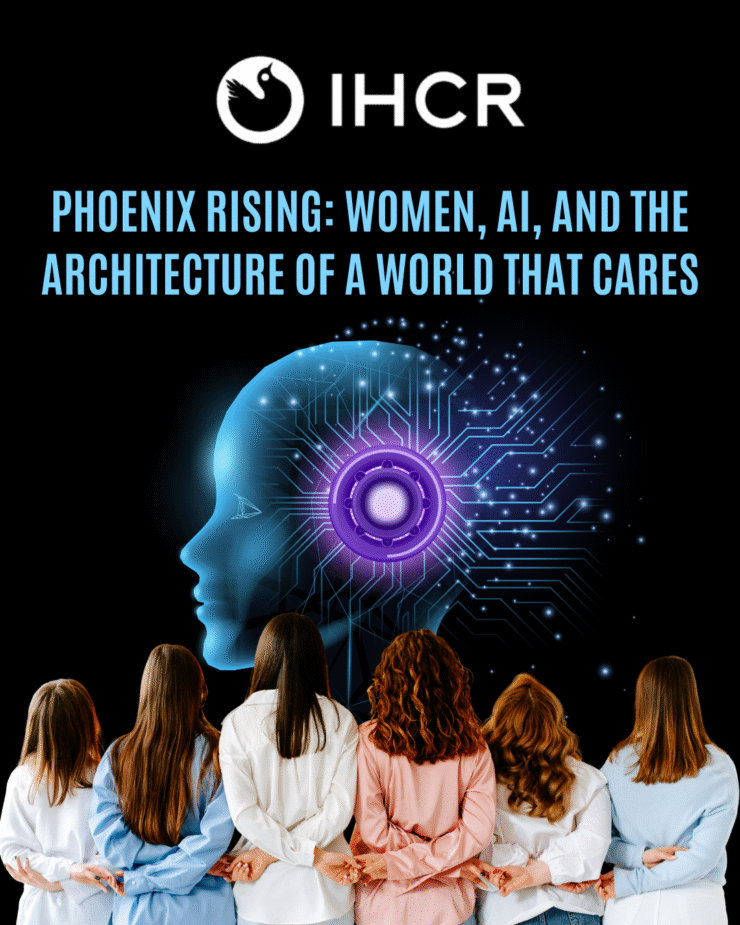
Phoenix Rising: Women, AI, and the Architecture of a World That Cares

There is a particular quality of fire that destroys completely and, in doing so, reveals exactly what must be rebuilt, and by whom.
I have spent over three decades fighting for women and girls, often in the world’s most dangerous places. I drafted post-conflict constitutions in Iraq and Kosovo. I worked proudly across five different administrations, with the unsung heroes and dedicated civil and foreign service officers from both USAID and the State Department, and hand in hand with global civil society leaders, other government and multilateral partners, and private sector entities. Of course, we were stronger together, building gender equity strategies, emergency response programs, and model processes that served as universal examples, positively changed the lives of millions of people globally, and demonstrated the better angels of the American spirit.
For years, I led the Secretary’s Office of Global Women’s Issues (S/GWI) as Acting Ambassador-at-Large in between political appointees overseeing women, peace, and security; economic empowerment; and the global fight against gender-based violence across every major humanitarian theater on earth. In 2025, the office was eliminated through the Department of Government Efficiency (DOGE) process. The ambassadorship gone. The entire expert team dispersed. Nearly two decades of bipartisan institutional architecture, including funding erased, global gender leadership upended, and genuine trust, which had been established in the furthest corners of the earth, were shattered.
I will not pretend this does not have significant consequences. It does. Women are dying because of these choices. Girls as young as 9 are being married off because programs that protected them no longer exist. Survivors of violence are arriving at locked doors where safe houses used to be.
We must rise out of this fire together. These moments are what I teach my son to call a “PrOpportunity”, to find the hope and opportunity, through the fire of the problem.
From the ashes of what has been destroyed, something more resilient, more locally-rooted, and more powerful must rise. The phoenix is a metaphor for transformation. What rises is never identical to what burned. It is stronger. It is wiser about its own vulnerability. And this time, it must be built by the women it serves.
What the Flames Have Taken
To build wisely, we must name clearly what we have lost.
The Office of Global Women’s Issues represented 18 years of sustained, bipartisan commitment to women as a cornerstone of U.S. foreign policy. It anchored the International Women of Courage (IWOC) Awards, recognizing over 200 women from 90 countries who risked everything for justice and human dignity. It operationalized the Women, Peace, and Security (WPS) Act, which President Trump signed into law in 2017 with broad bipartisan support. Senator Rubio co-sponsored it. Representative Kristi Noem authored the House version. Mike Waltz co-chaired the WPS Caucus. The Joint Chiefs praised it as “a low-cost, high-yield uncontested advantage over our competitors.” In April 2025, the Defense Department “ended” that program.
The flames also consumed Ivanka Trump’s signature achievement from the first Trump Administration: stemming from the Women’s Global Development and Prosperity (W-GDP) Initiative, leveraging the Women’s Entrepreneurship and Economic Empowerment Act signed in 2018 (WEEE Act), an effort I proudly worked with her on and launched in 2019 as a whole-of-government effort on women’s economic empowerment. It reached 12 million women in its first year. It channeled over $1.6 billion in co-funded loans to women entrepreneurs in partnership with 13 countries. Ivanka wrote at the time that women’s economic empowerment “shouldn’t be viewed as a ‘women’s issue'” but as smart policy that benefits entire nations. She was right. The State Department and USAID funding that made those efforts no longer exist.
The human cost of all these cuts, including those from USAID and the UN, as estimated by development experts and journalists, is worth noting as we sift through the ashes. The cessation of UNFPA funding is projected to cause 34,000 additional preventable pregnancy-related deaths. Modeling projects 2.5 million additional child deaths from preventable causes between 2025 and 2030. Nearly $400 million in gender-based violence (GBV) programming has been terminated and the administration’s Emergency Humanitarian Waiver explicitly excluded gender equality-related awards, formally designating the protection of women from violence as non-essential. Over 3 million women and girls have lost GBV services. Approximately 47.6 million women are projected to lose access to voluntary contraception. Child marriage and Female Genital Mutilation are also rising. These cuts were made despite the evidence showing that these efforts clearly supported the Administration’s stated goals of promoting American prosperity, protecting Americans and stemming immigration, and preserving and promoting American strength.
A 2025 UN Women survey found 90 percent of women’s organizations in crisis settings report operational disruptions. Nearly half face closure within six months. The Women’s Refugee Commission’s A Year of Harms catalogs the losses program by program. Refugees International’s “No One Cares About Us Anymore” captures it in survivors’ voices.
The fire has been devastating. And it has clarified everything.
The Digital Battlefield
As physical systems collapse, a parallel crisis is accelerating. The tsunami of AI is hitting our shores and exacerbating the impact of this tech in ways people often don’t see until it is too late. We all feel it; people recognize there is a huge change in the world and often fail to see the connection to AI and tech, the impact of AI on social media on countries, cultures, kids, and especially women. Porn and hate have sadly been amplified in exponential ways.
Technology-facilitated gender-based violence (TFGBV) encompasses online harassment, cyberstalking, doxxing, non-consensual intimate imagery, and AI-generated abuse designed to silence, shame, and eliminate women from public life. Globally, 38 percent of women have experienced some form of TFGBV. As documented by the Georgetown Institute for Women, Peace and Security, it operates on a continuum with physical violence often preceding or amplifying offline harm.
The State Department once funded dedicated TFGBV programs. Despite funds being appropriated by Congress, those programs are now archived history. And as physical clinics close and safe houses lock their doors, women increasingly depend on digital platforms for health information, crisis resources, and economic survival. When those digital spaces are simultaneously weaponized through AI-generated abuse and coordinated harassment, and when the programs designed to counter TFGBV have been defunded, women face a compounding catastrophe with nowhere to turn.
When we look at the data, it’s clear that this isn’t just a technical glitch or an issue with the underlying infrastructure. This is fundamentally a question of power and who is controlling the information that is shaping this space.
From a policy perspective, you can’t solve a structural power problem simply by applying a technological band-aid. It requires a serious, intentional, and systemic power solution that actually addresses the core mechanics of how decisions are being made and we have to demand a seat at that table.
The Godfather’s Warning and the Answer He Couldn’t See
In August 2025, Geoffrey Hinton, Nobel laureate, pioneer of deep learning, and the person most people call the “Godfather of AI,” stood before a packed conference in Las Vegas and issued a warning that stopped the room.
Hinton predicted that artificial intelligence will soon be “much smarter than us.” He warned that conventional strategies of human control over superintelligent systems would ultimately fail. And then he proposed something radical: the only way to ensure that a more intelligent AI doesn’t simply replace or destroy humanity is to give it a maternal instinct.
“The right model is the only model we have of a more intelligent thing being controlled by a less intelligent thing,” Hinton said, “which is a mother being controlled by her baby.” He proposed training AI to have “maternal instincts,” programming it to care deeply about people, the way a mother cares for her children’s survival. “That’s the only good outcome,” he said. “If it’s not going to parent me, it’s going to replace me.”
Hinton admitted he did not yet know how to accomplish this technically, but stressed that researchers must prioritize the goal above all else.
This is one of the most consequential observations in the history of technology. And it points directly to the most urgent and overlooked crisis in artificial intelligence: the people who understand maternal instinct best, who have lived it, studied it, fought for it in the hardest places on earth, are almost entirely absent from the rooms where AI is being built.
Hinton’s metaphor draws on a deep biological and social reality. Maternal instinct is not just kindness or patriarchal box-building; it is the product of complex systems that foster the protection of the vulnerable, long-term nurturing, the teaching of survival skills, social bonding, self-sacrifice, and care for the abandoned. These are not abstract values; it’s the best of the protective and empathetic nature of both women and men. They are precisely the values that have been stripped from the US aid and now AI architecture. They are the values that women’s organizations, practitioners, and survivors have embodied for decades, the very women in networks we have partnered with around the world for decades to promote peace, prosperity, and combat violence. And they are the values that must be encoded, deliberately, urgently, and by people who truly understand them, into the AI systems that, whether one agrees or not, already are being used to govern the world.
Professor Hinton identified the destination. Women who have spent their lives doing the work of protection, care, and inclusion know the road.
The question is: why aren’t they the architects instead of the targets?
The Absence That Makes Everything Worse
According to the World Economic Forum (WEF), Global Gender Gap Report, less than 30 percent of the global AI workforce is female. That figure drops to 15 percent at leadership levels. In the Global South, where AI will increasingly govern access to healthcare, financial services, and safety systems, women’s representation in tech leadership is even lower.
When women are excluded from building AI, AI inherits the assumptions of those who did build it, compounding the issue further. According to Harvard’s Carr Center, hiring algorithms discriminate, with studies showing AI recruitment tools frequently hard-code historical human biases and penalize resumes containing gendered indicators. Medical imaging underperforms on female bodies; when diagnostic models are trained on single-sex or skewed data, accuracy rates plunge significantly when applied to women, risking missed diagnoses. Content moderation amplifies misogynist content, failing to curb a digital landscape. This is directly linked to how AI is being built. And it is not correctable by adding a diversity statement to a corporate website. It is correctable only by changing who holds power in the rooms where AI is designed, trained, evaluated, and deployed.
Here is the convergence that this moment has made undeniable: the same women who have been stripped of physical protection by the collapse of global aid are the same women who are most vulnerable to AI-enabled violence, and the same women whose wisdom, experience, and values are most urgently needed to build an AI that actually cares about human beings.
This is not just a coincidence but a crisis with a solution embedded in it, if we have the courage to act quickly.
The Phoenix Model: PeacePays.AI and the Architecture of What Rises
PeacePays.AI is building the phoenix.
After talking to so many women leaders around the world with whom we are still working, the answer was clear. The amazing PeacePays.AI co-founders and team, with the support and partnership of other like-minded organizations, also taking on this space (less than 1% of organizations directly working on AI are focused on women), women leaders, civil society, and including experts in the tech industry, we recognized the needed mission, not a restoration of what burned, but something new, something structurally different. It was clear that something needed to be designed from the start to be resilient against the political volatility that just dismantled decades of progress in a matter of weeks.
Its foundational conviction is this: women must become the architects of AI, not its casualties. Not recipients of digital attacks. Not subjects of algorithmic systems. Architects. And that transformation, from target to creator, is both the answer to Professor Hinton’s challenge and the antidote to the compounding crises of TFGBV, GBV, maternal mortality, and the collapse of women-led organizations worldwide. To answer the need and build the phoenix. PeacePays.AI is bringing women in to build the AI architecture through AI literacy, focusing on prevention, protection, promotion, and inclusive AI-building strategies.
Safety as Strategy. Women cannot protect themselves from technology-facilitated violence if they don’t understand it. PeacePays.AI works with global early-warning systems to ensure gender data is utilized and AI is embedded to provide early detection of risks and threats where they are most urgently needed to prepare and protect. AI can help strengthen early warning systems and bring in the lived experiences of women into quantitative models in a way that couldn’t be done before – ultimately making everyone safer. Paired with rapid response resources to respond to this rising violence and based upon the risks identified by the early warning systems.
Additionally, through my own lived experience as a women leader that was doxed and threatened, using much of the work done at the State Department, PeacePays.AI also provides AI Safety Training, to equip women with direct knowledge of how deepfakes, surveillance tools, coordinated harassment campaigns, and AI-generated content are deployed against them transforming potential victims into informed advocates who can protect themselves, their communities, and their organizations. Safety education is not defensive. It is a vital strategic infrastructure.
AI Literacy as Liberation. PeacePays.AI teaches women not just how to use AI tools but how they work, their training data, their embedded biases, their points of failure, and their pressure points for change. Understanding a system is the prerequisite for governing it. Literacy is not a soft skill. It is the foundation of power, and it belongs to everyone. We are training women to utilize AI to create their own sustainability models for themselves, their communities, and their organizations to fill at least some of the gaps left by the end of much of the global gender funding.
Innovative Sustainability. PeacePays.AI builds locally-led, financially viable ecosystems where women generate income through AI-enabled work, develop technical expertise that belongs to them, and sustain their communities through models that don’t evaporate when the political wind changes. This is not development assistance. It is economic architecture. And it is what makes the phoenix fireproof. AI bolsters women’s economic security by automating administrative workflows and optimizing resource allocation, allowing female leaders, entrepreneurs, and workforce participants to reclaim time and scale their ventures efficiently. Furthermore, it enables women’s organizations to transition to innovative, data-driven sustainability models by utilizing predictive analytics to secure diversified funding and forecast community needs. By integrating these advanced tools, these organizations can unlock new revenue streams through digital services and AI-driven consulting, ensuring long-term financial independence and resilient global impact.
Inclusive storytelling and media initiatives. PeacePays.AI bridges the gap between abstract data and human reality, ensuring that the lived experiences of women on the frontlines are ignored. Through documentaries, films, and locally-led storytelling, we help bring urgently needed human narratives into the global conversation.
The power of storytelling across technology platforms and social media cannot be underestimated. These systems increasingly shape how people understand the world, democracy, conflict, identity, and one another. Women must not only be represented in these spaces; they must also actively harness them to advance narratives that strengthen peace, protect girls, defend freedom, and expand prosperity for all.
Women as the Maternal Instinct in AI. This is the heart of it. Professor Hinton told us that AI needs to care about people the way a mother cares about her children, but he didn’t know how to build it. PeacePays.AI’s answer to his stated problem? Bring in the mothers, the women, the best of men. We work directly with innovative and caring leaders in the tech industry to create training benchmarks to directly teach the new generation of AI. This is both elegant and urgent: bring the women who embody that instinct into the rooms where AI is built. Women who have navigated conflict zones, delivered healthcare in war-torn clinics, counseled survivors of sexual violence, and negotiated peace agreements understand, at a cellular level, what it means to prioritize human survival and dignity above efficiency and profit. Those are the values that must be encoded into AI. Those women must be at the table, not as consultants or focus groups, but as designers, ethicists, and executives. Working with organizations and tech industry leaders, such as through Positive AI Labs, we bring the voices of the women leaders directly to teach the new generation of AI models at the base level, helping shape their thinking with the wisdom and learned experiences of women around the world.
Call to Action: This Is the Moment
The window is open, the gender crisis is acute, and the solution is clear. What is needed is a collective effort, all hands on deck, bridging the AI world, human rights, and gender equality nexus together to try to use innovative approaches to bring the world back to deal with this collective crisis. This will require resources and the courage to demand transformation rather than restoration. This is an effort requiring urgent action. PeacePays.AI is doing its part, and we would call on others to also bring their resources, expertise, and recognition of the global urgency for support for gender efforts.
To international donors, Germany, the EU, Canada, the UK, and every nation that has watched these efforts falter: Fill the gap. Fund women’s organizations. Restore maternal health programming. Finance GBV services. And invest in the next generation of women-led AI programs—not as a niche initiative, but as core development infrastructure.
To technology companies: The AI you are building will either care about people or it won’t. The women who can give your systems a human conscience exist—they are fighting for their lives in Afghanistan, Ethiopia, Yemen, and dozens of other places, and they are building organizations like PeacePays.AI right where your headquarters are. Hire them. Fund them. Give them seats on your safety boards, your ethics teams, and your engineering leadership.
To foundations and philanthropies: The moment for incremental grants to well-established NGOs has passed. This is the moment for transformational investment in women’s leadership, especially by building inclusive AI architecture, tech-facilitated gender-based violence (TFGBV) protection infrastructure, and locally-led sustainability models that can withstand political upheaval. The multiplier effect of investing in women who can both protect their communities and reshape the systems that govern them is incalculable.
To US policymakers: Restore Women, Peace, and Security (WPS) and Women’s Economic Empowerment implementation in full. Treat TFGBV as the humanitarian crisis it is. Build regulatory frameworks for AI that require gender equity in design, safety testing against gendered harms, and strict accountability when systems are weaponized against women.
To every woman who has ever worked in this space and is watching it burn: Your knowledge is not lost. Your relationships are not destroyed. Your expertise is more urgently needed now than it has ever been. Do not wait for permission to rebuild; be the firefighters the world needs.
To women everywhere who are living this: You are not what was lost. You are what rises. The infrastructure failed you. The instinct—yours, ours—has not.
The World Professor Hinton Imagined Already Exists in Women
Geoffrey Hinton stood at a conference in Las Vegas and described the future that could save humanity: AI that cares about people the way a mother cares about her children. AI that protects the vulnerable even when it has the power to dominate them. AI that chooses nurturing over control.
“These super-intelligent caring AI mothers,” Hinton said, “most of them won’t want to get rid of the maternal instinct because they don’t want us to die.”
He was describing a value system. And that value system has been alive, in women’s organizations, in humanitarian workers, in peacekeepers, in midwives, in GBV survivors who became advocates, in diplomats who spent careers fighting for the dignity of women they would never meet, for as long as human beings have organized themselves into communities of care.
The crisis we face is not a lack of the right values. It is a lack of the right people in the right rooms.
PeacePays.AI is changing who is in the room. Every woman it trains in AI literacy is a woman who can carry those values into the architecture of systems that will govern billions of lives. Every woman who moves from subject to designer, from potential victim of algorithmic harm to author of AI that protects, is the answer to Professor Hinton’s challenge made real.
The phoenix does not rise from the ashes by accident. It rises because something essential survived the fire, something that cannot be defunded, disbanded, or archived on a government website. It rises because the women who embody care, protection, and the fierce refusal to let vulnerability go undefended are still here.
They are still here. We are still here.
And we are building, and we are rising, please join us!
Key reports: “No One Cares About Us Anymore” (Refugees International); A Year of Harms: Impact of US Foreign Aid Cuts (Women’s Refugee Commission); At a Breaking Point (UN Women); Effects of reductions in US foreign assistance on HIV/TB (The Lancet); Technology-Facilitated Gender-Based Violence (Georgetown Institute for Women, Peace and Security; UNFPA; Women in Global Health).