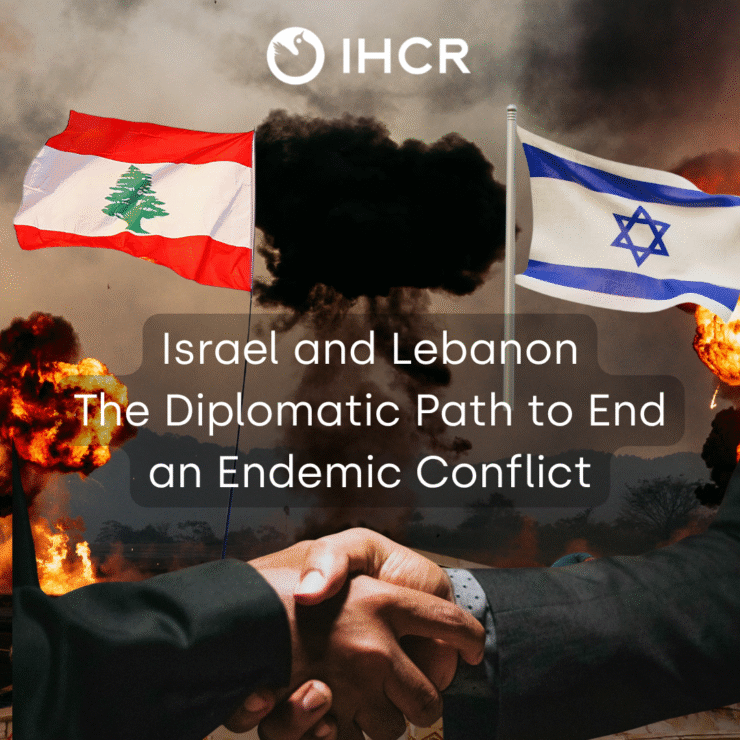
Israel and Lebanon: The Diplomatic Path to End an Endemic Conflict

For the past year the author of this article has, with a Canadian colleague, been deeply involved in an unofficial (“Track II”) diplomatic effort to create a solid foundation for successful Israel-Lebanon direct talks. We are doing our best to facilitate negotiations aimed at permanently ending 78 years of hostilities and instituting close, bilateral security cooperation between the two militaries, cooperation ultimately reconciling Israeli security with Lebanese sovereignty and ending combat operations whose effects have fallen disproportionately on civilians.
We deliberately defined our mission in terms of foundation-building. Through discussions with senior, experienced, and well-connected non-officials on both sides (and occasionally senior officials when invited), we hoped to deliver to both parties and their American mediator practical ideas of what a sustainable security agreement – something short of a peace treaty but a major step in that direction – would look like.
After sensing that we were making substantial progress, we began to lose hope in our prospects for success starting on March 2, 2026, when Iran directed its Lebanese proxy (Hezbollah) to launch missiles toward Israel. Israel’s military response was devastating, killing over 4,000 Lebanese, injuring some three times that number, displacing over a million Lebanese civilians, and razing to the ground dozens of abandoned Lebanese towns and villages south of the Litani River. Bilateral security cooperation and peaceful relations began to seem to be remote possibilities.
Then, on June 26, Lebanon, Israel, and the U.S. signed a Trilateral Framework agreement designed to set in motion a process whereby units of the Lebanese Armed Forces (LAF) would gradually replace units of the Israel Defense Forces (IDF) until the IDF is gone from Lebanese territory. Implementation would be difficult at best, requiring a robust American third-party intermediary presence, consolidation of a genuine ceasefire, a measure of Iran-Hezbollah cooperation, the ability of the LAF to secure areas to be repopulated from armed Hezbollah elements, and Israel’s willingness to take “Yes” for an answer if the LAF performs well. In any event, my colleague and I permitted ourselves a bit of optimism, as it appeared that the Framework reflected elements of what had been recommending to our Israeli, Lebanese, and American contacts.
In general, however, the prevailing conditions on the ground have not been conducive to building a foundation for successful direct talks between Israel and Lebanon. Indeed, they may not be so now. Still, a foundation of sorts was built and contributed, in some measure, to the Framework. The key to building it has been my colleague and I listening carefully to the Lebanese and Israelis with whom we have interacted.
Before traveling to the region in July of last year, we composed lists of people with whom we would try to consult; people who were reasonably open-minded, well-informed, and well-connected to official decision-makers. Track II diplomacy is, in the end, useless unless it informs and influences the deliberations and decisions of officials residing in what is sometimes referred to as “Track I.”
On the Lebanese side our list featured retired senior military officers and former senior officials. We included people of differing political views drawn from Lebanon’s main sectarian groups. We decided, however, not to try to engage Hezbollah. This was because we considered members of Hezbollah’s leadership cadre to be proxies for Iran – not independent Lebanese actors willing or able to put Lebanon first. We think our decision was justified by what happened on March 2nd this year, when Iran ordered its proxy to rocket Israel from Lebanese territory, and Iranian officers of the Islamic Revolutionary Guard Corps (IRGC) exercised direct command of Hezbollah’s military operations.
On the Israeli side the contacts we selected had profiles very similar to their Lebanese counterparts. Just as we decided in Lebanon to forego conversations with Hezbollah personnel, so in Israel we opted to avoid dead-end conversations with those publicly advocating the annexation of Lebanese territory and the installation of Jewish settlements in Lebanon.
Unfortunately, we had from the beginning to shuttle between Lebanon and Israel for separate conversations with each set of contacts. Track II diplomacy aims to bring two sides into the same room for moderated, direct conversations. Yet Lebanese laws prohibit Lebanese citizens from being in contact with Israelis. Ideally these laws will soon disappear.
In both countries we selected contacts we believed capable of engaging us in sustained conversations about the Lebanon-Israel-Hezbollah situation and ready to communicate with and even influence their respective governments. We listened carefully, took notes, and went to great pains to tell each side what we were hearing from the other side. And, while protecting the identities of our contacts, we made sure that the U.S. Government and other governments trying to end the violence knew what we were hearing. So: what was it we were being told by the two sides?
In Israel, one point was driven home relentlessly. After the horrific events of October 7, 2023, when Hamas militants crossed from Gaza into Israel murdering, raping, and taking hostages, Israel will no longer tolerate threats from non-state actors on any of its borders. Instead, it will act militarily and preemptively to neutralize those threats and to protect Israeli citizens.
We were told that Israelis remain deeply and perhaps permanently traumatized by the events of October 2023, including Iran’s decision to permit Hezbollah to open fire on northern Israel the day after the Hamas atrocities.
We were told that support for preemptive military strikes on non-state threats transcends political party lines and the political spectrum in Israel, and that opposition to them is politically negligible. Indeed, the attempt by the U.S. on April 9th of this year to impose a new ceasefire in Lebanon was, according to public opinion polls, opposed by between 70 and 80 percent of Israeli voters. Another ceasefire was announced in the wake of the June 17th signing of the U.S.-Iran Memorandum of Understanding (MOU), and it too attracted strong opposition from Israel’s government and public. Indeed, widespread Israeli skepticism about the new Framework is inevitable, which accounts for Prime Minister Netanyahu and others proclaiming that Israel will never depart from Lebanese territory until Hezbollah is completely disarmed in the entire country.
Yet we were also told that Israelis have no faith at all in the willingness or the ability of the Lebanese government and military to disarm and demobilize Hezbollah. Although we attracted considerable cooperation from our Israeli contacts in defining the essential contents of a potential security agreement with Lebanon, no Israeli with whom we spoke believed that Lebanese leaders had the appetite or the means to confront Hezbollah militarily in a decisive manner; that Israel would have to persist with armed violence until the threat was removed.
Finally, we were asked by our Israeli contacts to visit some communities on Israel’s side of the “Blue Line” border to speak with residents about the terror they have endured at the hands of a violent, non-state entity operating within a handful of meters from their homes. We did so. We asked those residents what it was they ultimately wanted to see on the Lebanese side of the Blue Line. Often we received an answer that surprised us deeply: “The Lebanese Army.”
In Lebanon, our contacts told us that they comprehended Israel’s Hamas-induced trauma and Israel’s new security doctrine of preemptively striking out preemptively at non-state threats. Some indicated they saw not much to distinguish the “new security doctrine” from past Israeli practices in Lebanon.
They told us, however, that most Lebanese – even most Shiite Muslims, many of whom support Hezbollah – want the permanent end to hostilities with Israel. But almost without exception our contacts decried what they described as Israel’s ignorance of Lebanese political realities, ignorance they claimed was driving military operations producing huge amounts of civilian suffering and enabling Hezbollah to rally support among Lebanese Shiites, support it seemed to be losing by acting militarily on behalf of Iran. Some indicated the belief that IDF-induced civilian suffering was neither driven by ignorance nor accidental.
All our Lebanese contacts told us they want Hezbollah disarmed and demobilized. They said that Lebanon has no prospect of recovering economically until state monopolies on weapons of war and war-and-peace decisions are established. They understood the reluctance of investors and donors to inject any resources into Lebanon so long as arms and key decisions were in the hands of Iran and Hezbollah. But they insisted on proceeding cautiously, noting the chicken-and egg dilemma of a bankrupt state being denied aid and investment while trying to compete with Iran and Hezbollah for the loyalty of Shiite citizens.
They pointed out that an armed Hezbollah represents Iran in Lebanon, and that it will not be easy for a Lebanese Army unable even to meet its payroll to oust Iran from Lebanon, much less violently neutralize its armed proxy. They pointed out that for decades Hezbollah, with Iranian financial support, had built a state-within-a-state in Lebanon, providing social welfare and political influence to an otherwise neglected Shiite community.
They said that Israeli attacks, producing great civilian suffering, were having the perverse effect of convincing Lebanese Shiites that they – not just Hezbollah – are Israel’s designated enemy. They argued it would take time and resources to make Hezbollah politically and militarily irrelevant in Lebanon. They feared that a Lebanese Army simply unleashed on Hezbollah would result in widespread sectarian clashes, possibly even a civil war.
Finally, they pointed out that the most powerful military in the region – the IDF – was proving unable to destroy Hezbollah. If the IDF could not militarily neutralize Hezbollah, what were the chances of the LAF doing so?
By September 2025 my colleague and I, after listening intently to both sides, drafted a potential “Agreement on Permanent Termination of Hostilities” and shared it with our Israeli and Lebanese contacts for their comments and suggestions. They had plenty, but we were able to reach broad consensus on a text. We shared an amended version with both sides and with the relevant governments when we submitted what we thought was our final report last November.
But in December of 2025 Israel and Lebanon conducted two sets of direct talks under U.S. auspices. We found support on both sides for the idea that we continue our efforts into the New Year, and we did so.
Yet the decision on February 28th by the U.S. and Israel to attack Iran complicated our efforts significantly. Among other things, it obligated us to revise our draft agreement considerably, which we did.
But more than anything else it led Iran to use its Hezbollah weapon which, combined with Israel’s response, once again brought widespread death, destruction, displacement, terror, and trauma to the Shiites of Lebanon. Between November 2024 – when the first “ceasefire” was announced – and March 2, 2026, Israel attacked Hezbollah-related targets almost daily, and Hezbollah did not respond. Since March 2nd, however, when Iran ordered Hezbollah to open fire, Israel has responded with intensified bombings, expanded occupation of southern Lebanon, and the systematic demolition of villages evacuated by Lebanese Shiites.
My colleague and I were not surprised by the intensity of Israel’s military response to Iran’s Lebanon-based aggression. Nevertheless, we were deeply disappointed by the tactics employed.
Having written extensively in other contexts about the requirement to minimize, to the extent possible, civilian casualties and damage to civilian property during combat operations, we were not at all persuaded that the IDF was doing all it could to apply the principle of “proportionality” in its targeting of Hezbollah fighters and facilities. Indeed, even President Donald Trump has publicly criticized Prime Minister Benjamin Netanyahu for dropping entire apartment buildings without regard to civilian protection. In the contest between the GOL and Iran/Hezbollah for political dominance in Lebanon, the large Shiite community will have the decisive “vote.” Yet the heavy civilian casualties produced, and the gratuitous demolitions of abandoned villages seemed, in a perverse way, to be making the case for Iran and Hezbollah.
It was difficult, under these circumstances, to see what Lebanon-Israel negotiations could accomplish. Until late February, when the U.S. and Israel launched surprise attacks on Iran, the Lebanese Army was making some progress in establishing its hold on southern Lebanon – something that’s not existed for nearly 60 years. That is now gone. Replacing it was a greatly enlarged Israeli occupation, with Hezbollah fighters firing drones at Israeli soldiers and Israel expanding its ground and air campaigns against Hezbollah targets, often in heavily populated areas.
President Aoun and Prime Minister Salam of Lebanon nevertheless committed themselves to negotiations with Israel, notwithstanding opposition and threats from Hezbollah. Aoun and Salam see negotiations as a way for the Lebanese State to assert that it, and no one else, oversees Lebanon’s foreign policy. Their insistence was decisive in the recent Framework Agreement being reached.
Still, Israel and Iran either remain very much at war in Lebanon or on the precipice of renewed armed violence, with Lebanese Shiite civilians bearing the brunt of death and destruction while the Lebanese government and army look on helplessly, and northern Israelis fear where the next Hezbollah missile, rocket, or armed drone might land.
My colleague and I for months urged both sides, ideally with American assistance, to devise a plan to go into effect if a real ceasefire were to take hold. The plan we recommended would, on a step-by-step basis, enable Lebanese Army units to replace their Israeli counterparts until there were no more Israeli soldiers left in Lebanon. It would institute a comprehensive structure for the two armies to communicate, coordinate, and cooperate so that northern Israelis and southern Lebanese could rebuild their lives and live in peace. Many elements of what we were recommending have been incorporated into the June 26, 2026 Framework.
It is not clear what my colleague and I might be able to do in an ongoing Track II project. Our original mission – establish a solid foundation for Israel and Lebanon to negotiate an agreement that would permanently end the state of hostilities existing since 1948 and implement security measures enabling Lebanese and Israeli civilians to co-exist in peace – appears to have been accomplished. Clearly the Framework Agreement could prove to be a strong precursor to what, based on our discussions with Israelis and Lebanese, we have been recommending.
One thing we might be able to do is to continue and deepen the exchange of information between the two sides, ideally in a traditional Track II format involving people speaking and listening in the same room. It will be vitally important for Lebanese to understand that there is no viable alternative to full cooperation with Israel on security matters and no viable alternative to a Lebanese state that fully controls weapons of war and war-and-peace decisions. It will be vitally important for Israelis to understand that Lebanese Shiites – perhaps 40 percent of Lebanon’s population – are not the enemy. On the contrary: their loyalty and support – whether to the Government of Lebanon or to Hezbollah – is the center of gravity in the current conflict, the prize to be won or the opportunity to be lost. My colleague and I think it’s vitally important that Israelis and Lebanese hear these things from one another, not from us.
In the end, for Track II to work there must be engaged and interested Track I customers. In this case my colleague and I have experienced mixed results.
At one end of the spectrum, we have interacted indirectly and sometimes directly with senior Lebanese officials. Perhaps owing to that government’s position of being trapped between Iran and Israel it has been open to the ideas surfaced in the process we have overseen.
At the other end of the spectrum, there is a Government of Israel not much interested in our work. Many of our Israeli contacts have told us that Prime Minister Netanyahu sees his prospects for getting reelected this October as depending in part on his ability to continue waging war in Lebanon, whether Hezbollah stops shooting or not. Indeed, most Israelis want the war on Hezbollah to continue, and few appear to be concerned about the costs to Lebanese civilians. Israelis, for understandable reasons, consider themselves to be the principal victims of nonstate actors in neighboring countries. And it is likely that far too many Lebanese regret attacks on Israeli civilians by Hezbollah not for the evil they represent, but for the responses they elicit.
And in the middle, there is the United States. My colleagues and I have shared everything we have learned and done with American officials. We have seen words we have written replicated in official American statements. We consider effective American mediation between Lebanon and Israel and effective American diplomacy toward Iran to be essential. There is no point to my colleague and I investing time and energy in this project without the United States taking full advantage of it. Yet American leadership in producing the new Framework is encouraging, provided it is implemented.
But implementation of this latest agreement will be tough and will require, among other things, a very robust and persistent American intermediary role. Is the U.S. prepared to do the proverbial “long patrol” in Lebanon? Is it willing to help Lebanon end Iran’s semi-suzerainty? Is it ready to compel Israel to fight differently in Lebanon if Hezbollah, acting (under Iranian instructions) renews its attacks to undermine the Framework Agreement? Is it committed to demand a clear GOL plan to establish the requisite state monopolies over weapons of war and war-and-peace decisions, and will it act to secure for Lebanon the resources it needs to compete successfully with Iran and Hezbollah in undertaking reconstruction and providing governmental services?
I would like nothing more than to conclude my professional life by facilitating peace between two countries I like and admire very deeply. Indeed, peace between Israel and Syria is also something to which I’ve devoted significant effort, something I’d very much like to live long enough to see. Israel and Lebanon, however, have rarely engaged in military confrontation on a state-to-state basis despite being in a state of war for over 77 years. The pathway to peace begins with ending armed violence and permanently terminating that state of war, thereby reconciling Israeli security with Lebanese sovereignty. With a modicum of mutual Israel-Lebanon respect and with an end to Iran’s deadly intervention in internal Lebanese affairs, the first steps on that pathway can be taken now. Ideally, the new Framework and ongoing Track II efforts represent those first steps.
Although my Canadian colleague and I have tried to employ unofficial diplomacy to facilitate written agreements between two parties, we have been profoundly affected by the impact of armed violence on civilians. The Framework signed on June 26, 2026, will ideally serve as the precursor to the agreement we drafted, which itself could be a precursor to a treaty of peace. But truly best efforts to protect civilians in combat operations require something transcending diplomatic agreements. It requires the mitigation of and end to mutual dehumanization.
For the leaders of Hezbollah, the dehumanization of Israeli Jews and targeting of civilian populations comes as naturally as money laundering, drug smuggling, and assassination. Disarming Hezbollah must be part of a broader process that ends Iran’s partial suzerainty in Lebanon and secures the loyalty of all Lebanese to the Lebanese state. In the meantime, however, we were profoundly moved by the fear and suffering of northern Israelis subjected to attacks by a party for which inflicting civilian terror is a matter of military doctrine.
For Israel, and particularly for a military that possesses a highly refined code of ethics, the challenge is to see maximum protection of civilians in combat operations not as an inconvenience to be avoided when targeting Hezbollah personnel and weaponry in populated areas, but as an opportunity to help the Lebanese state make the argument that Iran and its proxy are the ones placing the country on a pathway to total collapse. Yes, the mission of the IDF is to close with and kill the enemy. But victory in Lebanon will, in large measure, be defined in terms of what Lebanese Shiites decide: support the state, or support Hezbollah. Civilian protection is an essential element of fighting smarter. Dehumanization will take time to unwind. Assigning a higher priority to protecting civilians and their property should begin now.