From Victims to Perpetrators? The Israeli Jewish Case

Introduction
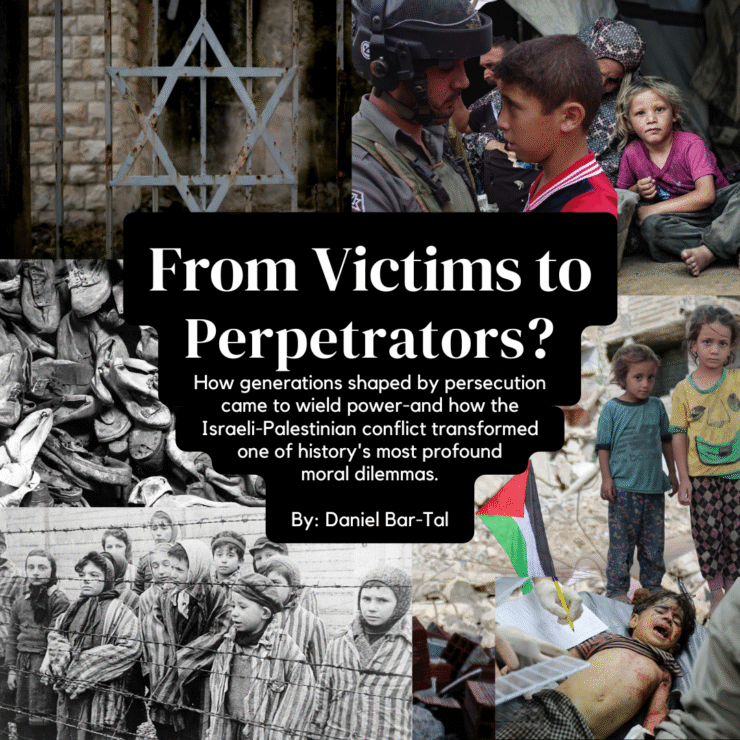
One of history’s most troubling paradoxes concerns the Jewish people. For nearly two thousand years, Jews experienced persecution, expulsions, pogroms, discrimination, and ultimately the Holocaust, in which six million Jews were murdered. Yet within a few decades of establishing Israel, many observers came to view the Jewish state as responsible for the dispossession, occupation, and oppression of another people: the Palestinians. How can a people shaped by victimhood become associated with practices many regard as oppressive?
This essay traces that transformation through six historical phases. It does not attempt a comprehensive history of the Israeli-Palestinian conflict, but rather examines how ideological beliefs, collective memories, and political developments shaped dominant Jewish-Israeli attitudes and policies.
Phase One (1882–1947): Zionism and the Emergence of Conflict
The conflict began with Zionist immigration to Ottoman Palestine in the late nineteenth century. Zionism emerged from the conviction that Jews needed a homeland where they could determine their own fate after centuries of vulnerability. Palestine, however, was already inhabited by an Arab population that was simultaneously developing its own national aspirations. From the beginning, competing national movements claimed the same land. Early Zionist immigrants, influenced by European colonial attitudes, often viewed Arabs as culturally backward. These perceptions contributed to a process of delegitimization that would become deeply embedded in Israeli Jewish society.
Several themes emerged during this period. Many Zionist leaders envisioned a Jewish state extending beyond the territory eventually established in 1948. Some also discussed the possibility of encouraging or forcing Arab emigration. Zionism further promoted the ideal of the “New Jew”: strong, self-reliant, physically capable, and liberated from the perceived weaknesses of Diaspora life.
As Jewish immigration increased, Palestinian resistance grew. Riots in 1920 and 1929 and the Arab Revolt of 1936–1939 intensified mutual hostility. Jews established defense organizations such as the Haganah, Palmach, Etzel, and Lehi. Each round of violence reinforced negative stereotypes and strengthened narratives portraying the other side as an existential threat. These developments merged with older elements of Jewish historical consciousness, including collective memories of persecution, a strong sense of group identity, and the belief that Jews faced constant danger. The Holocaust dramatically reinforced these perceptions. The murder of six million Jews convinced many Zionists that only an independent Jewish state could guarantee Jewish survival.
Phase Two (1947–1966): Statehood, War, and the Nakba
In November 1947, the United Nations approved a partition plan creating separate Jewish and Arab states. Jews accepted the proposal; Palestinians rejected it, viewing it as unjust because the Jewish minority received a majority of the territory. Civil war broke out, followed by the 1948 Arab-Israeli War after Israel declared independence. By the war’s end, Israel controlled significantly more territory than allotted by the UN plan. Approximately 750,000 Palestinians fled or were expelled, and hundreds of villages were destroyed. Palestinians remember these events as the Nakba (“catastrophe”). For Israelis, the war represented national liberation and survival. For Palestinians, it marked dispossession and exile. Both societies suffered heavy losses, but Palestinian society was particularly devastated, losing much of its political, social, and economic infrastructure.
The approximately 150,000 Palestinians who remained inside Israel lived under military rule until 1966, facing restrictions on movement, political activity, and land ownership. Meanwhile, large numbers of Jewish immigrants arrived from Europe, North Africa, and the Middle East. Israeli institutions, education, media, and public culture reinforced a conflict-centered narrative. The Holocaust became central to Israeli identity, shaping perceptions of security, vulnerability, and relations with the outside world. The memory of existential threat deeply influenced national psychology and policymaking.
Phase Three (1967–1993): Occupation and Settlement
The 1967 Six-Day War transformed the conflict. Israel captured the West Bank, Gaza Strip, East Jerusalem, Sinai Peninsula, and Golan Heights. The victory generated immense national pride but also placed millions of Palestinians under Israeli control. Israeli leaders justified retaining these territories on both security and historical grounds. The West Bank, widely renamed Judea and Samaria in Israeli discourse, was viewed by many as part of the historic Jewish homeland. Settlement construction began almost immediately and expanded steadily under both Labor and Likud governments.
Over time, Israel developed an extensive system of military, legal, and administrative control over the occupied territories. Palestinians experienced restrictions on movement, land confiscations, home demolitions, arrests, military courts, and pervasive surveillance. Human rights organizations increasingly criticized these practices as violations of international law. Some Israeli leaders also explored policies aimed at encouraging Palestinian emigration. Large-scale population displacement occurred in Gaza and elsewhere during the early years of occupation. The occupation generated growing international criticism.
The 1982 Lebanon War and the Sabra and Shatila massacre intensified debate within Israel itself. The First Intifada, beginning in 1987, reflected widespread Palestinian resistance to occupation and exposed the costs of continued military rule.
Throughout this period, the United States provided substantial military, economic, and diplomatic support to Israel. Settlement expansion continued despite international opposition.
Phase Four (1993–2000): Oslo and the Promise of Peace
The Oslo Accords of 1993 represented a historic breakthrough. Israel recognized the Palestine Liberation Organization (PLO), while the PLO recognized Israel and renounced terrorism. The agreements established limited Palestinian self-government and created the Palestinian Authority.
For many Israelis, Oslo humanized Palestinians and created hope for reconciliation. Palestinians gained partial self-rule in parts of the West Bank and Gaza. Yet the agreements left unresolved the conflict’s core issues: borders, settlements, refugees, Jerusalem, security arrangements, and Palestinian statehood. Settlement expansion continued during the Oslo years, undermining Palestinian confidence in the process. Violence also persisted. Hamas carried out attacks against Israeli civilians, while extremist Jewish opponents of Oslo sought to derail the peace process. In 1995, Prime Minister Yitzhak Rabin was assassinated by a Jewish nationalist opposed to territorial compromise. The election of Benjamin Netanyahu in 1996 marked a shift toward a more skeptical approach to Oslo. By the end of the decade, hopes for a negotiated settlement were fading.
Phase Five (2000–2022): Disillusionment, Gaza, and Entrenchment
The collapse of the Camp David negotiations in 2000 and the outbreak of the Second Intifada transformed Israeli public opinion. Many Israelis concluded that Palestinians were not genuine partners for peace. The violence of the Intifada, including suicide bombings and military operations, reinforced fear and distrust. Thousands of Israelis and Palestinians were killed. The conflict strengthened right-wing political forces and weakened the Israeli peace camp. A growing sense of pessimism took hold regarding the possibility of resolving the conflict.
Israel maintained extensive control over the West Bank through checkpoints, military operations, and permit systems. Palestinians viewed these measures as instruments of domination; Israelis viewed them as necessary for security.
After Hamas seized control of Gaza in 2007, Israel imposed a blockade restricting movement and trade. Gaza became the site of repeated wars and military confrontations, including major conflicts in 2008–09, 2012, 2014, and 2021. Palestinian casualties greatly exceeded Israeli casualties in each round of fighting. Meanwhile, settlement growth accelerated. By the early 2020s, hundreds of thousands of Israeli settlers lived in the West Bank and East Jerusalem. Human rights organizations increasingly described the resulting system as apartheid, arguing that different legal and political regimes governed Jews and Palestinians living in the same territory. Many Israeli leaders rejected these accusations and maintained that security concerns justified existing policies. Nonetheless, the prospect of a two-state solution appeared increasingly remote.
Phase Six (2023–2026): October 7, Gaza, and the Deepening Crisis
The Israeli government elected in 2022 included some of the most nationalist and religious parties in Israel’s history. Simultaneously, mass protests erupted against proposed judicial reforms that many Israelis viewed as threats to democracy.
On October 7, 2023, Hamas launched a devastating attack on southern Israel, killing more than 1,200 people, mostly civilians, and taking hundreds of hostages. The assault shocked Israeli society and revived fears deeply rooted in Jewish historical experience. Israel responded with a massive military campaign in Gaza. The war caused enormous destruction, displacement, and loss of life. Most of Gaza’s population was uprooted, infrastructure was devastated, and humanitarian conditions deteriorated dramatically. The scale of Palestinian casualties and destruction generated intense international criticism. Human rights organizations, legal scholars, and some governments accused Israel of committing grave violations of international law, while Israeli leaders strongly rejected these accusations and argued that the war was a legitimate response to Hamas’s actions.
The conflict also intensified violence in the West Bank. Settlement expansion, military operations, and settler attacks increased, while Palestinian communities faced growing displacement and restrictions. Critics argued that these developments amounted to a process of de facto annexation and ethnic cleansing. Israeli authorities rejected such characterizations.
Explaining the Paradox
The preceding narrative has focused primarily on the actions of Israeli Jews and the Israeli state. One notable feature of this history is the relative absence of official acknowledgment or apology for harms inflicted on Palestinians. More commonly, allegations of wrongdoing have been denied or justified by political and military leaders. When abuses have been investigated, accountability has often been limited. This pattern, according to critics, has persisted throughout the conflict. This brings us to the central question of this essay: How did a people with a long history of persecution become associated with policies that many observers describe as oppressive toward another people?
The Jewish-Palestinian conflict has lasted for more than 125 years. Initially, it was a struggle between two national communities in the same territory. Since 1948, however, it has increasingly become a conflict between a powerful state and a stateless population. The Nakba transformed the balance of power, leaving Palestinians politically fragmented and largely unable to achieve sovereignty. From this perspective, 1948 marked a turning point at which Israeli Jews ceased to be only victims and became, in varying ways and degrees, agents of domination over another people. Periods of negotiation occurred, but they never fundamentally altered the larger trajectory of occupation, settlement expansion, displacement, and recurring violence.
Zionism and Its Ideological Legacy
To understand this transformation, one must begin with Zionism. At its core, Zionism is the belief that the Jewish people constitute a nation entitled to self-determination in their historic homeland. Like all nationalist movements, it emerged from a desire for collective security, dignity, and political independence. Yet Zionism has never been a fixed ideology. Its meaning has evolved over time and has been interpreted differently by liberals, socialists, religious nationalists, and conservatives. Nevertheless, certain themes have remained remarkably consistent. From the movement’s earliest years, land and identity became deeply intertwined. The territory of historic Israel was not merely a place of residence but a central component of Jewish nationhood. Many Zionist leaders viewed territorial control as essential to national survival and renewal.
This perspective was reinforced by the experience of exile, persecution, and ultimately the Holocaust. The creation of Israel was therefore understood not simply as a political achievement but as the fulfillment of a historical mission. As a result, territorial questions often acquired emotional, symbolic, and even sacred significance.
After 1967, these tendencies intensified. The capture of the West Bank and East Jerusalem transformed the political landscape. For many Israelis, these territories represented the heartland of Jewish history and religion. Among religious-nationalist groups, settlement became not only a political project but a religious obligation. The land itself came to be viewed as sacred, and relinquishing parts of it increasingly appeared unacceptable.
Over time, this outlook contributed to the delegitimization of Palestinian claims. Israeli political discourse increasingly framed security, history, religion, and national identity as reinforcing one another. Palestinians were often seen not as a people with equivalent national rights but as obstacles to Jewish self-determination. The result was a political culture in which territorial expansion, settlement construction, and military control could be justified as necessary for both security and historical justice.
This tendency became particularly pronounced during the long political dominance of the Israeli right, especially under Benjamin Netanyahu. Settlement growth accelerated, support for Palestinian statehood diminished, and nationalist and religious currents gained influence. Critics argue that these developments culminated in the conditions now described by many human rights organizations as apartheid in the West Bank and in the devastating war in Gaza.
The broader consequence has been a hardening of attitudes on both sides. Israeli Jews increasingly viewed Palestinian demands as threats to national survival, while Palestinians saw Israeli policies as evidence that peaceful coexistence was becoming impossible. The conflict thus evolved into a self-reinforcing cycle of fear, mistrust, and escalating hostility.
The Power of the Israeli State
Ideology alone does not explain the transformation. Power matters as well. Over the decades, Israel developed into one of the strongest states in the Middle East. It possesses a highly advanced military, sophisticated intelligence services, cutting-edge technology, significant economic resources, and strong international alliances. These capabilities have allowed Israel to exercise overwhelming military superiority over its Palestinian adversaries. This power has been reinforced by extensive support from the United States and other Western countries. Military aid, economic cooperation, diplomatic backing, and technological partnerships have strengthened Israel’s position while limiting external pressure on its policies. Following the October 7, 2023 attacks, Western support increased further.
The result is a profound asymmetry. Israel possesses the institutions and resources of a modern state, while Palestinians remain politically divided and largely dependent on Israel. The Palestinian Authority exercises only limited authority in parts of the West Bank, while Gaza has been governed separately by Hamas. Palestinians lack the military, economic, and diplomatic capabilities available to Israel. This imbalance has shaped the character of the conflict. It has allowed Israel to maintain long-term control over Palestinian territories, expand settlements, and conduct military operations with relatively limited external constraints. At the same time, Palestinian weakness has reinforced feelings of frustration and powerlessness, contributing to cycles of resistance and repression.
The Holocaust as a “Chosen Trauma”
Another critical factor is the central role of the Holocaust in Israeli collective identity. The murder of six million Jews by Nazi Germany remains the defining trauma of modern Jewish history. In Israel, it is not merely remembered as a historical event but as a foundational lesson about vulnerability and survival. The Holocaust is taught extensively in schools, commemorated through public rituals, and embedded deeply within national consciousness. The dominant lesson drawn from this experience is “Never Again.” The phrase reflects the belief that Jews can rely only on themselves for protection and that a strong sovereign state is the sole guarantee against future catastrophe. This conviction has shaped Israeli political culture for generations.
Over time, however, the Holocaust has also become a broader framework for interpreting threats. Political leaders, educators, and media figures have often linked contemporary dangers to historical experiences of persecution. As a result, many Israelis view threats through an existential lens, fearing that even limited challenges could evolve into catastrophic dangers. This perception has strongly influenced attitudes toward Palestinians and the wider Arab world. In some cases, Arab adversaries have been portrayed through analogies to historical enemies of the Jewish people. Such comparisons intensify fear and reinforce the belief that Palestinians ultimately seek Israel’s destruction.
The psychological consequences are significant. Research on collective victimhood suggests that societies that strongly identify as victims often develop three tendencies. First, they may experience reduced empathy toward their adversaries, focusing primarily on their own suffering. Second, they may develop a sense of moral entitlement, believing extraordinary measures are justified in the name of self-defense. Third, they may view criticism from outsiders as unfair or illegitimate because it appears to ignore their historical trauma. Those who criticize Israeli policies and actions are immediately labeled antisemites.
These dynamics have been visible repeatedly throughout the conflict. After October 7, 2023, for example, many Israelis immediately connected the attack to the Holocaust, viewing it as the latest expression of a long history of attempts to destroy the Jewish people. This interpretation strengthened support for a forceful military response and reinforced the perception of Israelis as perpetual victims of existential hostility.
Wars, Security, and the Use of Force
Israeli governments have consistently portrayed military operations as acts of necessity and self-defense. In many cases, genuine security threats existed. Yet the distinction between wars of necessity and wars of choice remains a subject of debate. The wars of 1948, 1973, and the response to October 7 clearly involved major threats to Israeli security. Other conflicts, however, reflected strategic calculations, territorial ambitions, or political objectives alongside defensive concerns. Over time, military force became a central instrument of Israeli statecraft.
The Israeli military has generally displayed strong loyalty to civilian governments and has carried out policies approved by elected leaders, even when those policies generated substantial international criticism. Security considerations have frequently overridden competing moral, legal, or political concerns. This reliance on force has shaped both Israeli and Palestinian perceptions. Israelis often see military action as unavoidable and necessary for survival. Palestinians frequently experience the same actions as evidence of domination and oppression. Each side’s interpretation reinforces its existing narrative.
A Militarized Society
A final factor is the deeply militarized character of Israeli society. Since 1948, most Israeli Jews have supported the country’s major wars and military operations. Public opinion shifted toward greater openness to compromise during the 1980s and 1990s, particularly during the Oslo process. However, the collapse of negotiations and the violence of the Second Intifada reversed that trend.
Today, a substantial majority of Israeli Jews hold hawkish political views. Many support settlement expansion, view Palestinians with distrust, and prioritize security concerns over territorial compromise. Only a relatively small minority continues to advocate a comprehensive peace settlement based on Palestinian statehood and an end to occupation. These attitudes are reinforced by Israel’s system of military service. Military experience functions as a major social institution, linking generations and creating strong bonds between citizens and the armed forces. Schools, media, political leaders, and public commemorations frequently emphasize national resilience, collective sacrifice, and the importance of military preparedness.
As a result, security concerns occupy a central place in Israeli identity. Many citizens view the military not simply as a state institution but as a guarantor of collective survival. This orientation has contributed to widespread support for policies that prioritize security even when they impose severe costs on Palestinians.
At the same time, the conflict has imposed enormous costs on Israelis themselves. Tens of thousands of soldiers and civilians have been killed throughout the history of the conflict, while many more have suffered physical and psychological trauma. The economic burden has also been immense, consuming vast resources that might otherwise have been devoted to social and economic development. Yet resistance to Palestinian national aspirations has carried its own price. The continuation of occupation and conflict has repeatedly generated violence, instability, and insecurity. In this sense, both societies have become trapped in a cycle that perpetuates suffering for Israelis and Palestinians alike.
Conclusion
The paradox explored in this essay cannot be explained by a single factor. It emerged from the interaction of ideology, historical trauma, power, security fears, nationalism, religion, and prolonged conflict. Zionism provided a framework for Jewish self-determination and national revival, but it also fostered territorial claims that increasingly conflicted with Palestinian aspirations. The Holocaust reinforced a profound sense of vulnerability and the conviction that Jewish survival required strength and self-reliance. Israel’s growing power enabled it to dominate the conflict, while military success and prolonged occupation reinforced attitudes that prioritized security over compromise.
Together, these forces helped transform a people shaped by centuries of victimhood into a nation widely accused of imposing suffering on another people. Whether one accepts that characterization or not, the conflict demonstrates how collective trauma can influence national behavior in unexpected and troubling ways.
The tragedy is that both peoples possess legitimate histories of suffering, fear, and attachment to the same land. Lasting peace will require recognizing those realities simultaneously rather than treating one narrative as valid and the other as irrelevant. Only through such recognition can Israelis and Palestinians hope to move beyond a conflict that has shaped both societies for more than a century.