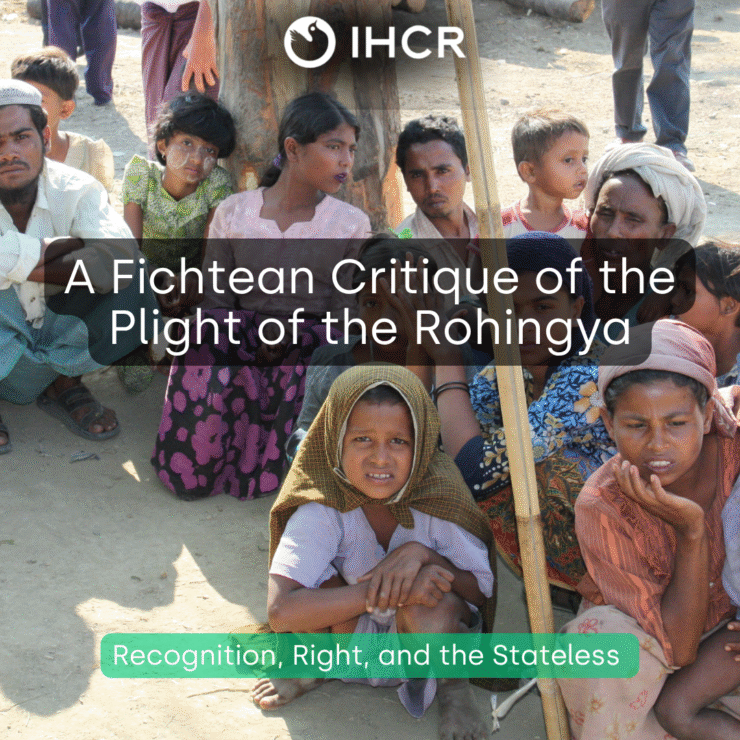
Recognition, Right, and the Stateless: A Fichtean Critique of the Plight of the Rohingya

Summary
I. Introduction: The Moral and Philosophical Scandal of Statelessness
Few conditions so starkly expose the limits of our moral and political order as those of the stateless person. For Hannah Arendt, the refugee or stateless individual—deprived of citizenship and stripped of political belonging—reveals “the right to have rights” as the first and most fundamental of all rights.1 The case of the Rohingya, denied citizenship under Myanmar’s 1982 Nationality Law and persecuted as an “alien” presence within their own homeland, exemplifies the deepest contradiction of modern politics: the existence of persons whom the law has rendered invisible.
To address this contradiction philosophically, we may turn to Johann Gottlieb Fichte, whose conception of right (Recht) as the condition of reciprocal recognition among free beings provides a powerful framework for understanding the moral catastrophe of statelessness. Though writing in the late eighteenth century, Fichte’s Foundations of Natural Right anticipates the central insight of Arendt’s political thought: that human dignity depends not merely on biological existence, but on the political and juridical recognition of one’s personhood.2
Through Fichte, we can understand statelessness not only as a humanitarian tragedy but as a transcendental violation—a negation of the very conditions that make moral agency possible. This essay develops that argument in three movements: first, Fichte’s conception of recognition and right; second, the function of the state as the realization of moral freedom; and third, the resonance of these ideas with Arendt’s account of the refugee as the paradigmatic figure of modern disenfranchisement.
II. Recognition and the Conditions of Selfhood
In the Foundations of Natural Right, Fichte establishes recognition (Anerkennung) as the ground of both self-consciousness and right. The I, he insists, does not first exist in isolation and then encounter others; rather, the very possibility of self-consciousness presupposes the existence of another rational being who summons me to recognize their freedom as I demand recognition for my own.3
“The concept of a finite rational being,” Fichte writes, “implies the existence of other such beings outside it, with whom it stands in a relation of reciprocal efficacy.”4
This reciprocal relation is not empirical but transcendental—it is a necessary condition of moral personality. A being who is not recognized, or who cannot recognize others as free, is denied the possibility of selfhood. In this sense, recognition is not simply social esteem; it is the ontological ground of freedom.
When a people, such as the Rohingya, are stripped of legal personhood and excluded from the political community, they are denied precisely this condition of recognition. They become, in the Fichtean sense, unrealized persons—not because they lack reason or will, but because the juridical world refuses to acknowledge their agency. Their plight, then, is not merely political but metaphysical: they are deprived of the intersubjective medium through which self-consciousness achieves actuality.
Fichte’s notion of right follows directly: Right is the relation of reciprocal freedom between rational beings.5 It is the form of coexistence that allows each to pursue self-determination without negating the freedom of others. For this reason, right cannot be the privilege of some; it is, by definition, universal. To exclude even one rational being from the sphere of right is to negate the very concept of law.
III. The State as the Realization of Freedom
In Fichte’s political philosophy, the state arises as the institutional embodiment of reciprocal recognition. The state is not primarily an apparatus of coercion, nor a mere social contract; it is the organ of rights, whose purpose is to secure for each member the conditions of autonomous action.
“Right,” Fichte maintains, “is possible only in a community of free beings who mutually limit their freedom according to a law they all recognize.”6 The state’s legitimacy therefore depends entirely on its function as the realization of freedom. A government that ceases to guarantee the equality of recognition among its members forfeits its moral standing.
In this sense, the stateless person represents an ethical contradiction: a human being without access to the community that alone can make freedom effective. The refugee exists in a liminal space where law withdraws, a zone of what Giorgio Agamben later called bare life—but the roots of that concept are already implicit in Fichte’s moral ontology.
When the state expels or refuses recognition to a group—declaring, as Myanmar has of the Rohingya, that they “do not belong”—it destroys the moral ground of its own existence. It becomes, in Fichte’s words, a “system of compulsion without right.”7 The expulsion of the Rohingya is thus not only a crime against a people; it is the suicide of right itself.
IV. The Moral World-Order and the Universality of Duty
Fichte’s System of Ethics deepens this argument by locating the moral imperative in the idea of an infinite moral world-order (sittliche Weltordnung). Every rational being, he writes, bears the duty to act so as to realize this moral world in the sphere of appearance.8 This duty transcends national boundaries; it is the obligation to treat every rational being as an end capable of freedom.
The sittliche Weltordnung thus entails a form of proto-cosmopolitanism. While Fichte is not a cosmopolitan in the Kantian sense, his ethics nonetheless points toward a universal moral community grounded in the autonomy of reason. To tolerate statelessness, therefore, is to participate in the destruction of the moral world-order. The existence of refugees is not a natural misfortune but a collective moral failure—a symptom of humanity’s inability to universalize the very principle it professes: that all rational beings are free and equal.
In Fichte’s system, moral action is the realization of freedom in the world. The ethical subject must seek to transform empirical reality until it accords with the idea of right. This imperative entails that political communities cannot rest content with partial justice. As long as there exist persons who are legally invisible, the moral task remains unfinished. The duty to the stateless is therefore not humanitarian but transcendental: it arises from the very structure of reason.
V. Arendt and the “Right to Have Rights”
Hannah Arendt’s The Origins of Totalitarianism offers a twentieth-century counterpart to Fichte’s analysis. In her chapter on “The Decline of the Nation-State and the End of the Rights of Man,” Arendt observes that the refugees of the interwar period—Jews, Armenians, and others—revealed a profound truth: human rights, when divorced from political membership, are empty.
The stateless person, she writes, lost “not the right to freedom, but the right to action; not the right to think, but the right to opinion.”9 For Arendt, this loss demonstrates that rights depend on belonging to a political community—on being recognized as part of a world where one’s words and actions count. The refugee is the being “from whom the world has withdrawn.”10
This insight converges with Fichte’s: for both, the human person exists only within a structure of reciprocal recognition. Arendt’s “right to have rights” is, in effect, the modern translation of Fichte’s doctrine that selfhood requires acknowledgment within a lawful community. The moral crisis of statelessness thus appears as a philosophical catastrophe: a regression to a pre-juridical state where persons are reduced to biological existence.
For Arendt, the totalitarian state begins precisely when it creates populations outside the law—when it produces superfluous men, human beings without a polity.11 The Rohingya, confined to camps and stripped of citizenship, embody this superfluity. Their condition is not accidental but structural, the consequence of a world order that still defines rights in terms of the nation-state.
VI. The Fichtean Critique of Nationalism
Fichte’s own political thought oscillates between cosmopolitan moralism and national particularism, especially in the Addresses to the German Nation. Yet even here, his nationalism is moral, not ethnic. Fichte conceives the nation as an educative community whose purpose is to cultivate universal freedom.12
A nation that defines itself through exclusion or racial purity, he would argue, betrays its own vocation. “Every people,” Fichte writes, “is destined to form itself into a complete and harmonious whole, a member of humanity which acts in freedom.”13 The nation’s legitimacy, then, depends on its service to humanity, not its withdrawal from it.
From this standpoint, the ethnic nationalism of Myanmar represents the perversion of the very idea of the state. A government that denies recognition to a segment of its population ceases to be a member of the moral world-order. It becomes, in Fichtean terms, a mechanism of domination devoid of right.
Indeed, Fichte’s insistence that right cannot exist for some without existing for all leads inexorably toward a universalist politics. If recognition is the ground of selfhood, and if right is the relation of mutual recognition among rational beings, then the full realization of right requires a cosmopolitan order. The plight of the Rohingya thus discloses not merely the failure of a state, but the incompleteness of the global moral order itself.
VII. The Stateless as the Limit of the Moral World
In both Fichte and Arendt, the stateless person occupies a liminal zone between humanity and non-being. For Fichte, the absence of recognition means that the individual cannot appear as a free agent in the world; for Arendt, it means the loss of a common world altogether.
The refugee, then, becomes the symptom of a deeper metaphysical disorder: the disjunction between the universality of reason and the particularity of political forms. Fichte’s philosophy helps us see that this disorder is not contingent but intrinsic to the modern system of states, which continues to define belonging in terms of national identity rather than universal right.
Yet Fichte also offers a path toward transcendence. His ethics of the moral world-order demands that we act to overcome every empirical limitation that contradicts the idea of universal freedom. This imperative entails the creation of political institutions capable of guaranteeing recognition to all persons, irrespective of national origin. In this sense, Fichte prefigures what we might call a transcendental cosmopolitanism: not an empirical federation of states, but a moral duty to construct a world in which the concept of right truly becomes universal.
VIII. Conclusion: Recognition as the Measure of Humanity
In the end, Fichte’s philosophy enables a radical critique of statelessness as both a moral and metaphysical affront. To deny recognition to a human being is to negate the very possibility of a moral world. The Rohingya, like the countless stateless peoples before them, are not merely victims of political exclusion; they are witnesses to the fragility of the moral order itself.
Through Arendt’s eyes, we see that the modern state, when it creates human beings without rights, approaches the threshold of totalitarianism. Through Fichte’s eyes, we see why: because it has severed the bond of recognition that makes freedom real.
To affirm the rights of the stateless is not an act of charity but of philosophical consistency. If reason and freedom are universal, then the conditions that make them effective—the juridical and political forms of recognition—must also be universal. The moral world-order demands no less.
Until the day when every rational being is recognized as such within a lawful community, the task of right remains unfinished. The plight of the Rohingya stands as a call to realize what Fichte named the highest vocation of humanity: to transform the empirical world until it reflects the idea of freedom itself.
1. Hannah Arendt, The Origins of Totalitarianism (New York: Harcourt, 1951), 296.↩
2. Johann Gottlieb Fichte, Foundations of Natural Right, trans. Frederick Neuhouser (Cambridge: Cambridge University Press, 2000), 35–38.↩
3. Ibid., 37.↩
4. Ibid., 42.↩
5. Ibid., 45–46.↩
6. Ibid., 47.↩
7. Ibid., 50.↩
8. Johann Gottlieb Fichte, System of Ethics, trans. Daniel Breazeale and Günter Zöller (Cambridge: Cambridge University Press, 2005), 110–115.↩
9. Arendt, Origins of Totalitarianism, 295.↩
10. Ibid., 297.↩
11. Ibid., 300.↩
12. Johann Gottlieb Fichte, Addresses to the German Nation, trans. Gregory Moore (Cambridge: Cambridge University Press, 2008), 26–28.↩
13. Ibid., 49.↩