
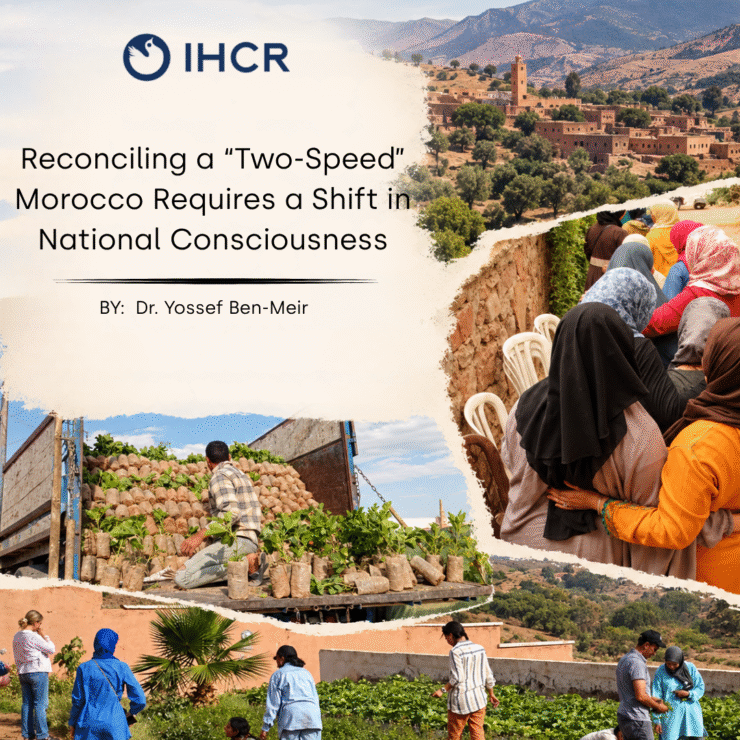
Reconciling a “Two-Speed” Morocco Requires a Shift in National Consciousness

Executive Summary: Morocco has formalized a dynamic development model over the past quarter of a century to guide sustainable growth in rural and urban areas. However, its inadequate implementation, particularly in rural areas, does not reflect the model’s excellent quality, underscoring the need for local community management and decentralization. Intractable rural poverty is more a matter of a national, urban-centered consciousness and the insufficient commitment of associated public and private classes to support codified charters for community planning and action, and the necessary access to funding programs to accomplish project goals. The essay suggests a practical way forward to effectively apply the established charters that compose Morocco’s overall vision for rural development, which emphasizes locally driven approaches and instills broader awareness to enhance community mobilization.
To be born and live in rural Morocco comes with a shared joy in heritage, yet also with depressive personal and collective conditions for growth. One’s gender, of course, defines the rural life experience, but for all members of small landholder farming families, the health, education, and economic trajectory is most likely a mere remnant of that of urban citizens. Decades ago, rural infant mortality was mortifyingly worse than it is today, but it remains multiple times higher than in urban places. Furthermore, the livelihood prospects remain inescapably dismal overall—particularly for youth and for the people in the country’s vast mountain regions.
Morocco has a divide between the infrastructural and managerial achievements within and between cities and with chronically overbearing rural poverty. This societal condition was aptly characterized in 2025 by the nation’s King Mohammed VI as two speeds. Of course, reconciling this divergence in Morocco involves multifaceted, multi-tiered, and multisectoral actions and the flexible allocation of the necessary resources for locally directed projects to uplift rural communities’ future. But I fear that there will not be fair and widespread rural fulfillment any time soon—even though Morocco has had appropriate plans for many years and has a helpful measure of financial dedication to implement them, yet still has unsatisfactory local sustainable growth that generates new revenue for reinvestment.
If urban-rural stratification were just a matter of necessary, strategic roll-out adjustments in programmatic and financial application, the “two speeds” would at least be better aligned than they are, narrowing the gap during generations of lost potential and bounty. After all, the divide does not exist for lack of an integrated model, policy, framework, roadmap, charter, or constitution. To Morocco’s truly laudable credit, such critical principal development guides are ratified in place—with communities at the center of action and change—and they require accomplishment and scale in rural places.
The Moroccan people have had, for at least a quarter of a century through a codified vision, an exemplary opportunity to self-determine their priority needs, create local organizations (civil, cooperative, and business) that coordinate efforts to address them, raise funds, forge national and global private and public partnerships, replicate, federate, and pursue their development using democratic and direct participatory procedures.
At the same time, the long-lasting off-speed wedging of society is not primarily due to uncommitted resources that can be garnered to achieve a just development course with rural Moroccan families and communities. Certainly, raising funds for local human development is a strenuous and uncertain ordeal. Yet, during the process of empowerment, the people and their surroundings have become replete with known opportunities and projects for achieving generational sustainability in local livelihoods, food security, individual and institutional capacities, women’s and girls’ freedom, and income-generating artisanal, agricultural, and other enterprises. However, local growth movements that can be unleashed have not been nearly often or deeply enough.
CONSCIOUSNESS OF URGENCY
My greater concern, however, is a lack of consciousness among those fortunate people who have neither endured the denial of education beyond age 12 nor had their children endure it. Rural girls even just outside city centers disproportionately experience that reality. Middle- and upper-class urbanites often demonstrate an observable disregard for rural others in their homeland, who endure the vast majority of poverty conditions.
University-educated urban youth (particularly at private institutions) seem to have a considerable lack of awareness—an absence of thought—about rural youth who are without prospects and means. Their educators and public officials with the responsibility to bridge the systemic harmful divide accept the two speeds and lack the interest, knowledge, or courage to assume what actions they are able and mandated to take. Morocco, for example, has codified decentralization of public administrations (sub-national decision-making and management) in its Constitution and a national Roadmap and Charter.1 While some regional and provincial directors of human-service ministries exercise the authority they have to sign agreements and proactively promote local development, the majority continue to defer to the tiers above them and ultimately to Rabat, a key reason for the suppressed rural speed.
It is inspiring to see sub-national public officials making responsible decisions without delay and self-propelling opportunities for the rural people. It is also frustrating and even heartbreaking that these exceptional individuals (who I have observed in multiple regions and ministries over decades) are typically not given the authority they deserve and would use to promote community action. To help make Morocco’s two speeds commensurate with one another, public personnel at lower tiers should be encouraged to perform with urgency for the people.
The national depth of denial and inability that makes rural poverty dense and the rural situation crushingly wasteful of enormous opportunities compels me to believe the situation will continue without an awakening of consciousness. The pleas in the discourses of the King of Morocco are not getting through to the extent needed; the voices of the afflicted are not penetrating to get rid of the scourge within this generation, and the civil advocates doing their best with what they have will, in the aggregate, continue to provide only marginal community gains. Only a fraction of the nation’s cooperatives and associations are economically viable, achieving financial independence, or sustainable human development benefits for their members.
The two speeds in Morocco are in fact two consciousnesses. The haves are the classes of detached public administrators, corporate leaders, and educators obligated to muster all they can in their positions and as citizens to assist the general welfare—beginning with the people who historically have been marginalized the most. The wealth display and public expenditures without significant rural poverty alleviation are appalling. This is especially true when we consider that a rural girl can go to middle school by covering the transport cost of $400 a year; or that $50,000 for water pipelines can transform community agricultural production and deliver safe drinking water, providing generational benefits of job security, food security, and girls’ education for 250 farming families.
The apparent consciousness of neglect cements the poverty of rural people. Farming communities typically have neither the existing capacities nor empowerment to self-drive their development change nor the catalyst investments to create jointly identified initiatives that meet personal and collective needs. A plethora of Moroccan charters, ministerial strategies, and policies remain unfulfilled by local communities not planning and following through on development with sufficient public and private support to meaningfully address stunting poverty and transformational potential.
PROJECTS BY THE PEOPLE
Rural people can conceivably lift themselves out of constant economic and poverty-induced environmental hardship. However, the inescapable need to achieve sustainable projects requires harnessing empowerment’s reflective and technical features and designing and creating locally prioritized human development projects. Communities of people who share a geographic space, culture, and local institutions and determine their development action plan must—individually and as a group—reckon with their own self-doubt, inhibiting relationships, emotional courage, unalienated production activities, consensus, and affirmation of a crystallized project vision. Launching and navigating this introspective process does not occur spontaneously, so it necessitates trained facilitators and an invitation from the participating community, which indicates their commitment to seriously challenge themselves and achieve their self-described development.
These self-determined projects, carried forward with hard work over dedicated time, are then in a position to deliver consistent financial self-reliance and reinvestment in their growth goals. Without external support or local people deciding to equip themselves for this personal, collective, and, yes, Moroccan-prescribed way, communities usually won’t move to pursue their own change with new, widely uplifting benefits.
Morocco is a truly inspiring example of every essential legal allowance being in place for each village and neighborhood to decide and carry out their goals of improving education, agriculture, well-being, and natural conditions. Yet, the insufficient level of enactment is disheartening, as the principal model to guide development is now itself cast as the problem. The King of Morocco’s Roadmap vision for decentralization through subnational private-public cooperation to assist local community projects is an integrative, creative part of Morocco’s model. However, if the vast majority of provincial and regional public agencies’ directors have a consciousness that reverts to the central level and do not assert their discretion, no matter the excellence of the model, decentralization does not function. As a result, the realization of rural opportunities becomes anemic, as we have seen for years.
A national hesitancy exists toward decentralizing to local levels that are replete with economic, class, and social stratifications and are also without the standard, critical skills to justly wield heightened decision-making authority and assumed responsibilities that decentralization grants. As we will now see, lack of entrenchment of this essential and dynamic part of Morocco’s development model results from the inefficacy of other key components.
MOROCCAN PATHWAYS FOR COMMUNITY SUSTAINABILITY
Morocco’s municipal charter, for example, has at its center people’s participation in the forging of local development plans. However, if elected council members have not been experientially trained to uphold this linchpin provision, then the Moroccan model becomes perceptively irrelevant in rural people’s lives, as it sadly is. Ministries’ ten-year strategic plans to train their local personnel to spur community development are common and part of the Moroccan vision. But a translation into the tangible reality of local change is uncommon, and furthermore unlikely to emanate from centrally inclined and hierarchical mindsets and systems.
The experience of community empowerment sharpens the facilitators’ ability to help create the basis for sustainable growth. Yet, participatory planning for future development launched with self-belief is just not happening with those for whom it is intended and most needed. Catalyzing empowerment and development movements across the countryside has the most widespread results when training is strategically concentrated with members of municipal councils, public guardians of the forests, agricultural and public health extension workers, teachers, members of civil organizations and cooperatives, and university students.
Pools of rural young people, many studying at their regional public universities, can strengthen their capacities to become powerful change agents. Universities unanimously seek learning-by-doing programs with their students that engage them in the process of alleviating poverty, but funds to support students’ stays in rural places are highly infrequent. University students from rural areas (particularly females) who focus on applied learning about participatory action gain the chance to ignite their community’s introspection toward a clarified path of projects and shared responsibilities, especially among women and youth who endure the brunt of poverty.
Using the nation’s heritage of multiculturalism as a productive bridge to the people’s development is a dynamic and exceptional element of Morocco’s model for growth—though one without substantial, subsequent impact. Morocco’s King has been a forerunner of this noteworthy vision for at least the past 20 years, and his direct support of opportunities has been excellent. The public and the government deeply appreciate the Moroccan Muslim-Jewish-Catholic historical experience, and the efforts to preserve this legacy as an indelible part of national and local identity.
However, these initiatives are too rarely found in thriving, integrated, and sustainable programs that lead to rural socio-economic growth and improved natural resource management. The High Atlas Foundation and the Moroccan Jewish Community, in partnership with the Moroccan government’s National Initiative for Human Development at the direction of the King of Morocco, spearheaded the House of Life program, which is an excellent example of cultural preservation and agricultural development advancing at once. This occurs through the Jewish Community’s free lending of land near their historic cemeteries, where rural people can build their fruit tree nurseries and wood-cutting farms for reseeding.
Unfortunately, this kind of innovative program design is exceedingly rare. Mostly, rural families express the sincere desire to preserve the diversity of their heritage, but that gives way to the reality of severe scarcity from joblessness. A rural community in the Taroudant province safeguarded its historic cemetery with fencing; both Muslim and Jewish people are buried side-by-side there, and pride in this heritage runs profoundly deeply. At the same time, they have to fetch clean drinking water kilometers away. Multi-stakeholder planning, grounded in local people’s defined project goals and advanced with cultural specificities and preservation needs, can reverse these lost opportunities and build on the people’s genuine will to uphold identity as a way toward livelihood.
COUPLING COMMUNITY PRIORITIES AND FINANCE
The effects of these and other fallouts or inadequate fulfillment in applying critical parts of the Moroccan model can only undermine other facets. Take the promising National Initiative for Human Development (NIHD), the more than 20-year-old, multi-billion-dollar program to finance the people’s projects. Its founding definition of sustainable development was pioneering in its time and integrating all the vital components of human life and mandating inclusion. Its core premise has thankfully informed public development policy in Morocco ever since.
Excessive barriers make NIHD inaccessible to most rural groups with highly viable projects. If the aforementioned mandates for community development planning remain incomplete, then project options for receiving finance have questionable sustainability. If communities jointly settle on a broadly shared initiative, NIHD’s proposal application requires a higher literacy level than is often available in rural communities. This underscores the widespread need for proposal co-creation alongside those responsible at NIHD. Then, if these hurdles have been overcome and the proposal is selected, the funding recipients need to have 25 percent of the requested budget amount in their bank account as their contribution, ready to dedicate to the proposed initiative. However, local buy-in to ensure project sustainability is best guaranteed by community participation, not as much by ability to contribute funds. The NIHD clause as it stands is therefore prohibitive, considering depressed existing rural income levels. Reducing the local contribution requirement to even 5 percent would secure the same commitment measure.
Perhaps most self-defeating of all is NIHD’s recent decision to exclude local civic organizations (not-for-profit entities) from eligibility to receive funding. The rationale is to instead concentrate its resources to promote vital job creation and entrepreneurial enterprises for revenue generation, which is appropriately the realm of cooperatives and the private domain. However, civil institutions represent the whole community, and are the very ones that maintain water infrastructure and create agreements among all households for managing water distribution. The installation of water containment and delivery systems for drinking and irrigation (pipelines, basins, canals, catchments, terraces, solar water pumps, and wells) remains the most common top priority I have observed during my 33 years of involvement with development in Morocco. The NIHD should permit the local responsible parties (having no replacement with formal jurisdiction) to apply for funding for such a singularly important resource project as a course-corrective measure of decentralization.
In addition, as the custodians of agricultural communities’ collective lands, local civil agencies can assist with their transition from herd animal grazing to fruit tree agriculture to significantly enhance livelihood benefits. One can hardly find a more viable enterprise for farming households—requiring water infrastructure investment, resilient and native tree saplings, and training—that provides a more sustainable income. Civil organizations are the gateway for this exceptionally life-enhancing opportunity.
Climate trends and forecasts have been devastating for Morocco, notwithstanding this rainy season that finally ended a bitter seven-year drought. Indeed, if NIHD were to focus mostly on village-based water infrastructure with civil groups, it would achieve a world of service: a net water gain, new employment, heightened food security, and increased capacities to reinvest in human development. To suggest that these kinds of community water projects are being covered by the Ministry of Agriculture in conjunction with other public agencies may be correct in terms of expectations, but in reality, their impact on rural people is fractional compared to the pervasive need and urgency, and the benefit that NIHD can bring.
If NIHD makes these adjustments, accepts proposals year-round, and becomes more flexible about project types, with participatory community determination as the primary criterion, it will expand sustainable activities. NIHD depends on inclusive community planning, though, and it will not find its potential stride if the national strategies to accomplish this in rural places remain too hollow.
For the 2030 World Cup, Morocco will spend an estimated $40 billion on associated infrastructure projects. Meanwhile, there are 1,282 rural Moroccan municipalities in need of unrelated infrastructure projects. If 10 percent of the total budget, approximately $4 billion, were dedicated to completing locally created projects in the same timeframe, it would achieve outcomes that improve rural lives and will be felt for multiple generations to come. In this way, Morocco will continue to be a global example for not only embracing all ethnicities and religions that constitute its national identity, women’s emancipation through their own propelled institutions and finance, decentralization constructed by the people’s free association, and renewable energy as a dedicated way of life, but also become an example for anchoring the most illustrious sporting event with poverty eradication.
TRAINERS FACILITATE DEVELOPMENT MOVEMENTS
Of course, everyone in Morocco wants to end the scourge of rural poverty. But do not expect a national consciousness of concern for this dire matter, or the necessary energy from all parts, to see its alleviation. There are unbelievably dedicated, self-sacrificing, very hardworking people in all agencies wanting to majorly address the rural poverty menace, and I fear that they are concluding as I am—the national will is inexcusably short, and the regularly dull attitudes smother possibilities. The connections between urban and rural are too fleeting, and ultimate conviction too shallow.
We need a great awakening, a willingness where it matters most to do differently, exhaustion from the status quo, to find once and for all intolerable the toleration of rural youthful futures lost unproductive in their origins and alienated when their situations compel them to urban settings.
I adore the earth of Morocco. To traverse any of its roads for the first time and behold its lands mesmerizes me. Planting native seeds in Morocco is an indelible part of my life’s pursuit. The conclusions I state sadden me, but they are what I honestly see.
THE PATH FORWARD FOR MOROCCO
Where does this leave us? Morocco has tried ranging measures to address this rural truth of intrinsic beauty and discontent. There are thoughtful and creative models and strategies, but clearly the people in positions to enact the models and engage communities need practical guides for implementation, and flexible purse allocations able to follow community determinations. Relentless directed focus on training of trainers to spark participatory community movements for their envisioned empowered development is a without-which, and their funding for translation into reality is the other par-none.
National service requiring the urban youth to work in rural places will help bridge the two speeds and consciousnesses. Providing rural youth with modest financial means to maintain themselves and build their capacities to focus on where they are from can be hugely meaningful for all involved.
After three decades of steadfast dedication to the Moroccan people’s self-reliant development, I suspect voices will respond questioningly to what I am describing. Who am I—a non-Moroccan person from the United States, someone of Iraqi-Jewish heritage—to surmise about our society that has welcomed and given me a rewarding life’s pathway beyond measure. I have one beloved in my life who is not a person, and it is Morocco. The rural people, particularly in the mountains, who can be self-afflicting and divided, with difficult effects, have won my whole heart. Their practical dreams can birth a Morocco that its people intend and can guide the world with good and just rural renewal using its model that leaps developmentally by reconciling members of communities within themselves, each other, and urban classes. We know, time and again, that achieving their self-defined development course forges solidarity, sees all girls in school, brings the peace of water, food security, and renewable energy, and ushers clear meaning to life. It is a Moroccan-declared pathway for community sustainability.
Moroccan youth everywhere share a bond of mutual socio-economic difficulty: not seeing their individuality in their productive activities; achieving educational degrees without commensurate assurance of employability. The Moroccan model constitutes national strategies that recognize their intrinsic penchant and dynamism to advance associational and cooperative activities. Their role as facilitators of empowered community participation can be a powerful engine toward scale, in combination with attaching emerging locally-backed projects with adaptive NIHD finance.
Morocco is a world-class destination, hosting global events and conferences and preparing for a spectacular 2030 World Cup. Not reconciling the rural-urban divide is becoming increasingly inexplicable, adding to the agony of rural people, borne stoically by girls at home wanting to be in school, youth without satisfying recourse, and parents with highly limited options.
Regional officials act constrained while human service awaits. This must end if Morocco is to get past being a country with insufferable rural incompleteness despite its endowed resources and opportunities beyond communities’ immediate dreams. It must become a country with its implemented model approach for local envisioning and rural people’s undeterred pursuit of possibilities. Morocco’s best days are already captured in its development design, and it awaits the people’s will, consumed by national care, to see it through.
1. Maria El Khdari. Deconcentration, political and fiscal decentralization, in Morocco. 2018. ⟨halshs-01774928⟩↩

