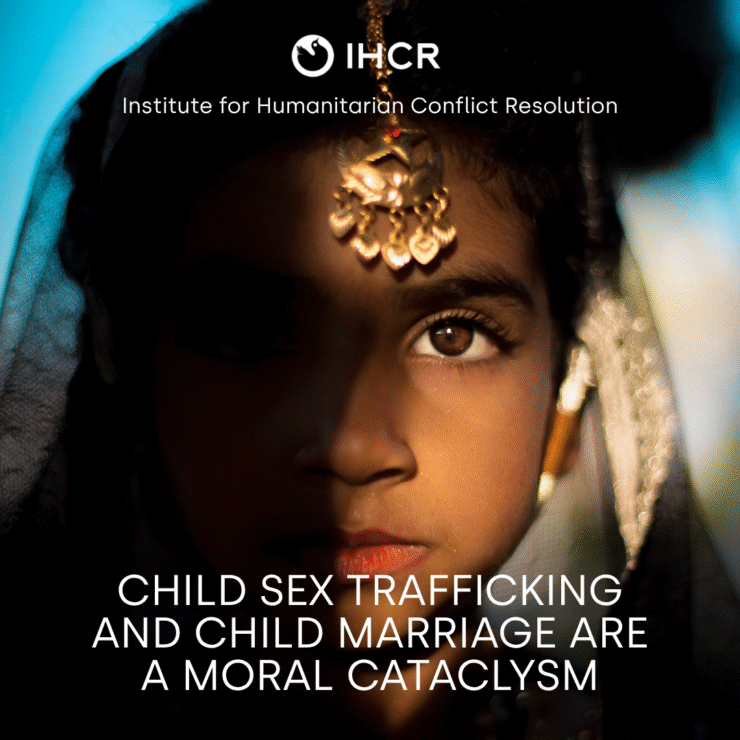
Child Sex Trafficking and Child Marriage are a Moral Cataclysm

INTRODUCTION
There are crimes that shock a society into action, and there are crimes so vast that they numb it into silence. Sexual abuse of children—child sex trafficking and child marriage—belong to the second category. Every year, millions of children are sold, coerced, married off, or worked into oblivion—and the world barely stirs. There are no emergency sessions, no sustained outrage, no leaders who stake their reputations on it. There is only a low, steady hum of statistics that we have learned to read without flinching.
The numbers should be unbearable. Children now make up approximately 25 percent of all detected trafficking victims worldwide; from 2019 to 2022, the number of child victims rose 31 percent over pre-pandemic levels. Victims have been identified as coming from more than 160 countries; no society is exempt. Six hundred fifty million women and girls alive today were married as children, and 12 million more girls are married off every year. Thirty-nine million children are forcibly displaced around the world from conflict, persecution, and other serious human rights violations, and displacement is a trafficker’s hunting ground. Child marriage remains legal, in some form, in most American states. And the United States is still the only country on earth that refuses to ratify the Convention on the Rights of the Child.
We face not a policy gap but a moral cataclysm. A child is not a smaller adult; a child is innocent, placing openness, dependence, and trust into the world. They are where the future enters the world. Kant insisted that no human being may be used merely as a means, yet trafficking makes the child nothing but a means, and child marriage completes the inversion by dressing the transaction in the language of family and custom.
Freedom, as Arendt understood it, requires a world where alternatives can even be imagined. Grooming, hunger, drought, debt, and war destroy that world before a girl is old enough to name it. To call her fate a choice is not analysis but an alibi.
Nor is personhood a private possession. Taylor, Honneth, and Butler remind us that we become subjects through recognition — through being seen, named, and counted. The trafficked child and the child bride are not merely harmed; they are socially erased, their suffering left to unfold in a moral vacuum.
That is why silence is not incidental to these crimes but constitutive of them. Traffickers need darkness; buyers need anonymity; complacent governments need our distraction. Simone Weil called attention to the purest form of generosity, and Levinas located ethics in the moment another’s suffering interrupts us. The first act of justice, then, is to let ourselves be interrupted. If we fail the child, we fail everywhere.
THE PLAGUE OF CHILD TRAFFICKING
Child sex trafficking is not just another societal problem waiting for legislative tinkering or bureaucratic reform. It is a moral outrage and a fundamental rupture in the ethical fabric of our being. The very fact that children are bought, sold, coerced, and abused for sexual purposes is evidence of a profound philosophical crisis, not merely a criminal one. It forces us to confront what dignity means, what freedom requires, and what becomes of a society that fails the most vulnerable beings entrusted to its care.
Globally, children represent a significant portion of those caught in human trafficking: according to UNICEF and the Inter Agency Coordination Group against Trafficking (ICAT), about 38 percent of identified trafficking victims worldwide are children. In some regions, especially parts of Sub-Saharan Africa, Central America, and the Caribbean, that proportion rises dramatically: in those regions, children account for around 64 percent and 62 percent of known trafficking victims.
The latest global overview from the United Nations Office on Drugs and Crime (UNODC) — the 2024 Global Report on Trafficking in Persons — shows a sharp rise in the detection of human-trafficking victims. Compared with pre-pandemic 2019 levels, the number of detected victims rose by 25 percent in 2022. Strikingly, child victims increased by 31 percent, and children made up 38 percent of all detected victims.
Sexual exploitation remains a major dimension of child trafficking. Though exact numbers are hard to verify due to the clandestine nature of trafficking and underreporting, international agencies estimate that millions of children worldwide are coerced into sexual exploitation yearly. The victims are often drawn from among the world’s most vulnerable: displaced persons, refugees, migrant children, or those fleeing poverty, conflict, and family instability; albeit not all victims of sexual exploitation are victims of trafficking.
Child trafficking is not limited to the global South — it affects every region of the world. Detectable victims account for 162 nationalities in 128 destinations countries, showing that no society is immune. One persistent challenge is under-identification. Many child victims remain invisible for reasons including fear of traffickers, social stigma, lack of trust in authorities, migration status, or simply ignorance of available protections. Consequently, the actual number of trafficked children is likely much higher than official statistics suggest.
Moreover, trafficking rarely occurs in isolation — it is bound to larger social problems. Socioeconomic inequality, displacement due to conflict or climate change, weak social services, and breakdown of community structures all contribute to creating fertile ground for traffickers. Traffickers exploit these vulnerabilities, often using coercion, deception, or manipulation — and once children are entrapped, the physical, psychological and social damage is nearly impossible to quantify.
In short, the most recent global data paints a grim picture: hundreds of thousands of children documented as trafficking victims, with dramatic increases in detection, and evidence that children remain a disproportionately large share of all trafficking victims. The official figures are likely to represent only a fraction of the real toll.
The Bearer of Inalienable Vulnerability
A child is not simply a smaller adult. A child is defined by openness, dependence, and trust. Philosophers as different as Aristotle, Kant, Levinas, and Arendt understood the child as morally primary: a symbol of potential, a bearer of inalienable vulnerability, the face that calls us into responsibility before we can even formulate a principle. A child is all expectation and all becoming; they are the place where the future enters the world. To harm such a being—let alone to systematize that harm through trafficking—is not just wicked. It is a desecration of the conditions that make moral life possible in the first place.
The crime of trafficking is often described in sociological or legal terms, but its deeper horror is philosophical. Trafficking transforms a person into a commodity. A child is turned into an instrument of gratification or revenue, their subjectivity erased and replaced with market value. Kant warned that no human being should ever be used merely as a means, yet child trafficking represents the total inversion of that moral law: the child becomes nothing but a means. This is more than exploitation; it is a metaphysical assault on the distinction between person and object. It reveals a society in which the intrinsic worth of human beings has not only been forgotten but also actively violated.
Some still cling to the damaging notion that adolescents caught in trafficking “chose” it. But the idea of choice collapses under even minimal philosophical scrutiny. Freedom requires knowledge, maturity, safety, and the absence of coercion. Trafficked children have none of these. Their so-called choices are shaped by lies, grooming, threats, hunger, homelessness, family instability, addiction, or emotional manipulation.
They are often controlled through fear, violence, or psychological conditioning so total that they cannot even imagine an alternative. The philosopher Hannah Arendt wrote that totalitarian systems destroy the very space in which freedom can appear. Trafficking does the same: it creates a world in which autonomy is not merely absent but unimaginable. A child cannot choose exploitation because exploitation annihilates the conditions of choice.
Nor can trafficking be understood as the work of a few monstrous individuals acting in isolation. It arises in the cracks of social and economic systems: poverty, homelessness, migration crises, war, family collapse, and the failure of public institutions. Traffickers prey on desperation. They look for children who have been abandoned by the social contract, children who have fallen through the floorboards of public concern. These children are not hidden; they are simply unseen. And this invisibility has philosophical weight. Social philosophers such as Charles Taylor, Axel Honneth, and Judith Butler argue that personhood is not merely an inner quality but a social achievement. We become subjects through recognition, care, and participation in a shared world.
Trafficking destroys that network of recognition. The trafficked child becomes socially erased—not dead but stripped of the relational context in which dignity is affirmed. Their suffering persists in a moral vacuum.
And then there is the demand side—the men who buy access to children. This reality is the most disturbing of all, because it forces us to examine not only criminal behavior but the collapse of moral imagination. What kind of desire is this? What kind of rationalization permits it? Buyers must actively suppress empathy, must refuse to see the child as a being with a future, a story, or a world of their own. They must numb themselves against the suffering in front of them.
The Moral Decadence of the Powerful
There is a further dimension of this catastrophe that decency itself tempts us to leave unspoken, and that is precisely why it must be spoken. Among those who purchase access to children are not only the desperate, the deranged, or the socially marginal. They include men of standing: figures who have held high office in governments, commanded corporations, been celebrated as artists and intellectuals, and been honored in the institutions that shape public life. The most notorious trafficking scandal of our era, built around one financier’s network of procurement and hospitality, revealed a clientele drawn from the very summit of political, financial, and cultural power. These were not men in the shadows of society. They were its ornaments.
This fact deserves more than outrage; it demands philosophical reckoning. We are accustomed to believing that moral corruption follows deprivation, that cruelty grows in the soil of want. Here the opposite is displayed. Men who possessed everything, who wanted for no pleasure, no comfort, no admiration, sought their ultimate gratification in the violation of children. What does this reveal? Not appetite but something closer to metaphysical boredom, an exhaustion of the ordinary that drives the sated toward the forbidden. Their satisfaction lay not merely in the act but in the transgression, in the demonstration that nothing, not even a child, lies beyond the reach of their entitlement.
This is decadence in its exact meaning: the rot that sets in when power is severed from any conception of restraint. And it is compounded by a monstrous arithmetic of self-regard, in which a man weighs his own fleeting appetite against the annihilation of a child’s life and finds the child weightless.
Yet the deeper scandal is not the appetite but the architecture that protected it. Around such men there assembled, over decades, an apparatus of concealment: lawyers who negotiated silence, investigators who declined to look, prosecutors who chose accommodation over indictment, institutions that accepted donations and asked nothing, employees and associates who saw what was happening and understood that seeing was not permitted. Files were sealed. Complaints were discouraged. Victims who spoke were discredited as unreliable, unstable, opportunistic. The machinery of cover-up did not merely follow the crime; it made the crime sustainable. Without it, no such network could have operated for years in plain sight of the powerful. The Epstein Files is a classic case that speaks volumes about the depth of the moral decadence of these powerful.
This is why the systematic concealment is, in a sense, the graver offense. The individual predator violates a child. The cover-up violates the child a second time, and then violates something larger: the possibility of justice itself. It tells every abused child that the world’s institutions are not for them, that testimony will be weighed against reputation and found wanting. Each act of concealment is an official communication about whose humanity registers and whose does not. It converts private depravity into a public verdict.
And it implicates far more people than the abusers. Every silent accomplice — the one who signed the agreement, closed the file, took the money, changed the subject — participated in the desecration without ever touching a child. This is Arendt’s insight extended to its uncomfortable conclusion: evil of this magnitude requires functionaries, not monsters. It requires ordinary professionals to do their jobs competently while declining to consider what their competence serves.
The Moral Collapse of the Legal and Institutional Machinery
If a civilization permits its most honored citizens to buy children and then builds legal and institutional machinery to ensure they are never held to account, it has not merely failed to enforce its laws. It has revealed what its laws were always for. Nothing will change until the cover-up is treated as what it is: not a lesser crime adjacent to the abuse, but the condition that makes the abuse possible.
In this sense, child exploitation is not merely a crime of desire; it is a crime of indifference, a crime of dehumanization. Arendt’s “banality of evil” is relevant here: atrocities are often committed not by flamboyant villains but by ordinary men who stop thinking, stop imagining, stop seeing the other as human. To purchase a child is to participate in a form of moral nihilism—the collapse of moral boundaries that protect the dignity of persons.
When a society allows children to disappear into trafficking networks, it reveals itself to be unjust in a deep philosophical sense. Aristotle argued that justice is giving each what is due to them by nature. And what is due to a child? Safety, nurture, education, and time to grow. Rawls insisted that the least advantaged members of society deserve the strongest protection. If trafficked children do not qualify as the least advantaged, then the concept has no meaning. A society that cannot protect its children cannot claim moral legitimacy, no matter its material wealth or political rhetoric.
There is, however, another dimension to this crisis: the ethics of attention. The philosopher Simone Weil said that attention is the purest form of generosity. Levinas argued that ethics begins when we allow another’s suffering to interrupt us. But child trafficking thrives in precisely the places where attention fails—where the child’s suffering is too distant, too painful, or too inconvenient for the public to face. Traffickers need darkness. Buyers need anonymity. Institutions fail most easily where no one is watching.
The first moral act, then, is to refuse the comfort of ignorance. Attention is not a passive state; it is the beginning of justice. It is the willingness to let the reality of another person’s suffering intrude upon our complacency. And if enough of us let ourselves be interrupted, the political, legal, and social changes required to combat trafficking would follow.
Child sex trafficking is a wound in the body of civilization. It is a test of our collective soul. The measure of our humanity will be taken not by how we treat the powerful, the wealthy, or the competent, but by how fiercely we protect those who cannot protect themselves. If we fail the child, we fail ourselves. And if we fail here, we fail everywhere.
CHILD MARRIAGE—A GLOBAL SCOURGE
Child marriage is another horrific practice that robs millions of girls of their childhoods and basic human rights. It is a global scourge that persists despite international efforts to combat it. It survives on a single fiction—that a child can consent. Locke, who grounded all legitimate authority in consent, understood that consent requires a will mature enough to bind itself; where that capacity is absent, an agreement is not a contract but a conveyance.
A girl of twelve handed to a man three times her age has not entered a marriage. She has been transferred. From that admission everything else follows, including Kant’s inescapable demand that we treat humanity, in our own person and in every other, always as an end and never merely as a means. Child marriage is the exact inversion of that maxim: a child converted into an instrument for someone else’s debt, dowry, honor, or appetite. In various corners of the world, from the United States to the Horn of Africa and the Middle East, young girls are being forced into marriages against their will. Here we delve into the alarming factors fueling this crisis and underscore the urgent need for international action to protect children’s rights and futures, which no one has the right to rob.
The Crisis of Conscience in Its Sheer Scale
The facts regarding child marriage are staggering and shameful. According to the United Nations Population Fund, one in five girls globally are married before 18 years of age—one every three seconds. As the International Women’s Health Coalition reported, “Child marriage effectively ends a girl’s childhood, curtails her education, minimizes her economic opportunities, increases her risk of domestic violence, and puts her at risk for early, frequent, and very high-risk pregnancies.”
That sentence is a catalog of amputations. Amartya Sen taught us to measure deprivation not in income but in capabilities—the real freedoms a person possesses to be and to do—and Martha Nussbaum named the most elemental of them: bodily integrity, health, education, imagination, affiliation, the capacity to form and revise a plan of life. Child marriage does not trim those freedoms at the margin. It severs all of them at once, before the girl has exercised a single one. This is precisely why the harm cannot be offset by a well-fed household or a gentle husband. What is stolen is not comfort. It is authorship over one’s own life.
The theft compounds across borders. By the end of 2022, 43.3 million children across the globe were forcibly displaced, according to a June 2023 UNICEF report—a number that has doubled over the past decade: “Of the 43.3 million children who were forcibly displaced by the end of 2022, almost 60% (25.8 million) were internally displaced by conflict and violence.” Russia’s ongoing war in Ukraine has alone forced nearly 2.6 million children to flee, internally displacing another 1.8 million children. Hannah Arendt, writing about the stateless of her own century, identified the deprivation at the heart of these figures: what the displaced lose first is not this or that entitlement but the right to have rights—membership in a political community obliged to answer for them.
A displaced girl has not surrendered her dignity; she has lost the address at which her dignity can be claimed, and it is into that vacuum of obligation that brokers, traffickers, and “husbands” step. These displaced children, denied entry into many countries, may end up in either a forced marriage or forced labor. Every border sealed against a child is therefore not a neutral exercise of sovereignty. It is a decision about who will collect her.
Once a person can be collected, she can be priced. The BBC reports that according to the International Labor Organization (ILO), an estimated 50 million people—that is, “one out of every 150 people alive—are trapped in forced labor or forced marriages.” This is a staggering number by any measure, and even more alarming and tragic is that it is roughly 10 million more than estimates from five years ago. Twelve million girls annually are affected by child marriage globally, with one in five girls in the world married before the age of 18—over 650 million women married as children alive today.
Listen to the grammar of the trade itself and the moral transformation becomes audible: girls are given, taken, exchanged, received. Kant drew the sharpest line in all of moral philosophy through exactly this point—whatever has a price can be replaced by an equivalent, while whatever admits of no equivalent has dignity. A child bartered for cattle, for a debt, or for a sack of grain has been assigned a price and, in that instant, moved from the class of persons to the class of things. Six hundred and fifty million such transfers are not a cultural variation to be respected. They are the largest standing repudiation of human dignity the international community still tolerates. Ending this horrible phenomenon must start with passing laws that ban child marriage, then empowering women and educating girls.
The Pervasiveness of Child Marriage
Where crisis strikes, the pricing accelerates and the excuses multiply. In 2022, UNICEF published an alarming report on the rising rates of child marriage and Female Genital Mutilation (FGM) in the Horn of Africa, fueled in part by the worst drought in 40 years. Girls as young as twelve are being forced into marriage, while in regions of Ethiopia, in the past year, child marriage has more than doubled. According to UNICEF, “The number of children at risk of dropping out of school across Ethiopia, Kenya and Somalia…has tripled within three months [an estimated 3.3 million children] – leaving vast numbers of adolescent girls at greater danger of a number of child protection risks, including undergoing FGM and being forced into marriage.”
Some countries in the Middle East also have high levels of child marriage. According to the Statistics Center of Iran, over 31,000 girls aged 10 to 14 were married in the country in 2020, an increase of 10.5 percent from the previous year. Furthermore, in a single six-month period of 2021, 791 babies were born to girls in this same age group. Consider what that second figure means: children delivering children, their bodies conscripted before their lives began.
In Syria, babies are being abandoned and left outside of mosques, hospitals, and on the streets. According to an Al Jazeera report, “between early 2021 and late 2022, more than 100 children, 62 of them girls, were found abandoned across the country.” Emmanuel Levinas, who lost nearly his entire family to the Nazis, built an ethics on precisely this moment—the encounter with the face of another human being, which commands before it explains and obligates before we consent.
The infant left on the steps of a mosque is that face in its most defenseless form. She advances no argument, invokes no treaty, belongs to no constituency. She simply appears, and her appearance is the demand. A civilization is measured not by what it grants those who can bargain with it, but by what it gives those who cannot. By that measure, a ledger of one hundred abandoned children is a verdict on all of us.
But make no mistake, child marriage is not limited to poor and underdeveloped countries. In the United States, child marriage remains legal in 32 states—only 18 states, plus the District of Columbia, the US Virgin Islands, and American Samoa, have banned the practice entirely, with California becoming the eighteenth in 2026; Mississippi and New Mexico still set no minimum marriage age whatsoever. According to a 2025 study, nearly 315,000 minors were legally married between 2000 and 2021, the majority of whom were girls. Defenders of these statutes invoke parental rights and religious custom, and neither survives the simplest test in political philosophy.
Ask, with Rawls, what rules we would write behind a veil of ignorance, not yet knowing whether we would be the parent signing the license or the daughter handed across the counter. No one reasoning from that position would authorize a regime in which a girl of sixteen may be married with a parent’s signature yet cannot file for divorce, sign a lease, or retain a lawyer—a legal order that grants a child the obligations of a wife and none of the powers of an adult.
Mill’s harm principle disposes of the appeal to custom just as swiftly: liberty is the right to conduct one’s own life, never the right to dispose of someone else’s. A parent’s freedom ends exactly where a daughter’s personhood begins. Within the US, state legislators must make every effort to fully ban marriage for children under the age of 18.
The Manufactured Rationale Behind Child Marriage
The defense offered is always necessity—the rains failed, the herds died, the family had no choice—but necessity is the oldest alibi for cruelty, and Judith Shklar’s answer to it remains definitive. Her liberalism of fear begins from the recognition that cruelty is the worst thing human beings do to one another, and that the first obligation of any decent political order is to stand between the powerless and those who would hurt them. Drought does not marry a twelve-year-old. Adults do, and governments permit it. To call a girl sold during a famine a casualty of the weather is to grant moral agency to the climate while withholding it from the men who signed the contract.
Climate change is one of the many factors fueling an increase in child marriage. Women and girls suffer the most, even from climate change—people in poverty suffer the most, and women make up 70 percent of the global poor. According to a Global Citizen report, climate change-induced poverty makes girls more susceptible to child marriage: “Climate change also leads to geopolitical instability which, in turn, results in greater instances of violence—which we know disproportionately impacts women and girls.” What this exposes is the moral arbitrariness of the entire arrangement.
Rawls called the distribution of birth circumstances a natural lottery and insisted that a just society refuses to let its outcome dictate a person’s life prospects. No girl chose her village, her gender, or the rainfall of the region into which she was born, and not one of those facts carries a particle of moral weight—yet together they now predict, with brutal reliability, whether she will finish school or be married at thirteen. A world that permits accidents of birth to function as sentences has not merely failed at charity; it has abandoned justice. That is why it is very important for development projects to focus on the education of women and girls globally, as education has been proven to reduce poverty.
Disaster zones and crisis zones are also potentially hotbeds for child abuse. Two months after two devastating earthquakes hit Turkey and northern Syria, UNICEF warned that 2.5 million children in Turkey remained in need of humanitarian support and were at risk of falling into poverty, child labor, or child marriage. People in the disaster zone accused the government of a tardy and inadequate relief effort. Over 55,000 people died in this catastrophe. Infrastructure has been Erdogan’s main selling point, yet poor construction could not withstand the earthquakes, resulting in greater damage.
Hobbes, no friend of liberty, nevertheless grasped the terms of the bargain better than today’s strongmen do: obedience is owed the sovereign in exchange for protection, and when protection fails the obligation dissolves along with it. A state that cannot shelter its children forfeits the authority it claims over them, and a regime that leaves 2.5 million of them exposed to labor and marriage has broken the only promise that justified its power. His failure to respond to the catastrophe has mobilized the opposition, civil society, and the Kurdish minority for the first time against this ruthless dictator—not because the earth shook, but because the covenant broke.
Countries with poor records of women’s rights also have more child marriages. Women are suffering under Afghanistan’s Taliban rulers. “The Taliban have allowed very few women, with the exception of medical workers, to continue their work,” according to CBS News. Most women have been totally banned from returning to work. “Many professional women have fled the country or given up on their careers, and girls and young women have not been allowed to return to school beyond the elementary years.”
For Aristotle, a human life goes well only when its capacities are developed through years of practice, so that potential never exercised is potential destroyed. For Sen, development is itself freedom—the widening of what a person is genuinely able to choose. A regime that bars girls from school is thus not restricting an opportunity; it is manufacturing dependence, and dependence is the raw material out of which forced marriage is made. Mill exposed the circular logic a century and a half ago in The Subjection of Women: subordinate a class of people by law, deny them every means of independence, then point to their condition as proof they were never fit for anything else. Keeping girls out of schools will not help alleviate the problem of child marriage, but only make it worse.
Child marriage increased during the COVID-19 pandemic, and UNICEF estimated that 10 million additional child marriages might occur before 2030. That figure is a forecast, which is to say a description of harm that has not yet happened and can still be prevented. Hans Jonas argued that modern power generates an entirely new ethical duty—an imperative of responsibility toward those who will inherit the consequences of what we do and fail to do, and who can neither vote, sue, nor protest today. Ten million girls fall squarely within that duty, and Kant’s rule that “ought” to presuppose “can” cuts in the same direction: because we are able to prevent these marriages, we are obliged to.
Child marriage is a violation of human rights, and we must pressure governments to take action to prevent and reduce this phenomenon that is on the rise globally. The COVID-19 pandemic affected children on an unprecedented scale. A December 2021 report published by UNICEF showed that the number of children who are hungry, out of school, abused, living in poverty, or forced into marriage was growing. “The COVID-19 pandemic has been the biggest threat to progress for children in our 75-year history,” said UNICEF Executive Director Henrietta Fore. Political will is needed to help millions of children. World leaders must act now to prevent further devastation.
What Can Be Done?
UNICEF Executive Director Henrietta Fore observed that governments and international development banks need “to prioritize investments in programs that can get children out of the workforce and back into school, and in social protection programs that can help families avoid making this choice in the first place.” Child labor takes away from millions of children the chance for an education; it robs them of leisure time; it often leads to injury, both physical and mental; it limits their future opportunities; and it “leads to vicious inter-generational cycles of poverty and child labor.”
Every remedy carries its own principle, and the principle is what makes the remedy obligatory. Ban marriage before eighteen without exception, because consent demands a capacity a child does not possess. Fund girls’ schooling, because a life must be developed before it can be lived. Extend social protection to families in crisis, because no parent should ever face a choice between a daughter’s childhood and a household’s survival. Prosecute the brokers, the officiants, and the clerks, because cruelty tolerated is cruelty licensed. Grant asylum to displaced children, because a person with no community to claim her rights has no rights at all.
Finally, it is unconscionable that the United States is the only country in the world that refuses to ratify the Convention on the Rights of the Child, the primary international treaty on the rights of children. The CRC outlines protections for children worldwide, and there is little excuse for the United States’ failure to ratify it. US state laws fall woefully short of the standards set by the Convention. The deeper offense, however, is philosophical. The entire force of a right lies in its universality, and a principle binding on everyone except the party proclaiming it is not a principle but a privilege.
Kant held that a genuine moral law is one we can will to be universal, and that any cosmopolitan order depends on nations accepting for themselves the obligations they demand of others. A country founded on the self-evidence of human equality, which then declines to sign the single treaty affirming that children are equally human, has exempted itself from its own creed. Child marriage will not end because the world grows sentimental about girls. It will end when we finally concede what we have always claimed to believe—that a child is a person, that persons are not property, and that no tradition, scripture, hardship, or statute confers the right to sell one. Until then, every exception left standing in the law is a signature we have all placed on the contract.
CONCLUSION
A Call to Conscience
Let us be clear about what we are living beside. In every region of the world, at this very hour, children are being sold for the pleasure of adults and girls are being handed over in marriage before their bodies or minds have finished becoming their own. This is not a rumor from a distant century. It is the present tense. And it continues not because it is hidden, but because we have agreed, tacitly and comfortably, not to look.
Indifference is a decision. Arendt taught us that the greatest atrocities are rarely the work of monsters; they are made possible by ordinary people who stop thinking, stop imagining, stop seeing the other as human. That is precisely the machinery at work here. Every day we do not speak, we cast a vote. Every budget that funds everything but child protection, every legislature that leaves a marriage loophole intact, every prosecutor who charges the exploited girl and releases the man who bought her, every one of us who reads the numbers and turns the page — all of it is consent, and consent is a political act. The trafficker requires darkness. The buyer requires anonymity. Both require a public that cannot be bothered.
So let the outcry begin where the silence has been loudest — and let each demand rest on a principle we claim already to believe.
Ban child marriage outright, in every American state and every country, with no exception for parental consent, judicial approval, pregnancy, or custom. Freedom, as Arendt understood, requires a world in which alternatives can be imagined; a twelve-year-old bride has been denied that world before she could name it. Consent extracted from a child is not consent, and a loophole is simply a legal permission slip for rape.
Ratify the Convention on the Rights of the Child. Rights are not gifts bestowed by the strong upon the weak; they are the recognition of a dignity that precedes the state. That the United States remains the only nation on earth refusing this recognition is not a technicality but a confession — and it should be spoken aloud until it becomes politically unbearable.
Prosecute the demand. Kant’s injunction that no human being may be used merely as a means is not an abstraction; it is the moral floor beneath every criminal code we have. The buyer deliberately steps through that floor. Treat him, not the child, as the criminal. No sixteen-year-old is a prostitute; she is the victim of a felony, and every law that says otherwise must be repealed.
Fund what actually protects children—schools for girls, shelters, caseworkers, cash support for families on the edge, legal aid in refugee camps and drought zones where traffickers recruit openly and unopposed. Aristotle held that justice gives each what is due by nature, and Rawls insisted that the least advantaged deserve the strongest protection. If a trafficked child does not qualify as least advantaged, the concept is empty, and our politics are a performance.
Demand accountability, not declarations. Governments and international institutions must be measured by the number of children they return to safety, not by the eloquence of their communiqués. Where power escapes measurement, it escapes morality.
Refuse the comfort of ignorance. Do the one thing that costs nothing and changes everything. Simone Weil called attention to the purest form of generosity; Levinas located ethics in the instant another’s suffering interrupts us. Attention is not a mood—it is the first political act; the moment a private conscience becomes a public force. Speak of this at dinner tables, in classrooms, in pulpits, in city councils, in editorials, in the offices of the people who represent us. Make it impossible to discuss human rights without first naming these children.
We become persons through recognition — through being seen, named, and counted. That is why the trafficked child and the child bride are not merely harmed but erased, their suffering unfolding in a moral vacuum we built by looking away. To see them is already to begin restoring what was taken.
A civilization is judged not by its wealth, its weapons, or its rhetoric, but by the ferocity with which it defends those who cannot defend themselves. On that measure, we are failing — and we know it.
The children cannot cry out. We can. And if we will not, then no one should ever ask why the world is sick as it is.