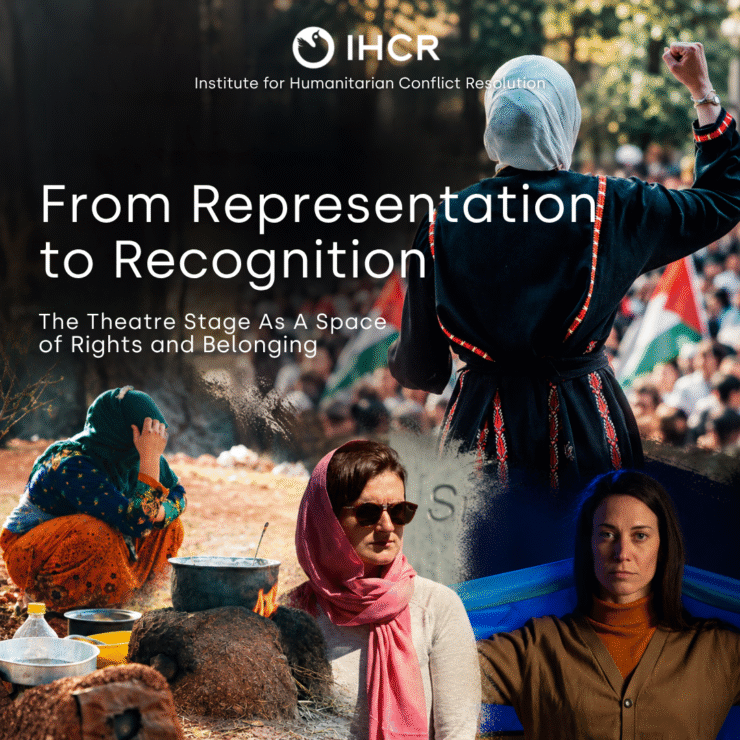
From Representation to Recognition: The Theatre Stage As A Space of Rights and Belonging

Abstract
In December 2024, the Bosnian-Herzegovinian NGO Bosanskohercegovačka inicijativa žena (BHWI) developed I Want to Live, a participatory theatre initiative involving migrant women from Palestine, Ukraine, Syria, Iraq, Iran, and Türkiye living in Sarajevo, Bosnia and Herzegovina. Through theatre, lullabies, song, somatic movement, and other verbal and non-verbal forms of expression, the performance brought different experiences of womanhood, migration, war, displacement, family, and belonging into a shared creative space.
This article examines I Want to Live through an interdisciplinary qualitative approach combining autoethnography with qualitative content analysis. Drawing on the researcher’s dual position as participant and observer since 2024, the analysis uses experiences from rehearsals, performances, and backstage encounters alongside selected media coverage, institutional statements, and public reflections by participants and practitioners. Rather than approaching migration primarily through security, vulnerability, or institutional categories, the article considers how participatory theatre can make women’s lived experiences publicly present while allowing them to retain agency over what and how they communicate.
The findings reveal that the theatre stage can function as a relational space where different identities, languages, memories, and experiences coexist without being reduced to a single narrative of the “migrant woman.” Expression occurs not only through verbal testimony but also through voice, lullaby, embodied performance, silence, cultural elements, and decisions about what remains undisclosed. The article therefore distinguishes visibility from recognition and argues that participatory theatre can create a space in which migrant women move beyond being represented by others towards actively shaping how their experiences are expressed and publicly encountered. Such creative practices can make dimensions of displacement visible that institutional categories and data may not fully capture. Where women choose to share these experiences beyond the stage, their lived-experience knowledge can complement existing humanitarian knowledge and contribute to more participatory forms of institutional dialogue.
1. Introduction and Background
Migration and forced displacement are more than geographical movements; they are lived experiences that shape human security, rights, identity, belonging, dignity, and social recognition. In this article, migration and displacement is not only understood as legal categories or demographic movements, but as lived and relational experiences shaped by different social positions, histories, and everyday realities. Therefore, I combine autoethnographic reflection with qualitative analysis of local media coverage to examine participatory theatre as a creative and relational practice and explore its potential contribution to more inclusive policymaking. I explore the creative process of a participatory theatre project developed collaboratively with nine adult women who resettled in Bosnia and Herzegovina.
Bosnia and Herzegovina represents a distinctive case1 that brings together two distinct migration realities within the same geographical space: the historical experience of a post-war society profoundly shaped by mass displacement and migration movement and the contemporary experience of receiving people in transit from contexts marked by war, political and economic instability, and insecurity. Hence, this intersection makes Bosnia and Herzegovina particularly relevant for examining migration and women in migration not only as demographic mobility, but as a lived experience that continues to shape identity, belonging, and social relations.
Migration and displacement profoundly affect social, economic, and psychological life while intersecting with sex, class, age, legal status, and pre-existing inequalities (Fleury, 2016). For women, these conditions may intensify patriarchal norms, care responsibilities, economic dependency, discrimination, and social exclusion. Yet recognising these vulnerabilities is different from defining migrant and displaced women primarily through trauma and victimhood, which can obscure their capacity to interpret, express, and shape their own experiences. This distinction is particularly important given that women have long constituted a substantial proportion of migration, while their numerical presence has not necessarily translated into adequate recognition within migration research and data collection (Piper, 2005; Fleury, 2016). Being statistically visible, therefore, does not necessarily make women’s lived experiences visible.
This raises a broader question for the present study: how do migrant women become visible, what forms of expression are recognised, and who participates in shaping their representation? These questions are especially relevant when women are approached primarily through humanitarian categories of protection, vulnerability, and need. Although such categories are important for identifying risks and allocating assistance, they capture only part of how women understand and represent their own experiences (De Smet et al., 2024; Misra, 2020). Public narratives may similarly reduce refugees, displaced, and migrants to contrasting images of “vulnerable individuals” or “dangerous collectives” (De Smet et al., 2024, p. 554).
These representations can overlook the complexity of everyday life during displacement. Separation from homes, communities, cultures, friends, and family networks can generate isolation, loss, and difficulties in communicating distress (UNHCR, 2025). At the same time, displacement does not suspend everyday responsibilities. Women caring for children may face uncertainty about their own futures while continuing to raise children, sustain family relationships, manage daily responsibilities, and create stability under unstable conditions. Vulnerability and agency are therefore not mutually exclusive: experiences of insecurity and loss can coexist with caring, decision-making, participation, and creative expression.
The importance of this study lies down that participatory theatre provides a space for examining this relationship because experience does not have to be communicated through verbal testimony alone. The presence of migrant experiences on stage may create visibility, encourage reflection, or challenge how audiences encounter migration, but the consequences of that encounter depend on what follows beyond the performance. As Nguyen argues, literature does not change the world unless people move beyond reading and act upon the conditions represented within it (Nguyen, 2018, as cited in Ercişli, 2025, p. 37). Any specific things like song, lullabies, movement, silence, cultural practices, and embodied performance can offer different ways of expressing and negotiating migration, womanhood, identity, and belonging. Misra (2020), reflecting critically on participatory theatre with people on the move, illustrates the tension between institutional narratives of vulnerability and participants’ own forms of self-representation. While migration systems may require credible accounts of persecution and trauma, some participants resisted being represented primarily as traumatised individuals or victims and instead sought recognition through their abilities, creativity, and capacity to contribute.
Importantly, participation does not require the disclosure of every difficult experience. Choosing silence or withholding parts of one’s story may itself represent agency and control over personal narratives (Andonov & Wolfe, 2021). Expression is also relational. As Schwartz and Melzak (2005) describe storytelling as “a relational phenomenon,” what matters is not simply whether someone speaks, but how that expression is encountered and responded to by others. From this perspective, agency in participatory theatre lies not simply in becoming visible, but in having greater control over what is expressed, how it is expressed, and what remains unspoken.
2. Analysis of the Issue
Theatre can provide a public space in which experiences of migration and displacement are represented, encountered, and interpreted beyond their institutional or statistical framing. In this sense, artistic representation is not politically or socially neutral. Gallien conceptualises migrant literature and art as forms of both “poetic and political intervention” (Gallien, 2018, as cited in Ercişli, 2025, p. 37). Applied to theatre, this perspective draws attention to the capacity of performance to bring experiences that may otherwise remain private or socially marginal into a shared public space. Through voice, movement, character, narrative, silence, and embodied performance, migration can be encountered not simply as a policy issue or humanitarian category, but through the lived experiences of those affected by it.
Yet representation alone does not produce social or institutional change. A similar distinction can be applied to participatory theatre: performance can create a space for representation and recognition, but its broader significance depends on whether listening and encounter generate dialogue, participation, or institutional response. The question is therefore not only whether migrant women become visible on stage, but whether that visibility creates opportunities for their lived experiences to be recognised within the social and institutional spaces that shape their lives.
The distinction between representation and recognition is central to this analysis. Representation can make migrant and displaced women visible; recognition concerns their capacity to participate in shaping how their experiences are understood and their needs meet in the policy making practice. Theatre writer and critic Aleks Sierz describes the 2000s as a period in which, in response to the British media’s often accusatory and unsympathetic portrayal of asylum seekers, theatre practitioners increasingly took on the task of engaging with and making visible the lived experiences of asylum seekers and other migrant communities in Britain (Sierz, 2011, as cited in Ercişli, 2025, p. 44). Miramonti et al. (2025) describe participatory theatre as having the potential to contribute to the “rehumanising of the Self and Other” and the “re-authoring” of narratives. In this context, re-authoring does not mean changing the past, but gaining greater agency over how lived experience is expressed and shared. Participatory theatre can create such a space by enabling women to communicate through speech, storytelling, embodied performance, creative expression, or silence.
This distinction matters in humanitarian contexts, where categories such as refugee, migrant, displaced person, or vulnerable woman may be necessary for identifying protection needs but cannot capture the complexity of individual lives. Participatory theatre does not remove legal insecurity, discrimination, economic inequality, or the material consequences of displacement. Its significance lies elsewhere: in creating conditions in which women can participate in how their experiences are represented and encountered. The movement from representation to recognition therefore occurs not simply when women become visible, but when they gain greater agency over what they express, how they express it, and what they choose to leave unspoken when these expression do not meet their own needs.
3. Human Impact
The well-known phrase attributed to Dostoevsky, “We all came out of Gogol’s Overcoat,” points to more than the emergence of a literary tradition. Gogol’s The Overcoat brought the ordinary person into a literary world largely occupied by remarkable heroes, aristocrats, and lives considered worthy of being written about. It demonstrated that an apparently insignificant life could also be worth telling, hearing, and remembering. From Pushkin’s The Stationmaster to Gogol’s The Overcoat, literature created a space of representation for the “ordinary person” whose life might otherwise have remained at the margins of history.2
Yet the question is not simply whose stories are told, but what is lost when certain lives remain untold. Wars, forced displacement, borders, and political decisions enter historical records, while the fears, losses, silences, lullabies, and everyday struggles of ordinary people caught within these events can easily disappear from view. If history is predominantly written through those who hold power, make decisions, or emerge as victors, how can we understand the experiences of those who lived through history without having the power to write it?
This is where representation becomes significant. Creating a public space for someone’s story does more than make that person visible; it can open a pathway toward recognition of experiences previously treated as private, ordinary, or unworthy of public attention. Literature achieved this by bringing the ordinary person into the centre of the narrative. Participatory theatre may create a similar possibility—not by speaking on behalf of migrant women, but by creating a space in which they can shape what is expressed, how it is expressed, and what remains unspoken.
I Want to Live (Želim živjeti), written and directed by Dubravka Zrnčić-Kulenović, was first performed in December 2024. The production involved Marijana Dinek and Daria Vujić, performers Alena Džebo and Mehmed Pašić, choir leader Dragana Glumac, and eight migrant women who had settled in Bosnia and Herzegovina following different migration journeys. It is important to note that all of these local artists experienced displacement during the 1992–1995 war in Bosnia and Herzegovina.
The theatrical narrative centres on the life of a migrant woman who, while staying in a humanitarian reception setting in Bosnia and Herzegovina, seeks psychological support. Through her sessions with a psychologist, different layers of her life gradually emerge: her experiences as a woman, early marriage, the births of her daughter and son, family difficulties, war, the killing of civilians, displacement, and the search for safety. These experiences are presented not as a linear account of suffering, but through shifts between distress, memory, resistance, and hope. The protagonist speaks, cries, sings, dances, screams, and remembers. Memories of her mother, children, childbirth, home, and earlier life become intertwined with her present experience of displacement and her attempt to reconstruct a sense of self and possibility for the future.
Alena Džebo’s performance gives embodied form to these emotional and biographical transitions, while the migrant women’s choir creates a collective presence around the protagonist through voice, song, lullabies, and movement. Their presence does not suggest that they have experienced the same events as the fictional character. Rather, the performance brings different women and different histories into a shared theatrical space where aspects of womanhood, loss, displacement, family, memory, and hope can coexist without being presented as a single migrant narrative. Mehmed Pašić, as the only male performer, plays the psychologist and occupies a different position within this encounter. Through his dialogue with the protagonist, he listens to and responds to experiences that challenge him to confront questions of gender, displacement, family relations, and the realities faced by women during migration. The psychological session thus functions not only as a narrative device through which the protagonist’s experiences unfold, but also as a relational space in which those experiences are spoken, heard, questioned, and encountered.
My autoethnographic reflexivity provides a different but complementary perspective. I entered the project in late 2024 as a participant rather than as a researcher, without a research question, observation plan, or methodological framework. This was my first social activist step into migration movement standing. I have felt that during the early rehearsals, communication did not always depend on a shared language; sometimes a few words, a gesture, a melody, or another woman’s lullaby was enough to create connection. One of the most intense moments for me occurred when we performed lullabies in our own languages.
“Here I am on the stage, looking at my chair. It differs from the others in colour and form, just as the experiences of the women sitting on those chairs, mine is red wooden one, differ from one another. As I watch the representation of a migrant woman’s life from the artist, I begin to cry. Her story confronts me with my own experiences of womanhood and with burdens I have carried for years.”
After hearing lullabies in Ukrainian, Bosnian, and Arabic, I sing mine in Turkish. This lullaby carries a deeply personal meaning for me as a migrant, a student, and a mother who lost her first child in this country. As I sing, I find it difficult to open my eyes. I am aware that someone from my professional or social life may be sitting in the audience, and I feel uncomfortable being seen in such a vulnerable moment. Yet I have chosen to let my voice be heard. I am afraid of being seen, while at the same time allowing myself to be heard.
This tension became central to my understanding of participation. I did not explain what the lullaby meant to me, nor did I turn my personal history into a narrative of suffering. I did not need to tell the audience what had happened to me. Yet something of that experience was communicated through my voice, body, and song. For me, this moment revealed that participation can make personal experience present without requiring its full verbal disclosure.
When examining the human impact of this participatory theatre initiative, participants’ own reflections provide an important perspective on the significance of I Want to Live. One Ukrainian choir member, who performed on stage for the first time, described her experience with the words, “Ovo nije igra” [“This is not a game”] (Faktor, 2025). In her account, the stage contained pain and emptiness, but also women’s strength. She connected her voice, Ukrainian songs, and elements of traditional clothing with survival, self-preservation, and dignity (Faktor, 2025). The public presentation of the project similarly emphasised women’s abilities, capacities, and aspirations rather than presenting them solely through vulnerability (Grad Mostar, 2025). At the PitchWise Festival, the Federal Ministry of Culture and Sports highlighted a question at the centre of the performance: “Šta nikada nisu rekle, a htjele su?” [“What had they never said, but wanted to?”] (Federalno ministarstvo kulture i sporta, 2025). Read together, these accounts suggest that the significance of participation was not limited to narrating difficult experiences. Song, clothing, movement, cultural references, and performance also enabled participants to present aspects of themselves that exceeded the category of the “vulnerable migrant woman.”
The human impact of the performance is also visible in the reflections of audience members who connected what they witnessed on stage with their own experiences of displacement. Hasija Borić Stojić, herself displaced during the 1992–1995 war in Bosnia and Herzegovina, recognised aspects of her own history in the central female character. She describes the character as encompassing both the Bosnian and the “universal” woman struggling to find her place in the world, recalling her own experience of fleeing the war with her two young daughters (Borić Stojić, 2025, p. 8). Her reflection moves beyond personal identification to a broader human-rights argument: “Human rights are human rights, regardless of which vulnerable community is concerned. They cannot be selective” (Borić Stojić, 2025, p. 8). She extends this argument through the striking metaphor that “human rights are not a buffet from which we choose only what appeals to us” (Borić Stojić, 2025, p. 8). Her response illustrates how the performance can move beyond representing migrant women on stage and become an encounter through which an audience member relates another woman’s displacement to her own history and to wider questions of dignity, rights, and recognition.
These experiences do not provide sufficient grounds to describe participatory theatre as therapeutic or to claim that it produces “healing.” After performances, I sometimes experienced a sense that something had been expressed, completed, or simply made easier to carry, but this remains an autoethnographic reflection rather than evidence of a general therapeutic effect. What the material does show is that human impact can take forms that are less definitive but still significant: being able to participate without explaining everything, encountering others without having identical experiences, communicating through forms other than testimony, and retaining control over what remains private. The women on stage did not share the same histories of war, migration, loss, or womanhood, and their participation should not be interpreted as evidence of a common migrant experience. Rather, I Want to Live created a shared space in which different experiences could coexist and be expressed without being made equivalent. Its human significance therefore lies not in repairing what has been lost, but in creating possibilities for expression, connection, dignity, and participation while leaving room for difference, silence, and individual boundaries. It captures the power of being represented and recognized.
4. Broader Consequences
“Koliko kola, od dola, do dola, koliko bola, od kola do kola. Koliko jada, od grada do grada, koliko greba od brega do brega…”[“How many circles, from valley to valley; how much pain, from circle to circle. How much sorrow, from town to town; how many graves, from hill to hill…”] (Dizdar, as cited in Borić Stojić, 2025, p. 9)
The broader significance of I Want to Live lies not only in making women visible on stage, but in the social encounters that such visibility can generate. Recognition requires moving beyond seeing a person primarily through categories such as “refugee,” “migrant,” “displaced person,” or “aid recipient” and encountering her as an individual with a history, culture, abilities, preferences, and the capacity to articulate her own position. Andonov and Wolfe’s (2021) observation that participants could see themselves as “individuals with an identity, a culture and wishes” captures this dimension of recognition. Importantly, this process also involves those who witness the performance. Following the production in Jajce, journalist Melida Travančić described it as creating a space in which society could confront realities it might otherwise prefer not to see, writing: “Neka riječ bude izgovorena. Neka priča bude kazana” [“Let the word be spoken. Let the story be told”] (Travančić, 2025). Viewed through Schwartz and Melzak’s (2005) understanding of storytelling as a relational phenomenon, the public significance of these stories emerges not only through their expression but through what happens when they are encountered by others. The audience is therefore not simply a passive receiver of representation; its presence creates the possibility of witnessing, responding, and recognising experiences that may otherwise remain socially distant or institutionally categorised.
The relational significance of the project also extended beyond the staged performance. During the performance in Jajce, I witnessed a Palestinian member of the group receive a telephone call and begin to cry while speaking in Arabic. We subsequently learned that her brother-in-law had been killed in Gaza. What followed was not part of the script: other women stayed with her, held and comforted her as she moved through the immediate shock and grief. For me, this moment revealed something that cannot be adequately explained through the performance alone. The women involved did not share the same things like war, language, migration trajectory, nationality, or personal history, yet these differences did not prevent care and connection. Belonging in this context did not depend on sameness. It emerged through the capacity to remain present with another person’s experience without claiming it as one’s own. Miramonti et al.’s (2025) concept of “rehumanising the Self and Other” is useful here because it directs attention to encounter across difference rather than the construction of a homogeneous migrant identity. Such moments should not be romanticised: participatory theatre cannot reverse loss, change legal status, eliminate economic insecurity, transform border regimes, or remove unequal power relations within participatory processes (Misra, 2020). What it may create, however, is a social space in which people whose lives have been shaped by different forms of displacement can encounter one another beyond the institutional categories through which they are commonly identified.
This has broader relevance for humanitarian and conflict-resolution practice. Humanitarian realities are necessarily documented through legal classifications, statistics, needs assessments, and categories of vulnerability, but these forms of knowledge cannot fully communicate how displacement is lived, interpreted, and carried into relationships and everyday life. Participatory creative practices can complement—not replace—such institutional forms of knowledge by bringing lived experience into public encounter. Their contribution to conflict resolution should therefore not be understood as a claim that theatre itself “resolves” conflict, but as the creation of conditions in which different experiences can be expressed, witnessed, and recognised without being treated as equivalent. In this sense, the movement from representation to recognition extends beyond visibility: it concerns whether people affected by displacement can participate in shaping how they are encountered and understood by others and bring practicality to policy making process.
5. International and Institutional Response
From its inception, I Want to Live was connected to an institutional humanitarian framework. The performance was developed by the Bosnian-Herzegovinian Women’s Initiative (Bosanskohercegovačka inicijativa žena), with the support of UNHCR Bosnia and Herzegovina, as part of a project providing psychosocial support and individual protection to refugees, asylum seekers, and persons with similar protection needs (Grad Mostar, 2025). The involvement of UNHCR therefore positioned the initiative within an existing humanitarian protection structure rather than as an independent artistic production.
The performance subsequently moved beyond its original project setting into wider cultural and public spaces. After its first presentation in Sarajevo during the 16 Days of Activism against Gender-Based Violence, I Want to Live was presented at theatre, arts, and women’s rights events in Sarajevo, Mostar, and Jajce (Grad Mostar, 2025; Faktor, 2025). This wider circulation brought the experiences represented through the performance into contact with different audiences, cultural organisations, civil society actors, and public institutions.
A more direct institutional response occurred in August 2026, when I Want to Live became the subject of a meeting involving Sarajevo Deputy Mayor Mirela Džehverović, representatives of the Bosnian-Herzegovinian Women’s Initiative, director Dubravka Zrnčić-Kulenović, and actress Alena Džebo. The discussion addressed possibilities for institutional cooperation and support for initiatives using culture and the arts to generate public dialogue on gender-based violence (City of Sarajevo, 2026). The significance of this meeting lies in the fact that an initiative developed within a humanitarian context and subsequently presented in public cultural spaces entered direct discussion with a local government institution.
This meeting should not be interpreted as evidence that I Want to Live produced a policy change. The available evidence demonstrates institutional attention and dialogue, rather than policy impact. Nevertheless, it documents a movement beyond the stage: from a UNHCR-supported humanitarian initiative, to public performances in several cities, and subsequently to discussion with the City of Sarajevo concerning possible institutional cooperation. In this sense, the institutional response to I Want to Live provides a concrete, although limited, example of how participatory creative practice can move from public representation toward institutional recognition without assuming a direct or automatic pathway from theatre to policy.
6. Recommendations and Solutions
Humanitarian organisations and public institutions should create structured opportunities for migrant and displaced women to contribute their lived experiences to institutional discussions following participatory artistic initiatives. Post-performance consultations could bring together willing participants, humanitarian organisations, women’s organisations, local authorities, and relevant service providers to identify concerns related to protection, discrimination, access to services, belonging, and participation. As Miramonti et al. (2025) demonstrate, participatory theatre can connect lived-experience expertise with other forms of knowledge used in research and policy development.
Such consultations should treat lived experience as complementary evidence, not as a replacement for legal, scientific, administrative, or professional knowledge. Their purpose should be to identify aspects of humanitarian interventions and policies that may not be visible through formal data alone. Most importantly, priorities should be identified with women rather than for them. Institutions should also provide feedback on how participants’ contributions were considered and whether they resulted in further consultation, programme adjustments, or other institutional responses.
Participation must remain voluntary and ethically protected. Women should decide whether they wish to participate beyond the performance, what they want to share, and how their contributions may be documented or used. They should never be required to disclose traumatic experiences in order to be heard or recognised (Misra, 2020; Andonov & Wolfe, 2021). The central recommendation is therefore to establish ethical, participatory, and accountable mechanisms that connect creative spaces with institutional consultation while allowing women to retain control over their own experiences and narratives.
7. Conclusion
This study examined I Want to Live to explore how participatory theatre can create a space in which migrant and displaced women express and negotiate lived experiences that are often approached through the institutional categories of migration, vulnerability, and protection. The analysis in the article shows that such expression is not limited to verbal testimony. Lullabies, songs, somatic movement, silence, cultural elements, and decisions about what remains unspoken can communicate experiences of migration, loss, womanhood, identity, and belonging. At the same time, sharing a stage does not make women’s experiences equivalent. Different histories, languages, memories, and forms of expression can coexist without being reduced to a single narrative of the “migrant woman.”
From a human rights perspective, this distinction is important. Forced displacement may expose women to intersecting forms of insecurity, discrimination, gender inequality, loss of social and economic rights, and restrictions on their ability to participate fully in the societies in which they live. Humanitarian responses are necessary for protection, but protection alone does not address questions of dignity, participation, self-representation, and recognition. I Want to Live illustrates how a creative space can allow women to engage publicly with experiences that affect their lives while retaining some control over what they communicate, how they communicate it, and what they choose not to disclose. Participatory theatre cannot restore a lost home, secure legal status, eliminate discrimination, repair the consequences of war, or substitute for institutional responsibility. Its contribution lies elsewhere: in creating possibilities for expression, encounter, participation, and recognition.
What happens after these experiences are expressed is equally important. Lived experience cannot replace legal evidence, protection monitoring, needs assessments, or other forms of humanitarian knowledge. Yet these mechanisms do not always show what displacement means in everyday life: how insecurity, loss, discrimination, care responsibilities, or the struggle to belong are actually experienced. Listening to these experiences can therefore add something that institutional data alone cannot provide. The challenge is to ensure that such knowledge does not remain on the stage. Where women choose to share it, there should be ethical and voluntary ways for their experiences to enter humanitarian and institutional discussions without losing their control over what is told and how it is interpreted. Moving from representation to recognition, then, means more than making migrant women visible. It means recognising that they can interpret their own experiences and contribute to discussions about the conditions that shape their lives.
The central argument of this study is therefore straightforward: women already have voices. The humanitarian task is not to “give voice” to migrant and displaced women, but to create conditions in which their different forms of expression can be heard without requiring them to translate themselves exclusively into narratives of trauma, victimhood, or humanitarian need. I Want to Live demonstrates both the potential and the limits of such an approach. The stage cannot correct the structural inequalities or human rights violations associated with displacement. It can, however, create a space in which women are encountered not solely as recipients of protection or subjects of humanitarian concern, but as individuals capable of expressing, interpreting, withholding, and giving meaning to their own experiences. Recognition begins when this capacity is taken seriously—and acquires broader significance when listening extends beyond the stage into the humanitarian and institutional spaces where decisions affecting their lives are made.
Ethics and Author’s Note
This article is based on the author’s autoethnographic and reflexive account of her own participation in I Want to Live, complemented by qualitative analysis of publicly available media reports, institutional publications, festival materials, and public statements related to the performance. No interviews, surveys, or other forms of research data collection were conducted with the women participating in the performance.
As a matter of transparency, prior to publication the author informed the organisation, the director, and members of the theatre group, including those involved both on and off stage, about the preparation of this article through the group’s established Viber communication channel.
The names appearing in the article had already been publicly disclosed in media reports, institutional publications, festival materials, or other publicly accessible sources documenting I Want to Live. The article does not disclose private or sensitive information about other participants obtained through personal communication or backstage interaction. Where participants’ statements or identities are discussed, the analysis is limited to material already available in the cited public sources.
Terminological Note
For the purposes of this article, the term migrant and displaced is used as a broad analytical term to refer collectively to people on the move, including refugees (locally: izbjeglice), asylum seekers, and people in regular or irregular migration situations. This usage is adopted for analytical clarity and does not imply that these categories are legally equivalent.
Under international refugee law, an asylum seeker is a person seeking international protection whose claim has not yet been finally determined, whereas a refugee is a person who meets the criteria for refugee status under applicable international or national law, including the 1951 Convention relating to the Status of Refugees and its 1967 Protocol. Other migrants may move under different legal and administrative circumstances and do not necessarily fall within the international refugee protection framework.
Accordingly, where the specific legal status of an individual or group is relevant to the analysis, the terms refugee, asylum seeker, or migrant in a regular or irregular situation are used as appropriate. The broader term migrant is otherwise used throughout the article as an analytical umbrella term and should not be understood as replacing or altering the distinct legal protections attached to particular cases.
1. The 1992–1995 war produced one of the largest forced displacement crises in Europe since the Second World War, displacing an estimated 2.2 million people, around 1.2 million of whom sought refuge outside the country (UNHCR, 1993, 1998, 2009; Fišo, 2026).). Approximately twenty-five years later, the country’s position within the European migration landscape had shifted considerably. Since 2018, Bosnia and Herzegovina has become an important transit area along the Western Balkan route, with 25,284 irregular migrants recorded in 2024 (Ministry of Security of Bosnia and Herzegovina, 2025).↩
2. This autoethnographic reflection was inspired by Alper Hasanoğlu’s book Hayat Bilgisi discussion of compassion (Hasanoğlu, 2024, pp. 183–185).↩
REFERENCES
Andonov, L., & Wolfe, S. (2021). In/visible faces: Dramatherapy as a tool for creating a space of possibilities with refugees. Dramatherapy, 1–16. https://doi.org/10.1177/02630672211020900
Angelo Miramonti, Lorenza B. Fontana & Caleb Johnston (2025) Forum Theatre for Reconciliation: a drama-based approach to conflict transformation applied to socio-environmental struggles in Bolivia, Peacebuilding, 13:1, 56-76, DOI: 10.1080/21647259.2024.2351709
De Haene (2024) The ephemerality of bearing witness: participatory refugee theatre with
Helen Cahill (2006) Research Acts: Using the Drama Workshop as a Site for conducting Participatory Action Research, NJ, 30:2, 61-72, DOI: 10.1080/14452294.2006.11649500
Denzin, N. K., & Lincoln, Y. S. (Eds.). (2018). The SAGE handbook of qualitative research (5th ed.). SAGE Publications.
Dom kulture Jajce. (2025). Bilten No. 4: 44. Pozorišne/Kazališne igre Bosne i Hercegovine u Jajcu, Jajce, 27. juni/lipanj–04. juli/srpanj 2025. godine. Festival bulletin PDF
Đurić, M., & Biber, A. (2024, December 11). O čemu sanja žena u pokretu? [Video]. Radio Slobodna Evropa. O čemu sanja žena u pokretu?
Ercişli, N. (2025). Yirmi birinci yüzyıl Britanya tiyatrosunda göç ve göçmen temsilleri [Unpublished doctoral dissertation]. Ataturk Universitesi.
Federalno ministarstvo kulture i sporta. (2025, September 16). Održan performans „Želim živjeti“. Federalno ministarstvo kulture i sporta
Fleury, A. (2016). Understanding women and migration: A literature review (KNOMAD Working Paper No. 8). Global Knowledge Partnership on Migration and Development (KNOMAD).
Grad Mostar, Služba za kulturu. (2025, May 14). Želim živjeti – u režiji Dubravke Zrnčić-Kulenović. Grad Mostar – Služba za kulturu
Grad Sarajevo. (2026). Džehverović: Grad Sarajevo nastavlja borbu protiv rodno zasnovanog nasilja. Grad Sarajevo
M. Ču. (2025, March 9). Performans “Želim živjeti” uskoro u Pozorištu mladih: Na sceni bol, praznina i snaga ženske duše i energije. Faktor. Faktor article
Misra, S. (2020). A critical reflexive account from participatory theater with asylum seekers: Lessons for framing trauma and resilience in refugee status determination. Frontiers in Communication, 5, Article 40. https://doi.org/10.3389/fcomm.2020.00040
Piper, N. (2005). Gender and migration. Global Commission on International Migration.
Saldaña, J. (2008). Ethnodrama and ethnotheatre. In J. G. Knowles & A. L. Cole (Eds.), Handbook of the arts in qualitative research: Perspectives, methodologies, examples, and issues (pp. 195–207). SAGE Publications. https://doi.org/10.4135/9781452226545.n17
Schwartz, S., & Melzak, S. (2005). Using storytelling in psychotherapeutic group work with young refugees. Group Analysis, 38(2), 293–306. https://doi.org/10.1177/0533316405052385
Sofie de Smet, Mark Fleishman, Cécile Rousseau, Christel Stalpaert & Lucia
Syrian young adults in exile, Research in Drama Education: The Journal of Applied Theatre and Performance, 29:4, 553-569, DOI: 10.1080/13569783.2024.2318218
United Nations High Commissioner for Refugees. (2025). Global report 2025. UNHCR. https://www.unhcr.org/media/global-report-2025