From Genocide to Justice: Iraq’s Reparations for Yazidi Survivors

Introduction
On 3 August 2014, the Islamic State (ISIS, also known as ISIL or Da’esh) launched a coordinated attack on the Sinjar region of northern Iraq, home to much of Iraq’s Yazidi community. Men and older women were killed, women and girls were subjected to sexual violence and enslavement, boys were separated from their families, indoctrinated and forcibly recruited. Religious sites, homes and livelihoods were also destroyed. In 2016, a United Nations commission of inquiry also concluded that ISIS had committed genocide against the Yazidis. (UN Commission of Inquiry, 2016)
The full scale of the atrocities against the Yazidis is difficult to capture, and estimates vary. A peer-reviewed household study estimated that about 3,100 Yazidis were killed and 6,800 were kidnapped during the August 2014 assault, bringing the total to nearly 9,900 victims. The study noted that the actual number may be higher, as entire families have been killed or disappeared without anyone left to report their fate. (Cetorelli et al., 2017)
Iraq responded in 2021 by adopting the Yazidi Female Survivors Law No. 8, usually shortened in English to the Yazidi Survivors Law. The law marked an important step by formally recognizing the harm suffered by the survivors. The real test is whether the law is helping survivors rebuild their lives through accessible and effective reparations. While the law has brought important progress, particularly through monthly financial support, significant gaps remain in healthcare, education, housing, justice, reconstruction, and support for safe return.
The Sinjar Attack and its Consequences
ISIS deliberately sought to destroy the Yazidi community because of its religious identity. The crimes included mass execution, torture, abduction, forced conversion, rape and sexual slavery, the forcible transfer of children, and the destruction of cultural and religious heritage.
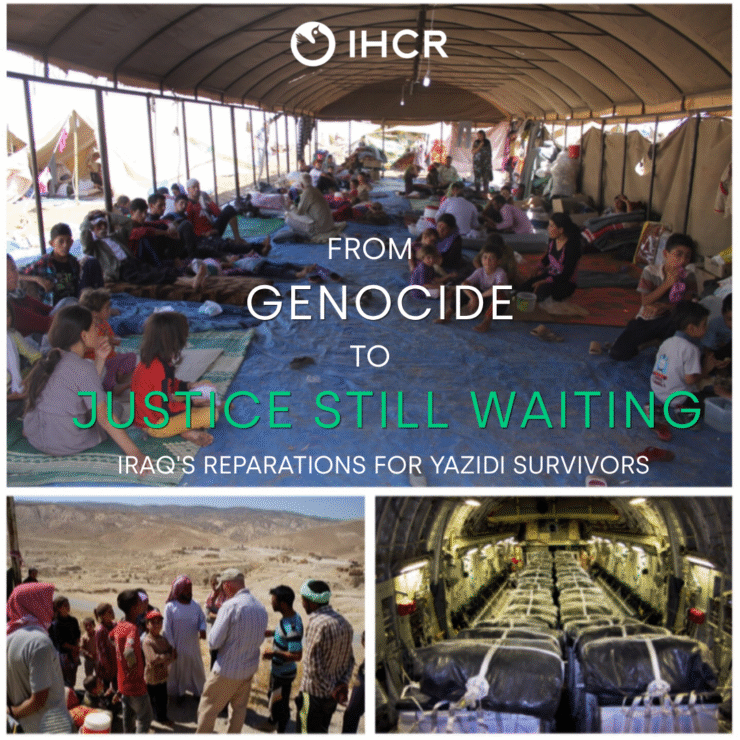
The effects of the genocide continued long after ISIS lost territorial control. Many Yazidi families remain divided between Sinjar, camps in the Kurdistan Region of Iraq, and diaspora communities. In 2023, the United Nations and International Organization for Migration (IOM) reported that more than 200,000 Yazidis remained displaced. The report identified destroyed infrastructure, limited public services, scarcity of basic necessities, and limited access to property documents as major obstacles preventing their return. (UN in Iraq/IOM, 2023)
The effects of the genocide extend far beyond the immediate humanitarian crisis. Survivors continue to face social, political, and economic challenges. The loss of family members and community institutions has weakened social ties. Unresolved security and governance disputes in Sinjar have undermined confidence in the state. The destruction of farms and businesses has made it difficult for families to rebuild independent lives. Survivors of sexual violence and children with disputed legal status often face stigma and administrative barriers that deepen their harm. These lasting consequences raise an important question: what responsibility does the Iraqi state bear today to mend the damage suffered by survivors and help rebuild a community devastated by genocide?
What Iraq’s Responsibility Means
ISIS, not the Iraqi state, directly committed the genocide. Iraq’s responsibility must therefore be understood in the context of its legal obligations. These obligations include protecting people within its jurisdiction, investigating serious crimes, prosecuting those responsible, searching for missing persons, and providing victims with an effective remedy. Article 2(3) of the International Covenant on Civil and Political Rights requires states to ensure the victims have access to an effective remedy through competent authorities (ICCPR, article 2(3)).
The United Nations’ Basic Principles on Remedy and Reparation provide a useful way to understand what a complete response should contain. (UN General Assembly resolution 60/147)
- Restitution: restoring rights, property, legal identity, and living conditions where possible.
- Compensation: financial redress for physical, psychological, and economic harm.
- Rehabilitation: medical care, psychosocial support, legal help, and social services.
- Satisfaction: truth-seeking, recognition, memorialization, recovery of remains and public acknowledgment of wrongdoing.
- Guarantees of non-repetition: security, legal reform, education, accountability, and institutions capable of preventing renewed violence.
What the Yazidi Survivors Law promised
The Iraqi Parliament adopted the Yazidi Survivors Law on 1 March 2021. The law covers women and girls from the Yazidi, Turkmen, Christian, and Shabak communities who survived specified ISIS crimes, Yazidi children who were abducted, and survivors from these four communities who escaped mass-killing operations. It formally recognizes that ISIS committed genocide and crimes against humanity and establishes a state-administered reparations program. (Yazidi Female Survivors Law No. 8 of 2021)
For approved applicants, the law and its implementation framework provide:
- Monthly financial support: a minimum monthly payment of 800,000 Iraqi dinars. (IOM Iraq, 2022)
- Health and recovery: medical care, mental-health and psychosocial support, and rehabilitation.
- Education and work: routes back into education and priority opportunities in public employment.
- Housing and land: access to residential land, housing-related support, and real-estate lending.
- Truth and remembrance: searches for missing people, mass-grave work, identification, and return of remains, and memorialization.
- Accountability and prevention: support for prosecutions, public education, and measures intended to prevent recurrence.
This law is one of the few nationally administered reparations frameworks that explicitly addresses conflict-related sexual violence. Its adoption also demonstrates that sustained survivor advocacy can lead to meaningful policy change. (Joint civil-society statement, 2026)
Progress and Recognition
Implementation of the law was initially slow, but the first salary cards for monthly financial support were distributed in March 2023. For survivors who had waited years for official recognition, this marked both a practical and symbolic milestone. As Manal, a survivor from Sinjar and a member of the Survivors Voices Network, said:
“Today, I feel better because I am seeing a tangible step toward the implementation of the YSL.” – Manal, 2023 (UN in Iraq/IOM)
The program has since expanded. According to the Iraqi government, 2,354 people were benefiting from the law as of May 2025, including 1,099 women and girls, 1,231 people who had been abducted as children, and 24 survivors of mass killings. The government also reported that 262 survivors had received residential plots, 192 had accessed psychological or social support, 471 had been issued health cards, and 73 students had returned to education. (Government of Iraq, CEDAW reply, 2026)
A June 2026 monitoring update reported further progress, with 2,496 survivors in total approved under the law and 2,216 receiving reparations in May. It also noted that a joint committee had helped issue civil documents to more than 5,000 survivors and relatives. (Coalition for Just Reparations, June 2026)
Gaps in Accessing Reparations
Accessing reparations remains difficult for many survivors. Applicants may have to travel long distances, replace missing documents, navigate multiple government offices, and repeatedly recount traumatic experiences. The additional requirement to file a judicial complaint has also been criticized as burdensome and stigmatizing, particularly for survivors living in displacement camps or remote areas. Recognizing these challenges, the UN Committee on the Elimination of Discrimination against Women (CEDAW Committee, 2026) urged Iraq in 2026 to simplify application procedures, adopt gender-sensitive and non-stigmatizing practices, strengthen monitoring, and bring the law into closer alignment with international standards on reparation.
The experience of Kawe Haji, a displaced Yazidi mother living in Khanke camp, illustrates why documentation cannot be treated as a minor administrative issue. After her family fled Sinjar, the loss of identity documents prevented her two youngest children from obtaining birth certificates and enrolling in school. With legal assistance over several months, she eventually obtained the certificate needed to continue the process. Her experience demonstrates a broader reality; without legally recognized identity documents, survivors may be unable to access education, public services, and other basic rights. (UNHCR Iraq, 2024)
Furthermore, the law does not fully address every form of harm caused by ISIS. Important gaps remain for children from non-Yazidi communities who were abducted, men and boys who survived conflict-related sexual violence, and children born of rape. (International Review of the Red Cross, 2026) In 2026, the CEDAW Committee called on Iraq to establish a legal framework protecting children born of rape, repeal discriminatory laws and practices, and ensure access to benefits, services, and reparations. (CEDAW Committee, 2026)
Return Cannot be Reduced to Closing Camps
Many families want to return to Sinjar, but their return must be safe, voluntary, dignified, and sustainable. Others may choose to integrate locally (i.e., where they are currently displaced) or settle elsewhere. A durable solution respects those choices rather than placing the burden of unresolved political and security challenges on displaced families.
Rebuilding Sinjar is therefore an essential part of reparations. Financial assistance may help families meet their immediate needs, but it cannot address the conditions that forced them from their homes. Progress also depends on inclusive agreements over Sinjar’s governance and security. More broadly, rebuilding infrastructure, restoring public services, strengthening trust in state institutions, and creating conditions for peaceful coexistence can lead to reconciliation and long-term peacebuilding. Addressing the legacy of genocide is therefore not only about remedying past injustice but also about reducing the risk of future conflict.
Accountability Remains Unfinished
International investigations have established a substantial body of evidence documenting the crimes committed against the Yazidis. In September 2024, the United Nations Investigative Team to Promote Accountability for Crimes Committed by Da’esh/ISIL (UNITAD) concluded that there were reasonable grounds to believe war crimes, crimes against humanity, and genocide had been committed against the Yazidis. (UNITAD, 2024) UNITAD’s mandate ended on 17 September 2024 after it produced 19 case assessments and analytical reports and developed an evidence archive for future proceedings. (UNITAD, 2024)
The greater challenge is translating evidence into survivor-centered justice in Iraq. Although Iraq has prosecuted many ISIS suspects under its counter-terrorism laws, these cases have often focused on membership in ISIS rather than on the specific crimes against victims. As of 2026, Iraq had still not incorporated genocide, crimes against humanity, and war crimes as separate offenses under domestic law, limiting the ability of its courts to accurately recognize and prosecute these crimes. (Joint civil-society statement, 2026)
Courts outside Iraq have demonstrated that accountability is possible for ISIS atrocities. In 2021, a German court issued the world’s first conviction of an ISIS member for genocide against the Yazidis. (Amnesty International, 2021) While such cases are an important step toward justice, they cannot replace an accessible Iraqi justice system that allows survivors to participate safely and make full use of the evidence already collected.
Accountability extends beyond criminal prosecutions. It also includes searching for missing persons, identifying and returning human remains, protecting witnesses, and preserving the memory of what happened through memorialization. Each of these measures serves a different purpose, but together they help establish the truth, recognize victims, and reduce the risk of denial or future atrocities.
A practical Agenda for Iraq and its Partners
1. Remove unnecessary barriers. End the extra-legal requirement to file a criminal complaint as a condition of reparation; accept reliable evidence already collected; expand mobile, remote and consular application options; provide free legal help; and issue reasoned, dated decisions with a clear appeal route.
2. Deliver the whole law. Maintain timely monthly support while adequately funding trauma-informed healthcare, psychosocial rehabilitation, education, land and housing, livelihoods, missing-person searches, mass-grave work, and memorialization.
3. Close gaps in coverage and legal identity. Amend the framework through consultation with survivors so that comparable harms receive comparable remedies, including those experienced by children from other affected communities, male survivors of sexual violence, and children born of rape. Ensure every child can obtain civil documentation without discrimination.
4. Support durable solutions to displacement. Invest in Sinjar’s homes, services, schools, healthcare, infrastructure, demining, and local economy; pursue inclusive agreements on administration and security; and protect each family’s right to choose between safe return, local integration, and relocation.
5. Make accountability real in Iraq. Incorporate genocide, crimes against humanity, and war crimes into domestic law; preserve and use UNITAD evidence; protect victims and witnesses; prosecute conduct rather than membership alone; and continue the search for missing people and identification of remains.
6. Empower survivors. Publish regular, disaggregated data on applications, approvals, rejections, appeals, and each form of benefit; establish independent monitoring; and give survivor representatives a meaningful role in program design, evaluation, and peacebuilding.
Conclusion: From Recognition to Restoration
The genocide against the Yazidi community represents one of the gravest crimes of the twenty-first century, marked by systematic violence, mass killings, sexual enslavement, and the deliberate destruction of an ancient religious community. Iraq has taken an important step by adopting the Yazidi Survivors Law, but a significant gap remains between legal commitments and survivors’ lived experiences.
To fulfill its obligations under international human rights law, Iraq must simplify access to reparations, remove unnecessary administrative barriers, expand eligibility, increase funding, and integrate reparations into a broader framework of transitional justice. Equal priority should be given to rebuilding Sinjar, supporting the voluntary and safe return of displaced families, identifying missing persons, prosecuting those responsible for genocide and crimes against humanity, and ensuring that survivors have meaningful access to justice.
The international community also has an important role to play. Continued political, financial, and technical support is essential to strengthen Iraq’s reparations program, support reconstruction, and ensure that accountability for ISIS atrocities remains an international priority rather than a forgotten chapter of history.
Ultimately, the experience of the Yazidis demonstrates that justice cannot be measured solely by legal recognition or financial compensation. Genuine reparations restore dignity, rebuild communities, and enable survivors to reclaim their lives with security and hope. Fully implementing the Yazidi Survivors Law is therefore more than a legal obligation—it is an opportunity to strengthen the rule of law, promote reconciliation, and help prevent future atrocities. Transforming recognition into restoration is not only a matter of justice for the Yazidis; it is an investment in humanity and lasting peace.
Selected sources
- UN Commission of Inquiry, ‘They Came to Destroy: ISIS Crimes Against the Yazidis’ (2016)
- Cetorelli et al., PLOS Medicine, ‘Mortality and kidnapping estimates for the Yazidi population’ (2017)
- International Covenant on Civil and Political Rights, article 2(3)
- UN General Assembly resolution 60/147, Basic Principles on the Right to a Remedy and Reparation
- Iraq, Yazidi Female Survivors Law No. 8 of 2021 (IOM English translation)
- IOM Iraq, ‘Launch of Application Process for the Yazidi Survivors Law’ (2022)
- United Nations in Iraq/IOM, ‘Yezidi Survivors See First Benefits of Landmark Reparations Law’ (2023)
- United Nations in Iraq/IOM, ‘Nine Years in Remembrance, the Road Ahead for Yezidi Genocide Survivors in Iraq’ (2023)
- UNHCR Iraq, ‘Civil documentation gives displaced Yazidi renewed hope for the future in Iraq’ (2024)
- UNITAD, ‘Detailed Findings of International Crimes … Against the Yazidi Community in Iraq’ (2024)
- UNITAD, Statement on the Conclusion of the UNITAD Mandate (2024)
- Government of Iraq, Replies to the CEDAW Committee, CEDAW/C/IRQ/RQ/8 (2026; data to May 2025)
- CEDAW Committee, Concluding Observations on Iraq, CEDAW/C/IRQ/CO/8/Rev.1 (2026)
- Coalition for Just Reparations, YSL Newsletter, Issue 15 (June 2026)
- Global Centre for the Responsibility to Protect et al., Joint Statement on Five Years of the YSL (2026)
- Amnesty International, ‘World’s first judgment on crime of genocide against the Yazidis’ (2021)
- International Review of the Red Cross, ‘Visible wounds, invisible rights’ (2026)