Israel’s Genocide in Gaza and Ethnic Cleansing in the West Bank

Introduction
The war crimes Israel has perpetrated against the Palestinians in Gaza—and its relentless ethnic cleansing across the West Bank—defy every moral principle that governs human behavior. Much of the world now condemns Israel, most openly, some only in whispers, but the verdict is unmistakable: its moral standing has collapsed to a point of almost no return. This ruin is the work of the extremist government now in power and the savagery with which it grinds down a captive people—reducing a nation once revered as a moral exemplar to a byword for impunity, and a synonym for shame before the world.
To make the case against Israel, I will present a few out of hundreds of documented pieces of evidence for each of these crimes—citing the time and place of each, and, in most instances, the names of the victims themselves. I conclude this work by calling on all Israeli and diaspora Jews to rise and demand that the Israeli government immediately cease its barbaric treatment of the Palestinians. They must rise, not just to safeguard Palestinian lives and dignity, but so Israeli Jews themselves can begin the arduous and necessary journey toward collective atonement and lasting redemption.
Moral Army is a Myth
One of the most consistent claims Israel has made over the years is that the Israel Defense Forces (IDF) is the most moral military in the world — a claim taken for granted by Israelis themselves and by many others around the world. The egregious assault on the Palestinians in so many different settings, times, and circumstances raise the cynical question: if the most “moral military” in the world is capable of committing such heinous crimes against tens of thousands of innocent Palestinians only because of who they are, how much worse can a corrupt, bloodthirsty army be?
How did an army that once preached “purity of arms” fall this far? Herbert Kelman, in his classic study of “sanctioned massacres,” showed that ordinary soldiers commit atrocities when three conditions converge — authorization, which suspends normal moral judgment; routinization, which removes any occasion to raise moral questions; and dehumanization, which strips victims of identity and community. All three have been supplied to the IDF in abundance. There are six mutually reinforcing forces that explain the transformation from “purity of arms” to “sanctioned massacre,” which social psychology has long since named.
First, dehumanization from the top. When the defense minister announces a total siege with the words “we are fighting human animals and we are acting accordingly,” he was portraying Palestinians as subhumans. Although that’s not an explicit order to kill civilians, such language can strip away moral restraint, signaling that Palestinian lives are of lesser value and that violence against them carries diminished ethical consequence.
Second, the existential mindset. Israeli political psychologist Daniel Bar-Tal has spent decades documenting the “siege mentality” and the delegitimization of the adversary that sustains intractable conflict—beliefs that cast one’s own side as the eternal, sole victim and deny the other’s humanity. Sociologist Eva Illouz put it more bluntly: “Where you see human beings, Israelis see enemies,” and Israelis have lost “the capacity to identify with the suffering of a distant other.” A population defined as an existential threat cannot be a population of victims.
Third, October 7 and the summoning of Holocaust memory. The savagery of that day was real and searing. Still, it was immediately transposed into a biblical register when the prime minister told the nation and its soldiers to “remember what Amalek did to you” — a verse whose scriptural sequel commands the annihilation of men, women, and infants alike. Genocide scholar Omer Bartov, an Israeli-born historian, concluded that the IDF’s operational pattern came to match precisely that rhetoric. Trauma was converted from a claim on the world’s conscience into a license against it.
Fourth, sanctified vengeance. Albert Bandura’s work on moral disengagement describes exactly this machinery: inhumane conduct is cognitively restructured into something “benign or worthy” through moral justification and sanitizing language, while responsibility is displaced upward and the injury inflicted is minimized. “Mowing the lawn,” “collateral damage,” and “human shields” are not descriptions; they are anesthetics.
Fifth, the long apprenticeship of occupation. Nearly six decades of checkpoints, night raids, demolitions, and military courts habituated a conscript army to treating an entire people as a population to be managed rather than citizens to be respected. Yeshayahu Leibowitz, whom Isaiah Berlin called the conscience of Israel, warned from 1967 onward that the occupation would corrupt the occupier as surely as the occupied, and coined the term “Judeo-Nazis” precisely to describe what he feared the army would become. What was heresy in 1982 reads today as prophecy.
Sixth, impunity and industrialized distance. Almost no soldier is investigated, fewer still are charged, and killing is now mediated through algorithmic target lists and munitions released from miles away — conditions under which, as Hannah Arendt observed of bureaucratized evil, atrocity requires no monsters, only functionaries who never see a face. An army that is never held to account learns that nothing it does is accountable.
Taken together, these forces demonstrate that the “most moral military” was always a myth—a comforting fiction embraced by the perpetrators. The unfolding horror in Gaza has stripped that myth naked for the whole world to see. The IDF flagrantly breached nearly every category imaginable: torture; ethnic cleansing; indiscriminate killing; deliberate deprivation of aid, food, fuel, and medicine; dehumanization; attacks on humanitarian zones; wholesale destruction of infrastructure; demolition of homes; cold-blooded execution; strangulation of movement; assassinations of journalists; and attacks on hospitals and health clinics. The sheer number of war crimes and crimes against humanity committed by the IDF brought a near-global conclusion that Israel committed genocide through the most egregious crimes imaginable. The following offers a window into what genocide looks like.
Dehumanization
Israel’s dehumanization of the Palestinians was never incidental; it was cultivated through language, law, and habit. Officials and public figures spoke of “human animals,” invoked Amalek, and denied the existence of Palestinian innocents — rhetoric the UN’s commission of inquiry cited as evidence of genocidal intent. Occupation converted persons into permits, checkpoints, and case numbers. Two legal systems governed one territory: civil law for settlers, military courts for Palestinians — an architecture B’Tselem and others named apartheid. School curricula, conscription, and media erased Palestinian history and grief alike.
Dehumanization supplied the permission. Once soldiers were taught that no Gazan is innocent, that an entire population is inhuman, the distinction between combatant and child dissolved. Hannah Arendt understood how ordinary this becomes: the perpetrators of mass murder, she wrote, were “neither perverted nor sadistic,” but “terribly and terrifyingly normal.” Free-fire zones, flattened neighborhoods, and starvation as strategy followed logically— not from battlefield necessity, but from the prior conviction that these lives never counted. Genocide begins in the mind long before the airstrike.
Settler pogroms in the West Bank proceed under army protection; prisons have become, as B’Tselem documents in its report “Welcome to Hell,” networks of torture where starvation, sexual violence, and death go unpunished. Impunity is not the failure of the system. It is the system’s design. The consequence was moral anesthesia. Once a people are rendered faceless, killing them requires no justification and abusing them incurs no penalty. Emmanuel Levinas located the whole of ethics in that vanished feature: “The face is what forbids us to kill.” For him, the face is not a likeness but the encounter with another’s irreducible singularity, and it issues its command before any argument about security is made. To strip a people of that face—to convert them into a demographic problem or a statistic—is not merely to insult them, but to dismantle in advance the one restraint that makes violence against them unthinkable.
Indiscriminate Killings
Israel falsely claims that its military forces never engaged in indiscriminate killing of Palestinians, when in fact such killings happened routinely in broad daylight. The deliberate killings were seemingly meant not merely to neutralize a security threat but to eliminate as many Palestinians as possible, regardless of age, gender and circumstances. There were hundreds of such incidents; the following offer only a glimpse of the wanton, indiscriminate killings that Israel denies, but the iron-clad evidence speaks for itself.
On October 31, 2023, four Israeli aerial munitions struck the six-story Engineers’ Building in central Gaza, which collapsed, knowing it was sheltering some 350 civilians. Human Rights Watch verified at least 106 dead—34 women, 18 men, and 54 children—from families including the Abu Saeed clan, of whom 23 perished together. Survivor Ameera Shaheen lost 20 relatives; she awoke in hospital screaming for her daughter. Naheed Mahmoud watched rescuers free her niece Nada, 17, whose “lower body was crushed under the rubble… she was in severe pain, yelling and screaming.” Those who claim that the Israeli army is subject to civilian authority and must follow orders also know that every soldier understands the difference between combatants and innocent civilians.
Not only have there been hardly any known cases where an Israeli soldier disobeyed an unlawful order to kill non-combatants, but there were, conversely, many documented incidents — captured on soldiers’ own phones and verified by Amnesty International, The Washington Post and the Associated Press — in which soldiers cheered as residential blocks were leveled and as strikes killed Palestinian civilians On December 21, 2023, Israeli forces stormed a Sheik Radwan home, hurling grenades into a room where 12 civilians sheltered, then opening fire. Seven were killed: Ahmed al-Khalidi, 34; Fatma al-Khalidi, 32, seven months pregnant, her “belly and face full of metal fragments;” Nawal al-Khalidi, 70; her blind 73-year-old husband Abd Rabu, allegedly shot after the house was secured; and others whose legs, a survivor said, “looked like mincemeat.” Five-year-old Faisal endured seven surgeries and may never walk. His uncle said the once-fearless boy now “can never be left alone.”
Another chilling example is the killing that took place on November 22, 2023, in Gaza City on Moneer al-Rayyes Street in the Tal al-Hawa neighborhood, with no battle raging and no threat in sight. Israeli snipers methodically picked off four unarmed members of the Doghmosh family—Mohammed, Salem, Montasser, and Farid—and wounded two more. They were not fighters; they were civilians in their own neighborhood, marked for death simply for being Palestinian men. No army that hunts the unarmed can call itself the most moral in the world.
Attacking Rescue Teams and Hospitals
Not only does the IDF shoot and kill innocent Palestinians, but they have also made it a practice to attack rescue teams and aid convoys that come in cases of emergency to help the wounded and evacuate the dead resulting from an Israeli attack. This, of course, is not only against international law and is considered a war crime, but it also shows the heartlessness that has characterized the Israeli onslaught on the Palestinians in Gaza. A couple of abhorrent examples demonstrate the egregiousness of such inhumanity.
On November 20, 2023, after a days-long siege, Israeli tanks and snipers surrounded the Indonesian Hospital facility at Beit Lahiya. Fire struck the post-operative department, killing at least 12 people and wounding dozens. Snipers on rooftops blocked ambulances, and troops later disabled the main generator, forcing the hospital out of service. Another ghastly case took place on December 6, 2024, when the Kamal Adwan Hospital in northern Gaza was raided by Israeli forces; they killed four medical professionals and left about 20 injured. Overnight, troops severely damaged the oxygen generators, leaving only two inexperienced surgeons to provide critical care. The strike was part of repeated assaults that ultimately shut the hospital down by late December.
And to cap these debased violations of the human right to medical treatment, one other incident stands out. On March 23, 2025, in southern Rafah, a convoy of clearly marked ambulances and a fire truck, emergency lights flashing, came to aid the wounded. Israeli soldiers unleashed over 900 rounds across two hours, killing 15 rescue workers—among them paramedic Refaat Radwan, who recorded much of the attack—then buried them in a mass grave, alongside their crushed rescue vehicles. To slaughter medics racing to save lives and hide the evidence is not the mark of morality; it is the signature of impunity.
This is a part of a wider pattern in which medical sanctuaries, meant to shelter the sick and wounded, became sites of killing.
Preventing Supply of Essential Aid as a Weapon of War
I do not believe that there is anything more inhumane that deserves universal condemnation than the deliberate starvation of men, women, and especially children as a weapon of war. This not only points to the beastly conduct of Israel in a war against civilians but to the utter loss of the last vestiges of any moral tenet by a country founded on the ashes of the hundreds of thousands of Jews who perished from starvation.
On August 22, 2025, the Integrated Food Security Phase Classification (IPC)—the world’s foremost authority on food crises—confirmed Famine (Phase 5) in Gaza Governorate, with over half a million people facing starvation and preventable death. UNICEF reported in July 2025 that the entire under-five population, more than 320,000 children, are at risk of acute malnutrition. Nine-year-old Jana, who had recovered from malnutrition in 2024, relapsed and died in October 2025 as aid restrictions persisted; her two-year-old sister Jouri had already starved to death on August 20. Doctors reported infants dying for want of basic potassium chloride.
For framing, these were not logistical failures but, according to assessments by the UN and rights bodies, deliberate policy: UNRWA said it had enough food stockpiled outside Gaza to feed the entire population for months, with trucks left waiting at closed crossings. By late August 2025, Gaza’s Health Ministry recorded at least 289 malnutrition deaths, including 115 children. The earliest emblematic case was 10-year-old Yazan al-Kafarneh, who had cerebral palsy and needed a special diet; he wasted to a skeleton and died in Rafah on March 4, 2024, becoming, as the New York Times put it, “the face of starvation in Gaza.”
But to fathom the extent of the Israelis’ cruelty, one has to listen to former Defense Minister Yoav Gallant, who announced on October 9, 2023, “a complete siege… No electricity, no food, no water, no fuel—everything is closed,” adding, “We are fighting human animals.” And adding insult to injury, the then Energy Minister, now Minister of Defense, Israel Katz said, “Not a fuel truck will enter until the Israeli hostages come home.” Human Rights Watch concluded Israel was using starvation as a weapon of war—a war crime—deliberately blocking water, food, and fuel. By December 6, the WFP reported nine of ten households in northern Gaza had gone a full day and night without food.
Attacking Israeli Designated Safe Zones
In Gaza, the IDF established designated “safe zones” for Palestinians to enter, yet deliberately and repeatedly attacked these very same zones. These malicious attacks can only be described as a deliberate trap just to kill as many Palestinians who, for a moment, feel that they are safe. If this is not a grave travesty, then I don’t know what is. Just try to internalize the following:
On February 20, 2024, an Israeli tank fired at a multi-story building housing only Médecins Sans Frontières staff and their families in al-Mawasi—the very “humanitarian zone” Israel had designated and ordered civilians to flee toward. The strike killed two people and injured seven. MSF had given Israeli authorities the building’s exact coordinates, saw no military targets nearby, and received no warning. One would accept the possibility that in a certain case the coordinates were wrong, resulting in such a tragic error. The attack however, underscored a pattern in which no place in Gaza—even Israel’s own declared safe areas—offered families refuge, as these attacks have been repeated time and again.
On December 4, 2024, an Israeli airstrike hit a makeshift camp sheltering 21 displaced families in al-Mawasi, Khan Younis—an area Israel had unilaterally declared a “safe humanitarian zone.” The strike and secondary explosions, seemingly sparked by gas cylinders used for domestic purposes, incinerated all 21 tents, killing at least 23 Palestinians, among them at least four children and two women, one of them pregnant, and gravely wounding others. The UN noted it was the seventh attack on displacement camps in two weeks, part of a relentless targeting of families who had already lost their homes and were living in canvas shelters. Every time such a criminal attack takes place, you find the Israeli authorities providing baseless excuses—in this instance, claiming to target senior Hamas commanders—trying to explain away the daily unfolding tragedies.
Normalizing Torture
Whereas Israel denies it engages in torture of Palestinians prisoners, the evidence available not only proves Israel’s lies and deception but demonstrates the unimaginable extent of torture, sparing no one regardless of age and gender. The UN documented the torture and deaths at Sde Teiman and other facilities. Thousands of Palestinians—including women, children, doctors, and patients—were taken from Gaza, shackled and blindfolded, and held incommunicado, subjected to waterboarding, electric shocks, burning, stress positions, prolonged food and water deprivation, and sexual abuse. Nurse Younis al-Hamlawi described being forcibly penetrated with a foreign object and electrocuted; another detainee recounted being suspended from chains and electrocuted until “the world was spinning… and I fainted.” B’Tselem found deliberate denial of medical care in six of ten autopsies. At least 84 Palestinians have died in Israeli custody per B’Tselem’s monitoring; other rights organizations cite at least 94 deaths.
Dr. Adnan al-Bursh, the 50-year-old head of orthopedics at Gaza’s al-Shifa Hospital, was seized by Israeli forces on December 14, 2023, while treating patients at al-Awda Hospital in northern Gaza, and taken to Ofer Prison in the West Bank. He died in custody; Israeli prison authorities confirmed his death on April 19, 2024. Fellow inmates told Sky News that at Sde Teiman, he had been beaten so severely he could no longer use the bathroom unaided, and when he arrived at Ofer Prison, guards threw al-Bursh into the prison yard naked from the waist down, his body bearing clear signs of assault; he died not long after.
The UN Special Rapporteur on health, Tlaleng Mofokeng, said she was “horrified” and warned his case raised serious concerns that “he died following torture at the hands of Israeli authorities,” demanding an independent international investigation. Israel withheld his body.
In the West Bank, the systematic torture of Palestinian detainees over decades represents one of the darkest failures of basic decency by the Israeli authorities, whether inflicted to instill fear, extract information, humiliate, or reduce a person to silence; it strips victims of dignity and leaves wounds that do not fade. The routine use of such abuse, which ends with the death of the prisoner, corrodes the moral fabric of any society that tolerates it, making violence seem normal and lives expendable.
There are scores of cases of tortured Palestinian prisoners in the West Bank. Here are only a couple of cases that describe the sheer inhumanity of the Israeli prison guards. On September 30, 2024, Israeli soldiers stormed the Silwad home of 17-year-old Walid Khaled Abdullah Ahmad, dragging the boy from his bed. Nearly six months later, on March 23, 2025, he collapsed and died in the yard of Megiddo prison — the first confirmed death of a Palestinian child in Israeli detention. Prisoner-rights groups reported he had suffered from severe deprivation and abuse; medical accounts cited signs of starvation and neglect. A child who should have been in school instead died in a facility notorious for torture, held for months without a resolved charge.
His case reflects the broader pattern documented by B’Tselem in its report “Welcome to Hell,” which found a “systemic, institutional policy” of abuse including severe beatings, sexual assault, deliberate starvation, and sleep deprivation.
Deliberate Destruction of Infrastructure
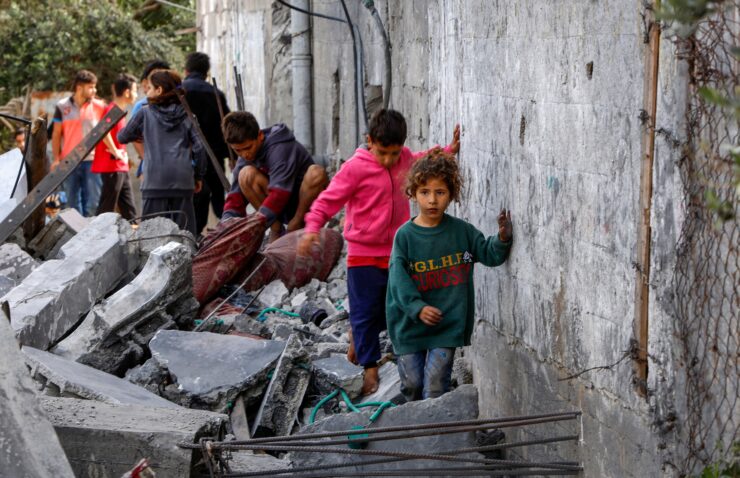
The mass destruction of civilian infrastructure by Israel was carefully calculated to ethnically cleanse the territory and prevent the Palestinians from ever returning. This unprecedented and indiscriminate scorched-earth destruction, leaving thousands of Palestinians buried under the rubble, defies madness and inhumanity.
In April 2025, the United Nations Satellite Center (UNOSAT) found roughly 70 percent of all structures in Gaza were destroyed or badly damaged, totaling 174,486 buildings, while civilian infrastructure has been flattened 80 to 90 percent. Even after the October 2025 ceasefire, demolitions continued behind Israeli lines.
The BBC verified that more than 1,500 buildings were leveled in Israeli-controlled zones in the month after the October 10, 2025 ceasefire took effect, most through systematic demolition rather than combat. Israeli soldiers have since testified to the “systematic and deliberate” flattening of structures posing no threat, describing bulldozers that “were simply destroying homes.”
The Killing of Journalists
To prevent the world from witnessing and reporting in real time on Israel’s continuing incomprehensible atrocities, the IDF did not hide the targeting of Palestinian journalists in cold blood, deemed as “executions” by many observers. More than 200 journalists, almost all Palestinian, have been killed since October 2023. The Palestinian Journalists Syndicate counts 264, the UN counted over 260 by December 2025, and CPJ, after a contested internal review, lists 209. Brown University’s Watson Institute found more journalists killed in Gaza than in both World Wars, the Korean and Vietnam wars, the 1990s and 2000s wars in Yugoslavia, and the post-9/11 war in Afghanistan combined.
Israel has barred independent foreign correspondents from entering Gaza since October 7, 2023, a blackout approaching a thousand days by mid-2026, leaving Palestinian journalists as the only witnesses, and then killing them. The Palestinian Journalists Syndicate has documented 4,127 violations against media workers, including destroying 140 journalists’ homes and 187 media institutions. CPJ also found Israel responsible for two-thirds of the 129 journalists killed worldwide in 2025, the deadliest year for the press in more than three decades.
Ravaging the West Bank
Israel’s intention to annex the West Bank required, first, that law defined the land as Israeli sovereign. Once sovereignty was treated as a foregone conclusion, Palestinians became obstacles to be cleared rather than persons bearing rights. Hobbes described the result precisely: “Where there is no common power, there is no law; where no law, no injustice”—and in that condition, “force, and fraud, are in war the two cardinal virtues.” Settlers and soldiers now operate inside that vacuum: over 1,000 attacks causing casualties or damage in five months—six a day—the highest pace on record, and 46 communities emptied entirely. Displacement, the UN Secretary-General warns, is at “levels not seen since 1967,” amid what Amnesty International calls state-driven ethnic cleansing. Annexation did not follow lawlessness. It manufactured it.
To have a real sense of the extent of Israeli soldiers’ and settlers’ merciless rampage in the West Bank, a few examples of various crimes against the Palestinians offer a shocking picture of what they have and continue to endure.
Extrajudicial Killing
On December 8, 2023, during a raid on al-Far’ah refugee camp, security-camera footage obtained by B’Tselem captured two short-range executions. Rami Jundob, 25, was shot and fell; a military jeep then approached and a soldier fired again, afterward filming the dying man on his phone. Jundob died the next day. Thaar Shahin, 36, who had hidden beneath a car, was shot dead from close range. The footage of a soldier casually filming a man he had just shot became a searing emblem of impunity; Israel’s military opened an inquiry, to no avail.
The gruesome extrajudicial killings continue unabated, revealing a collapse in moral restraint where such wanton killing barely registers in the Israeli public consciousness. In Jenin, during a raid on November 27, 2025, soldiers were filmed shooting two Palestinians at point-blank range: Yusef ’Asa’sah, 39, and al-Muntaser bel-lah ‘Abdallah, 26. The footage shows the men, labeled “wanted,” led from a building and surrendering—then ordered back inside to sit on the ground, where soldiers executed them despite apparently posing no threat. B’Tselem’s director called it “the result of an accelerated process of dehumanization… and the complete abandonment of [Palestinian] lives,” committed with full impunity.
On October 19, 2023, in the Nur Shams camp, 15-year-old Taha Mahamid stepped outside, holding only a cellphone, and told his sister Sara, “I won’t be long.” He was shot. His father, Ibrahim, 58, unable to bear ‘the sight of his son bleeding on the ground,’ went to him and was shot in the abdomen. Israeli forces blocked ambulances; Taha lay motionless with blood pooling around his head. “No sound, no movement… no one came to him,” Sara said. Taha died in those early morning hours; Ibrahim died of his wounds four months later. HRW found neither was armed.
The extrajudicial killings continue with chilling regularity, revealing a hardened moral numbness. Palestinian lives, including the lives of children, are regarded as disposable rather than as lives of equal human worth.
B’Tselem’s June 2026 report “Unshielded Childhood” documented 54 Palestinian children and teenagers killed by Israeli forces in the West Bank in 2025 alone, and 235 since October 7, 2023—the highest rate of child killings there since the occupation began in 1967, with roughly one in four West Bank fatalities being a minor. B’Tselem found no evidence that any of the 2025 child victims posed a threat or belonged to any armed group, documented that medical teams were delayed or blocked in nearly a quarter of cases, and noted that not a single indictment has been filed since October 2023.
Settler Violence
The government did not merely tolerate settler violence; it commissioned it. Ministers armed militias, funded outposts, and shielded perpetrators from prosecution. Settlers torch olive groves, sever water lines, steal livestock, and burn cars — behavior Amnesty International concludes is not the work of rogue individuals but state policy designed to accelerate annexation. The purpose is exhaustion. Make farming impossible, water inaccessible, sleep unsafe—and families leave without a single expulsion order being signed. OCHA has documented more than 190 water and sanitation structures damaged or destroyed this year, nearly always unpunished and frequently carried out under the watchful protection of Israeli soldiers. Limited access to safe and clear water has led to an increase in skin diseases and other infections, among other hazardous health conditions. The following examples illustrate the pattern.
After settlers established the illegal Meitarim Farm outpost a kilometer away from the Palestinian village of Khirbet Zanuta, in the South Hebron Hills, they waged a relentless campaign against Zanuta’s residents: burning tents and classrooms, breaking into homes, beating villagers with rifles, smashing solar panels, emptying water tanks, and pumping sewage onto farmland. Settlers destroyed water tanks and power lines and stole equipment; in one incident a soldier stood by, then fired into the air to cover the settlers’ retreat.
In October 2023, armed settlers pressed a rifle to the chest of shepherd Masafer Yatta, kicked him in the stomach, forced him face-down, covered his head, and threatened to kill him—invoking Gaza. “Did you see what we did to the children of Gaza? We’ll do the same to your children,” one told him. “When he put his rifle on my chest and hit me on my stomach… my daughters were watching and screaming,” the shepherd recalled. Another resident of Zanuta, “Marwa,” recounted that settler Yinon Levi “broke our door and beat our children with their rifles… as we were sleeping.” Adel al-Till said: “We were the last family… We were afraid, it was terror.” Raids came alongside Israeli forces, and police ignored two Supreme Court return orders. By March 30, 2025, satellite imagery confirmed Zanuta “no longer exists.”
Amnesty situates these individual expulsions within a deliberate, state-backed campaign of creeping annexation: between 2023 and 2025, Israel declared roughly 25,959 dunums of Area C as “state land”—about half of all such designations since the Oslo Accords—and by April 2026 there were 363 outposts across the West Bank, 212 of them established under the current government. Herding outposts alone expanded settler control to some 746,000 dunums, about 22 percent of Area C, with Peace Now and Kerem Navot finding settlers seized 70 percent of all the land they have taken since the 1990s within just two and a half years.
Demolition of Houses
Israel has perfected demolition as an instrument of dispossession. A Palestinian in Area C who wants to add a room, a cistern, or a solar panel must obtain a permit that OCHA describes as “nearly impossible” to obtain — then watch bulldozers arrive to demolish the building he had no lawful way to build. Where the permit regime proves too slow, land is declared a firing zone, a nature reserve, or state property, with the burden of disproving it thrown onto the families who have farmed it for generations. At least 37,135 Palestinians were displaced across the West Bank in 2025 alone — a record. The horror is not merely the rubble. It is the calculated cruelty of a legal architecture built so that Palestinian shelter is always a crime and Palestinian land is always available.
One particular example says it all. Days after the Gaza ceasefire, Israel launched “Operation Iron Wall” in the West Bank on January 21, 2025, ordering, via loudspeaker-mounted drones and armed raids, the entire refugee camps of Jenin, Tulkarem, and Nur Shams emptied. Human Rights Watch found roughly 32,000 residents displaced and about 850 buildings demolished—a forcible transfer it called a war crime. Nadine G., 53, fled Nur Shams with her husband and 14-year-old daughter, walking past ruined homes as “women along the way… were all crying.” Her testimony gave the report its title: “All My Dreams Have Been Erased.”
Another chilling case is when, on May 5, 2025, Civil Administration personnel, escorted by Border Police and soldiers, along with an excavator and a bulldozer, carried out the largest demolition to date in Masafer Yatta—an area featured in the Oscar-winning film “No Other Land.” In roughly two and a half hours, they demolished ten homes, leaving 49 people, including 27 children, without shelter. They also destroyed sanitation structures, kitchens, 11 water tanks, 5 cisterns, sheep pens, and the solar power network. Families received tents and remained amid the rubble of their community.
For framing, OCHA reports that more than 1,700 Palestinians were displaced by “lack-of-permit” demolitions in 2025 alone in Area C and East Jerusalem—and that Operation Iron Wall produced “the longest and largest displacement crisis in the West Bank since 1967,” with at least 31,919 refugees driven from Jenin, Tulkarem, and Nur Shams camps. MSF documented that in Masafer Yatta’s communities, four mass demolitions since February 2025 reduced more than 85 percent of homes and shelters to rubble, forcing families to move into caves.
Deadly Restriction of Movement
The movement of Palestinians from one checkpoint to the next within the West Bank itself has been criminalized. OCHA counted 925 checkpoints, gates, and earth mounds across the West Bank — the most in twenty years, restricting 3.4 million Palestinians. A two-mile journey to a clinic can consume half a day; a mother seeking her child’s medicine may not arrive at all, in a territory where a third of essential medicines are out of stock. The purpose is not security. It is attrition — to make ordinary life so exhausting that staying becomes unbearable.
Without providing a reason, on March 2, 2025, Israel sealed all crossings, halting even baby formula and medications for over two and a half months. This was not an aberration; Israel frequently seals all crossings, offering various unfounded pretexts, such as suspicious terrorist infiltration or smuggling of drugs. The WHO called it a “deliberate withholding of humanitarian aid.” Children died first: four-month-old Janat succumbed on May 4 before her evacuation could be arranged; five-month-old Zeinab Abu Halib died in her mother’s arms en route to the hospital in July. At Gaza City’s Patients’ Friends Hospital, five malnourished children—aged four months to four-and-a-half years—died over four days because the treatments to save them had run out under the blockade.
Night Raids
The night raid is the occupation’s signature ritual. Soldiers arrive at two in the morning — not pursuing a suspect, often with no name at all — kick in doors, drag children from their beds, blindfold and cuff them before their parents, then take a boy away for weeks. The purpose is terror administered for its own sake. In his book, On the Genealogy of Morals, Nietzsche named the impulse plainly: “To see others suffer does one good, to make others suffer even more” — an “ancient, mighty, human, all-too-human principle.” Cruelty here is not a byproduct. It is the reward.
There are an endless number of night raids that can be cited here; only a couple are shown to demonstrate the cruelty of the Israeli occupying authority. Shortly after 8 p.m. on September 3, 2021, in Hebron’s Tel Rumeida neighborhood in Hebron, roughly eight Israeli soldiers burst into the home of the extended Da’na family and pulled thirteen children—ranging from kindergarten age to elementary school—out of their beds. The soldiers herded the terrified, sobbing children onto a balcony and photographed them one by one; a soldier told the crying, trembling children to “say cheese” as he took their pictures. Photographing minors in this manner is illegal under Israeli military regulations, and no arrests were made—the raid served no purpose but to intimidate. Families whose children have been similarly or worse treated by Israeli soldiers described children who afterward wet their beds, refused to sleep alone, and woke screaming from nightmares.
Another chilling case happened at 3:30 a.m. on October 12, 2022, when roughly eight Israeli soldiers broke down the front door of a Palestinian home with a sledgehammer and stormed into the bedroom of a 13-year-old boy. According to his mother’s testimony, a soldier kicked the boy as he lay in bed and the terrified child passed out; when the family rushed toward him, a soldier aimed his weapon at them. The mother begged to retrieve her two-month-old baby crying in a nearby crib and was refused permission. Her son was blindfolded, handcuffed, and taken away into the dark. “It was a hellish night I will never forget,” she said—the youngest children were left shaking and inconsolable.
These are not isolated aberrations but the machinery of a system. Israeli forces arbitrarily detain an estimated 500 to 1,000 Palestinian children every year, the overwhelming majority seized from their beds in terrifying pre-dawn raids—Save the Children found that 65 percent of detained children were taken between midnight and dawn, and that afterward 73 percent suffered insomnia and 53 percent recurring nightmares.
B’Tselem, documenting four nighttime home invasions in Hebron in May–June 2023 alone, described a routine founded on “violence, collective punishment and systematic looting”—entire families roused at gunpoint, homes ransacked, and adults hauled into administrative detention without charge, a number that has quadrupled since 2023. The purpose is a permanent atmosphere of dread: no family knows which night the soldiers will come for their children.
Conclusion
The Gaza war should never have happened. It was, in effect, delivered by negligence — Netanyahu’s negligence above all.
The warning signs were there. Israeli intelligence knew Hamas was drilling for a large-scale operation. Egypt’s intelligence chief, Gen. Abbas Kamel, reportedly phoned Netanyahu roughly ten days before the attack to warn that Hamas was preparing “something big,” even “a terrible operation”—a warning the prime minister’s office flatly denies receiving. Israeli observers along the fence flagged suspicious activity in Gaza. And yet two days before October 7, two companies from the IDF’s Commando Brigade were pulled off the Gaza perimeter and sent to Huwara in the West Bank.
All of it was ignored, because Netanyahu had convinced himself Hamas was neither willing nor able to mount an attack of that scale. He acted on that conviction: for years he permitted the transfer of Qatari cash — tens of millions of dollars a month, roughly a billion over time — into Gaza, while Israeli intelligence watched Hamas dig hundreds of miles of tunnels and manufacture and procure weapons. A substantial share of that money went into rebuilding Hamas’s military, in plain sight.
The logic was never a secret. At a Likud faction meeting in March 2019, Netanyahu reportedly told his own MKs: “Anyone who wants to thwart the establishment of a Palestinian state has to support bolstering Hamas and transferring money to Hamas… This is part of our strategy — to isolate the Palestinians in Gaza from the Palestinians in the West Bank.” He now denies saying it, calling it a misquote — but the policy he pursued said it for him. Divide and rule.
Taken together, it is hard to escape the conclusion that Netanyahu invited the catastrophe he failed to prevent, or, I dare say, chose not to prevent. What has followed confirms the design: a government openly intent on annexing at least northern Gaza, and systematically entertaining the ethnic cleansing of the territory. That is the tragedy in summary. The question now is where Israel goes from here.
A Mother’s Grief Knows No Nation
Every Israeli mother should ask herself, in the privacy of her own heart, the question she has been taught never to ask: if my son were killed, would I mourn my child any more or less than a Palestinian mother mourn her own child?
Does grief check a passport before it breaks a heart? The tears are the same. The silence in the house is the same. The crib and the grave are the same. A mother’s love knows no border, no flag, no faith — and neither, in the end, does a mother’s unbearable loss. In Gaza, tens of thousands of mothers have learned this. Israel taught them.
Now dare to imagine it were you. Your family on the same land for generation upon generation — your grandfather’s olive trees, your children’s school, the graves of your dead in soil your name is written into. Then strangers arrive, armed, and tear you from all of it, declaring the land was theirs by a claim two thousand years old. Would you call that justice? Or would you call it what it is — the theft of a home, and of a history?
You know the answer. You have simply agreed not to say it aloud.
A Liability, Not an Asset
Israel was meant to be world Jewry’s shield. It has become its exposure. Its crimes against humanity have fed a surging tide of antisemitism, and Jews from Melbourne to Montreal now pay for atrocities they never chose and openly abhor — condemned by association, defenseless by proxy.
And the young are walking away from supporting Israel. Not out of ignorance, but out of clarity: they recoil from a state that no longer reflects a single value they were raised on, and they will not spend their lives defending the indefensible. Israel has taken the deepest source of Jewish pride—the state itself—and turned it into a source of Jewish shame. There is no sanction, no boycott, no resolution that could inflict the wound Israel inflicted on itself and on the Jews around the world.
When Will the Israeli Public Awaken?
Nearly three years have passed since October 7, 2023, and its horrific consequences—and still the Israeli public remains numb. Numb, and certain: the Palestinians are an existential threat, full stop. It is a conclusion the government feeds them daily, and one they swallow whole, because the alternative requires thinking.
So, the question must be put plainly: what will it take to wake Israelis to reality?
The reality is not complicated. The Palestinians exist. They existed before the war, they exist after it, and they will exist long after Netanyahu and his coalition are gone. They have nowhere else to go — and no amount of denial, demolition, or displacement will conjure a country willing to take them. Between the river and the sea, more than seven million Palestinians live intermingled with Israeli society, in Jerusalem, in the West Bank, in Gaza, and inside Israel itself. They are not a demographic problem to be managed. They are a people, and they are permanent.
Denying them their rights will not end the conflict; it will extend it by decades, perhaps generations. Creeping annexation and ethnic cleansing may redraw a map, but they cannot erase a nation. Every dunam seized, every home razed, every child raised under occupation is another year added to a war Israel insists it is winning, but will never win.
This is the illusion that must break. Not because the world demands it, but because Israel’s own survival depends on it. A state that can conceive of no future beyond permanent domination of another people has already surrendered the one thing it cannot afford to lose — the moral premise on which it was founded.
A Betrayal of Its Own Purpose
Israel has betrayed the very reason it was created. A sanctuary born of unspeakable suffering has become an engine of it. A people who swore never again is doing to another people what was done to them — not in the same measure, but in the same spirit of a nation, a people, deemed disposable.
This will not be repaired in a decade, or in a generation. It will not be repaired at all unless Israel recognizes the Palestinians’ right to a state of their own and becomes a constructive force in its region rather than the hand blamed for stoking its wars.
A nation founded to end persecution cannot survive as its author. Its redemption rests on justice; without it, there is no redemption at all.