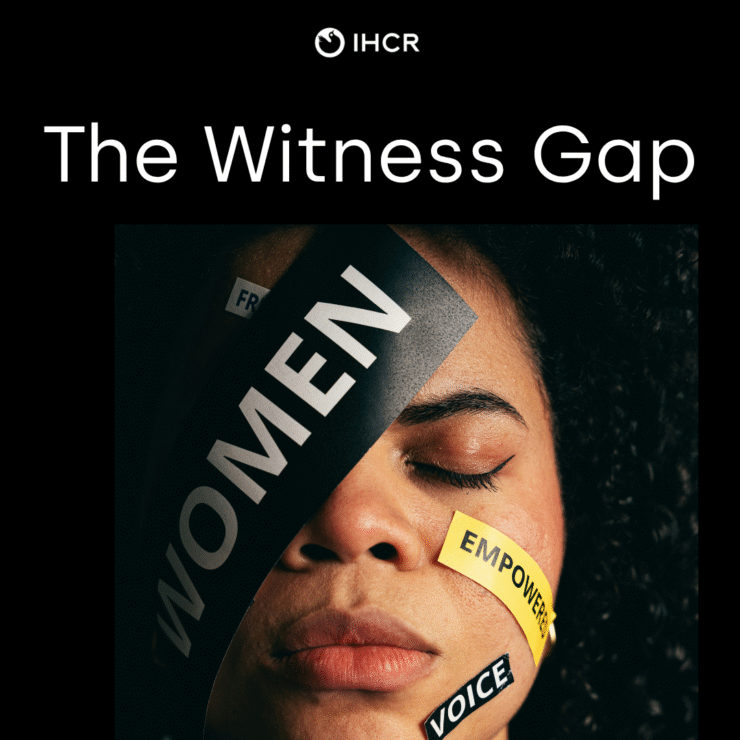
The Witness Gap: Why the Age of Storytelling Has Not Become the Age of Justice for Women

I. INTRODUCTION AND BACKGROUND
We are told we live in the golden age of storytelling. Never before have more stories reached more people with greater immediacy. A woman describing her displacement from a conflict zone can reach millions in real time. A survivor of gender-based violence can publish her testimony without an editorial intermediary. Documentary filmmakers distribute their work globally within days of production. By every measure of reach and volume, we have never had more access to women’s stories.
And yet the numbers tell a different story entirely. Women and girls account for the vast majority of those forcibly displaced by armed conflict — UNHCR data consistently shows that women and children make up approximately 80 percent of the global refugee and displaced population.1 The World Health Organization estimates that one in three women worldwide has experienced physical or sexual violence, with rates substantially higher in conflict-affected settings.2 Gender-based violence remains among the most underreported human rights violations globally. The stories are present. The accountability is not.
This is what I call the Witness Gap: the measurable distance between knowing and acting, between emotional response and systemic change. Dr. Alon Ben-Meir, in founding this journal, named it precisely — why do the experiences of women in conflict and crisis “struggle to receive sustained public attention”? The implicit assumption is that the problem is volume: if only more stories were told, more often, to more people, something would shift.
After a decade building Hear Her Stories — an organization dedicated to advancing women’s rights and visibility through storytelling, working alongside UNICEF USA, UN Women, and partners across five continents — I am no longer sure that is true. I think we have been solving the wrong problem. The barrier to justice for women is not a shortage of stories. It is the architecture through which stories are told, received, and — critically — forgotten.
This article argues that the humanitarian storytelling ecosystem, as currently designed, is optimized for emotional consumption rather than institutional accountability. It identifies three structural failures that explain the Witness Gap, draws on lessons from Hear Her Stories to propose an alternative model, examines how international institutions have both advanced and constrained the storytelling agenda, and offers concrete recommendations for practitioners, funders, and policymakers.
II. ANALYSIS: THE CATHARSIS ECONOMY AND ITS STRUCTURAL FAILURES
When a story makes us weep, we feel we have done something. This is not a moral failure — it is how narrative has functioned since human beings first gathered around fires. Stories provoke feeling; feeling motivates action. The causal chain is ancient and real.
But modern humanitarian storytelling has broken that chain between feeling and action. It has created what I call a catharsis economy: a system in which emotional response is the product, not the precursor. Audiences consume stories of suffering, feel genuinely moved, and experience something that functions like moral resolution. The story has completed its work on the audience. Whether it has done any work for the woman whose story was told is, structurally, beside the point.
This is not a criticism of audiences. It is a criticism of architecture. The platforms through which most humanitarian stories now travel — social media feeds, streaming services, viral video — are optimized not for accountability but for engagement. Psychologist Paul Slovic coined the term “psychic numbing” to describe the paradox at the heart of this system: our emotional response to suffering does not scale linearly with the number of people affected.3 Statistical lives move us less than individual ones, and the same individual story, told repeatedly, moves us less with each telling. The algorithm that surfaces a devastating portrait of women displaced by conflict in Sudan will, within seventy-two hours, replace it with the next devastating portrait from the next crisis.
The result is a landscape of humanitarian storytelling that has more in common with entertainment than advocacy. We produce beautiful, heartbreaking, award-winning work that confirms our compassion — and then lets us rest.
Structural Failure One: Stories Designed for Emotional Resolution, Not Obligation. The canonical humanitarian story follows a recognizable arc. We meet a woman in crisis. We are taken through her suffering. We end with either a note of hope — she survived, she is rebuilding — or a call to donate. What this structure rarely does is implicate the audience in what happened or in what happens next. The woman’s story is complete. Our relationship to it is that of witness, not participant. As Susan Sontag observed in Regarding the Pain of Others, the act of watching suffering at a distance carries within it a built-in exemption: “So far as we feel sympathy, we feel we are not accomplices to what caused the suffering.”4 Sympathy, in other words, is a form of moral alibi.
The most powerful social movements in history have not operated this way. They have told stories that made audiences complicit — that made the injustice feel close, personal, and demanding of response. The gap in humanitarian storytelling is not more suffering. It is more obligation.
Structural Failure Two: Trauma Extraction Disguised as Voice. Much of what passes for women’s storytelling in conflict and humanitarian contexts is, on close examination, trauma extraction. We approach women in crisis, document their worst moments, and place those moments before audiences who find them moving. The woman becomes the object of the story. Her interiority — her analysis, her demands, her specific vision for what justice requires — is rarely what the audience retains, because it is rarely what the story centers. Chimamanda Ngozi Adichie’s landmark warning about “the danger of a single story” applies with particular force here: when we tell only the story of a woman’s suffering, we participate in reducing her humanity to her wound.5
Trauma narratives are powerful at generating sympathy. They are poor at generating the specific attention that leads to policy change. Sympathy is generalized; advocacy is specific. When we listen only for suffering, we miss the politics — the particular demands women in conflict zones are making, the specific policy failures they can name, the concrete changes they need. We receive the wound but not the diagnosis. The result is that even well-intentioned storytelling can leave a woman more visible but no less powerless.
Structural Failure Three: Visibility as a Substitute for Accountability. Somewhere in the last two decades, the humanitarian sector adopted the implicit belief that making something visible was itself a form of justice. If enough people saw it, something would change. This belief is not entirely wrong — visibility is necessary. But it is not sufficient, and treating it as sufficient has allowed institutions to celebrate media coverage as an outcome rather than a means.
The Global Media Monitoring Project, which has tracked gender representation in news media since 1995, has documented persistent and significant gaps in coverage of women — including in conflict and humanitarian reporting, where women’s voices and perspectives are consistently underrepresented relative to men’s.6 And yet even when coverage is substantial, it does not automatically produce institutional response. A story about a woman’s suffering that reaches ten million people and triggers no institutional accountability has not advanced her cause. It has advanced the story’s reach. These are not the same thing.
III. HUMAN IMPACT: WHAT THE GAP LOOKS LIKE IN PRACTICE
The Witness Gap is not an abstraction. It has a texture, and women living through it can describe it precisely.
In the Democratic Republic of Congo, where sexual violence has been systematically used as a weapon of war for more than two decades, the international media has produced thousands of stories, countless documentaries, and numerous award-winning investigations.7 The International Criminal Court has issued indictments; NGOs have published reports; advocacy campaigns have trended globally. And yet the International Committee of the Red Cross has documented that access to justice for survivors of conflict-related sexual violence in the DRC remains profoundly limited, with impunity rates for perpetrators estimated at above 90 percent.8 The stories were told. The accountability did not follow.
This pattern — abundant storytelling, insufficient accountability — appears across conflict contexts. In Afghanistan, the catastrophic reversal of women’s rights following the Taliban’s return to power in 2021 occurred in full view of a global media that had spent twenty years documenting Afghan women’s lives, aspirations, and resilience. In Sudan, reporting on the systematic targeting of women by armed factions has accompanied years of international diplomatic paralysis. Visibility, in each case, was not the obstacle. Accountability infrastructure was.
At Hear Her Stories, I have witnessed this gap from a practitioner’s position — and nowhere more acutely than in our work with Afghan women. Beginning in 2021, following the Taliban’s return to power, we began amplifying the voices of women living inside Afghanistan: women losing their right to education, to work, to appear in public, to exist in civic life at all. The stories circulated widely. They generated international response — media pickup, expressions of solidarity, audience messages from across the world. And yet the women inside Afghanistan who had shared their voices with us remained inside the same structures of constraint. Their visibility had increased. Their conditions had not.
That recognition forced a question we could no longer avoid: what would actually change something? The answer, when it came, was structural. We launched the Afghan Women’s Initiative — a mentorship program connecting women living inside Afghanistan to Afghan diaspora mentors globally, offering not just emotional solidarity but professional guidance, networks, and navigational knowledge that visibility alone could never supply. We began with twelve mentors. By October 2026, we are scaling to thirty, with plans to deepen the program further. The stories we told did not produce this directly. But the relationships built through telling those stories — the trust, the understanding of what women inside Afghanistan actually needed, the network of diaspora women who wanted to do more than bear witness — made it possible. The story was not the intervention. It was the foundation for one.
IV. BROADER CONSEQUENCES: WHAT THE WITNESS GAP COSTS
The consequences of the Witness Gap extend well beyond individual women whose stories go unacted upon. They reshape the landscape of humanitarian advocacy in ways that deserve direct attention.
First, repeated exposure to stories of suffering without observable change produces what researcher Susan Moeller termed “compassion fatigue” — a documented psychological phenomenon in which audiences, overwhelmed by relentless accounts of crisis, progressively disengage.9 The catharsis economy, by design, generates this fatigue. When audiences learn — even implicitly — that feeling moved does not produce change, they begin to protect themselves from feeling moved at all. This is not moral failure. It is rational adaptation. But its effect on the long-term sustainability of humanitarian advocacy is corrosive.
Second, the structural marginalization of women’s voices in humanitarian storytelling reinforces, rather than challenges, the political conditions that produce their marginalization in the first place. Research consistently demonstrates that when decision-makers — in governments, international organizations, and civil society — do not hear women’s political analysis, their specific demands, and their concrete prescriptions for policy change, those demands are less likely to shape outcomes.10 Stories that reduce women to their suffering make it easier, not harder, to design humanitarian responses that treat them as beneficiaries rather than agents.
Third, the mismatch between storytelling investment and accountability infrastructure represents a significant misallocation of humanitarian resources. Organizations and funders spend enormous sums producing and distributing stories of women’s experiences. Far less is invested in the connective tissue — the institutional partnerships, the advocacy pipelines, the sustained follow-up — that would allow those stories to produce consequences. The result is a field that is media-rich and accountability-poor.
V. INTERNATIONAL AND INSTITUTIONAL RESPONSE
The international community has not been indifferent to women’s experiences in conflict and crisis. A substantial body of legal and institutional architecture exists specifically to address gender-based violence, women’s political exclusion, and gender inequality in humanitarian response.
United Nations Security Council Resolution 1325, adopted in 2000, was a landmark achievement — the first resolution explicitly recognizing the disproportionate impact of armed conflict on women and calling for their meaningful participation in peace processes.11 The subsequent Women, Peace and Security agenda, expanded through a series of resolutions, has created normative obligations for member states and provided civil society organizations with legal and political frameworks to advance accountability claims.
The Convention on the Elimination of All Forms of Discrimination against Women (CEDAW), ratified by 189 states, provides a binding legal framework for gender equality and obligates states to address gender-based violence including in conflict settings.12 UN Women, established in 2010, exists specifically to advance this agenda institutionally.
And yet there is a significant gap between these frameworks’ normative power and their operational impact. Implementation of Resolution 1325 commitments has been widely acknowledged as uneven at best. Women’s participation in peace negotiations — one of the resolution’s central demands — remains the exception rather than the norm. A 2019 UN Women analysis found that women comprised an average of 13 percent of negotiators and 6 percent of mediators in major peace processes between 1992 and 2019.13 Gender-based violence in conflict settings persists at scale across every region where armed conflict occurs.
The storytelling ecosystem has a specific and underexamined relationship to this institutional failure. International frameworks create obligations, but obligations require political will to enforce — and political will is shaped, in significant part, by what the public and decision-makers know and care about. Humanitarian storytelling is theoretically the mechanism that closes that loop: stories build public awareness, public awareness generates political pressure, political pressure drives institutional action. The Witness Gap is precisely the failure of that theory in practice. Stories that produce emotional response without institutional connection do not reliably generate political pressure. They generate sentiment, which is something different.
Where the theory has worked — where storytelling has contributed to traceable institutional change — it has consistently done so through organizational infrastructure that connected the story to specific decision-makers and created conditions in which inaction had consequences. The campaign to address rape as a weapon of war in international humanitarian law succeeded not because the stories of survivors were more compelling than other stories, but because advocates built sustained relationships with international legal bodies and used testimony strategically within those institutional processes. The story and the institution were coupled. That coupling is what made the difference.
VI. RECOMMENDATIONS: TOWARD ACCOUNTABLE STORYTELLING
Addressing the Witness Gap requires changes at the level of practice, organizational design, funding, and institutional architecture. The following recommendations draw on both the research literature and the lessons of a decade of work at Hear Her Stories.
1. Shift from broadcast storytelling to relational storytelling. Stories produced primarily for maximum reach and emotional impact — broadcast storytelling — are poorly suited to generating accountability. Organizations should invest in relational storytelling: stories produced within specific, structured relationships between storytellers and the institutions that have obligations toward them. This means identifying, before a story is told, what specific change it is meant to produce, and in what institutional context it needs to land. The story is not finished when it is published. It is finished when something changes.
2. Center the storyteller’s analysis, not only her experience. Women affected by conflict and human rights abuses are not only witnesses to their own suffering — they are analysts of their own situations, with specific demands and concrete prescriptions. Storytelling practices should create structures that allow these political analyses to be heard as prominently as personal testimony. This means investing in long-form, collaborative storytelling processes that give women the time and editorial power to articulate their demands, not only their pain.
3. Measure success by change, not reach. The metrics currently dominant in humanitarian media — views, shares, impressions — are measures of consumption. They say nothing about outcomes. Funders and organizations should develop and adopt accountability metrics that track institutional responses a story generated, policy changes it contributed to, and specific material improvements in the lives of the women depicted. These are harder to measure. They are the right things to measure. Without them, the field will continue to optimize for what it can count rather than what it is trying to achieve.
4. Invest in the connective tissue between stories and institutions. The gap between a story’s publication and an institution’s response is not filled by better stories. It is filled by sustained relationships between advocacy organizations and the decision-makers who have the power and obligation to respond. This requires organizational capacity — staff whose role is to build and maintain those relationships, to follow up when stories generate response, and to hold institutions accountable when they do not. This work is unglamorous. It is what actually moves outcomes.
5. Fund longitudinal storytelling projects. The novelty imperative that governs most media funding — the pressure to find the next story rather than deepen the current one — systematically undermines sustained attention. Funders should deliberately create incentives for storytelling projects that return to the same communities and individuals over years, building the kind of ongoing narrative that makes it harder for audiences and institutions to look away. Accountability requires repetition. Justice is not a one-time event.
6. Build women’s storytelling capacity, not only their visibility. Sustainable change requires that women affected by conflict and crisis can tell their own stories — not as objects of others’ documentation, but as producers of their own narrative. Investment in training, platforms, and institutional access for women journalists, advocates, and storytellers in conflict-affected communities creates a fundamentally different kind of story: one in which the woman is not dependent on external intermediaries to make her voice heard. At Hear Her Stories, our most durable partnerships have been those in which women became the storytellers, not only the stories.
A current example of this model in practice is Project Silent Campus, a joint initiative between Hear Her Stories and Amnesty International UK launching in August 2026. The campaign documents the experiences of racialized women and Muslim female students in UK universities who face administrative intimidation and disciplinary action for exercising their right to dissent on human rights issues. Critically, the project is not designed as broadcast journalism — it is structured from the outset around Amnesty’s institutional accountability machinery, with storytelling formats calibrated to specific advocacy outcomes: the adoption of a Defend Dissent Charter by student unions nationwide, a published policy briefing, and direct engagement with university governance structures. The story and the institution are coupled from the beginning. That coupling is what distinguishes advocacy from content.
VII. CONCLUSION
Dr. Ben-Meir, in the letter that opens this journal’s inaugural issue, wrote that “silence is the oxygen of impunity.” It is a formulation of striking clarity, and I believe it is right. What I want to add, from the standpoint of someone who has spent a decade trying to break that silence, is this: noise without direction is still just noise.
The Witness Gap is not a storytelling failure. It is an architecture failure. We have built a powerful, sophisticated, emotionally resonant machine for producing stories about women’s suffering. We have not built, with anywhere near equivalent investment, the institutional infrastructure through which those stories produce accountability. The result is a field that generates enormous feeling and insufficient change — one that serves the audience’s need to witness more reliably than it serves the woman’s need for justice.
What is at stake is not abstract. The women whose stories circulate in our media landscape — displaced, surviving violence, fighting for legal recognition, demanding political inclusion — are making specific claims on the world. They are not asking to be seen in the general sense. They are asking for concrete responses from specific institutions that have identifiable obligations toward them. The question for humanitarian storytelling is whether we are building the connections that allow those claims to land — or whether we are building more beautiful, heartbreaking, award-winning content that confirms our compassion and then lets us rest.
The answer requires honesty about what we have been optimizing for, and courage to optimize for something harder. Empathy is available in abundance. What remains scarce is accountability — the institutional response, the policy change, the sustained follow-through that turns a story from an emotional event into a political one.
We have been building audiences. We need to be building architecture. The voices in these pages, and the millions of voices they represent, are not waiting for more witnesses. They are waiting for what comes after witness: the structural response that makes silence, when it finally falls, the silence of a wrong addressed rather than a woman ignored.
References
1. United Nations High Commissioner for Refugees (UNHCR). Global Trends: Forced Displacement in 2023. Geneva: UNHCR, 2024.↩
2. World Health Organization. Violence Against Women Prevalence Estimates, 2018. Geneva: WHO, 2021.↩
3. Slovic, Paul. “If I look at the mass I will never act: Psychic numbing and genocide.” Judgment and Decision Making 2, no. 2 (2007): 79–95.↩
4. Sontag, Susan. Regarding the Pain of Others. New York: Farrar, Straus and Giroux, 2003.↩
5. Adichie, Chimamanda Ngozi. “The Danger of a Single Story.” TED Global, 2009. ted.com.↩
6. Global Media Monitoring Project. Who Makes the News? 6th Global Report. WACC, 2020.↩
7. Human Rights Watch. “Seeking Justice: The Prosecution of Sexual Violence in the Congo War.” HRW Report, 2005.↩
8. ICRC. Addressing the Needs of Women Affected by Armed Conflict. Geneva: ICRC, 2004.↩
9. Moeller, Susan D. Compassion Fatigue: How the Media Sell Disease, Famine, War and Death. New York: Routledge, 1999.↩
10. Batson, C. Daniel, et al. “Empathy and Attitudes: Can Feeling for a Member of a Stigmatized Group Improve Feelings toward the Group?” Journal of Personality and Social Psychology 72, no. 1 (1997): 105–118.↩
11. United Nations Security Council. Resolution 1325 on Women, Peace and Security. S/RES/1325, October 31, 2000.↩
12. UN General Assembly. Convention on the Elimination of All Forms of Discrimination against Women (CEDAW). Resolution 34/180, December 18, 1979.↩
13. UN Women. “Facts and Figures: Women, Peace and Security.” UN Women, 2023. unwomen.org.↩