
“I Am Because We Are”: Practical Justice and Survivor Participation in the Rehabilitation of Conflict-Related Sexual Violence Survivors in Eastern Democratic Republic of the Congo

Authors: Dr. Wioletta Rebecka, Alain Bayongwa, Aline, Anita Bizimana Espérance, Aziza Aimerance, Bulonza, Bahati Balingene, Charline Kihuo, Diane Kahindo Feza, Esther Faida Feza Josephine, Furaha Joyeuse, MunYerekana Kahiro Collette, Nabintu Angela Nabintu Mulume Josline, Naomi Sharon, Noella Sekola Esther, Nshobole Muderhwa Pascaline, Plamedi Mapendo Marie, Sanganire Anne Marie, Sarah Chance / Bénédicte, Sintia Chance Solange, Sonia Scovia
Abstract
Survivor participation has increasingly been recognized as a core principle of ethical rehabilitation for survivors of torture and conflict-related sexual violence. Article 3 of the Global Charter of Survivors of Torture calls for survivors to participate meaningfully in the design, implementation, and evaluation of services that affect their lives. Despite this commitment, rehabilitation models continue to emphasize individual recovery, while offering limited theoretical guidance on how survivors become active contributors to rebuilding their communities in specific socio-cultural context.
This article introduces Practical Justice, a survivor-centered framework developed through participatory collaboration with World Hope Givers (WHG) in Goma, Eastern Democratic Republic of the Congo. Drawing upon documented life histories of conflict-related sexual violence survivors and war-displaced young women, together with participatory interpretation involving survivors, local practitioners, and researchers, the study examines rehabilitation as a relational and community-based process. The methodological approach is informed by non-extractive qualitative research principles in which survivors participated not only as narrators of lived experience but also as co-authors and contributors to the interpretation of findings.
The findings demonstrate that armed conflict and sexual violence disrupt social belonging alongside physical and psychological integrity. Rehabilitation within the WHG model unfolds through interconnected stages that include community recognition, collective storytelling, shared witnessing, vocational learning, economic participation, and opportunities to contribute to others. Tailoring and sewing function as mechanisms for rebuilding daily structure, competence, economic independence, and social identity, while reciprocal contribution restores dignity through meaningful participation in community life.
Grounded in Bantu understandings of personhood expressed through the principle “I am because we are,” Practical Justice conceptualizes rehabilitation as a process of restoring reciprocal social relationships, agency, and collective responsibility independent of formal judicial outcomes. The framework expands current interpretations of survivor participation by demonstrating that sustainable rehabilitation emerges when survivors regain opportunities to shape their communities as contributors, mentors, workers, and co-creators of social recovery. This culturally grounded model offers a transferable framework for rehabilitation programs seeking to integrate survivor leadership, community participation, and locally rooted understandings of justice into post-conflict recovery.
Keywords: conflict-related sexual violence; Democratic Republic of the Congo; survivor participation; rehabilitation; Practical Justice; Ubuntu; Bantu philosophy; community restoration; participatory research; Article 3; Torture Journal
Introduction
Conflict-related sexual violence (CRSV) remains one of the most devastating consequences of protracted armed conflict in the eastern provinces of the Democratic Republic of the Congo (DRC). Beyond immediate physical injuries, sexual violence disrupts family structures, destroys livelihoods, fragments communities, and forces thousands of women and girls into prolonged displacement, poverty, and social exclusion. Many survivors experience rejection by partners and relatives, loss of economic security, interrupted education, forced motherhood, and continuing exposure to insecurity long after the original act of violence has ended (Kelly et al., 2011; Mukwege 2021; World Health Organization [WHO], 2020).
For many decades, humanitarian organizations have expanded access to medical treatment, psychosocial support, legal assistance, and economic recovery programs for survivors of CRSV throughout eastern DRC. These interventions have substantially improved access to emergency care and protection. Nevertheless, rehabilitation continues to be evaluated primarily through individual outcomes, including symptom reduction, service utilization, legal redress, or economic assistance. Such indicators are essential, yet they do not fully explain how survivors recover their social position within communities that have themselves been profoundly disrupted by war, displacement, and collective insecurity (WHO, 2020; United Nations, 2014).
Recent international developments have increasingly emphasized that survivors should occupy a central position in rehabilitation and justice processes. The Charter of Rights of Victims and Survivors of Torture and Other Cruel, Inhuman or Degrading Treatment or Punishment (International Rehabilitation Council for Torture Victims [IRCT], 2026), particularly Article 3 on survivor participation, argues that survivors should actively influence the development, implementation, and evaluation of rehabilitation services. This principle represents an important shift from viewing survivors solely as recipients of professional interventions toward recognizing them as partners whose lived experience constitutes indispensable knowledge for rehabilitation systems. Yet practical models demonstrating how meaningful participation can be translated into everyday rehabilitation remain limited, particularly within conflict-affected African communities.
This article argues that survivor participation extends beyond consultation, representation, or advisory roles. Participation becomes transformative when survivors regain opportunities to contribute to the reconstruction of social life itself. In eastern DRC, rehabilitation unfolds within communities whose cultural traditions have long understood personhood as fundamentally relational. Across many Bantu societies, human identity is constituted through reciprocal relationships, mutual responsibility, and collective belonging. The philosophy commonly expressed through the Ubuntu principle—”I am because we are“—describes personhood as emerging through participation in community rather than existing independently of it (Ramose, 1999; Letseka, 2012; Marovah & Mutanga, 2024). Contemporary African scholars further argue that Ubuntu provides an important epistemological foundation for participatory research, social justice, and locally grounded knowledge production because it recognizes communities as active producers of knowledge instead of passive objects of investigation.
Although Ubuntu has frequently been discussed within restorative justice, transitional justice, and reconciliation scholarship, considerably less attention has been devoted to its relevance for the rehabilitation of survivors of conflict-related sexual violence in contemporary humanitarian settings. Existing rehabilitation frameworks often separate psychological recovery, economic empowerment, and community reintegration into distinct intervention domains. The experiences documented through World Hope Givers (WHG) suggest that these dimensions are inseparable. Survivors consistently describe recognition by others, opportunities to tell their stories, vocational learning, economic participation, and the ability to support others as interconnected processes that gradually restore dignity, belonging, and social identity. The documented life histories collected by WHG illustrate recurring trajectories of displacement, rejection, community recognition, vocational engagement, and renewed participation in collective life.
Building upon these experiences, this article introduces the concept of Practical Justice. Practical Justice refers to the everyday social practices through which dignity, belonging, agency, and reciprocal contribution are restored following conflict-related sexual violence, independent of formal judicial outcomes. The concept does not replace criminal accountability or transitional justice mechanisms. Instead, it addresses a complementary dimension of justice that emerges through relationships, shared recognition, meaningful work, and opportunities to contribute to community recovery.
Drawing upon participatory collaboration between World Hope Givers, survivors of conflict-related sexual violence and forced displacement, and local practitioners in Goma, this article demonstrates how survivor participation can be operationalized through culturally grounded rehabilitation practices. In doing so, it proposes Practical Justice as a theoretical framework that connects Article 3 of the Global Charter of Survivors of Torture with Bantu understandings of personhood, offering a model of rehabilitation in which survivors become co-creators of individual and collective recovery rather than beneficiaries of humanitarian assistance alone.
2. Article 3 of the Global Charter of Survivors of Torture: Survivor Participation as Co-Creation of Rehabilitation
The Global Charter of Survivors of Torture identifies meaningful survivor participation as one of the fundamental principles of rehabilitation. Article 3 recognizes that survivors should actively participate in the design, implementation, monitoring, and evaluation of services affecting their lives, acknowledging their lived experience as an essential source of knowledge rather than solely an object of professional intervention (Global Charter of Survivors of Torture, 2026).
This principle represents an important shift in international rehabilitation practice. Historically, survivors of torture and conflict-related sexual violence have frequently been positioned as recipients of humanitarian assistance, clinical interventions, or legal protection. Although these services remain indispensable, survivor participation requires a deeper transformation of professional relationships. Participation is not fulfilled through consultation alone. It requires that survivors possess genuine influence over rehabilitation processes, contribute to knowledge production, and participate in decisions concerning their own recovery and the development of services intended for future survivors (International Rehabilitation Council for Torture Victims [IRCT], 2026; United Nations, 2014).
Within African contexts, this understanding resonates strongly with relational concepts of personhood embedded in Bantu philosophical traditions. Knowledge is understood as emerging through relationships, reciprocity, and collective responsibility rather than through the actions of isolated individuals (Ramose, 1999; Letseka, 2012; Marovah & Mutanga, 2024). Rehabilitation therefore becomes a shared social process in which survivors, practitioners, families, and communities jointly participate in rebuilding the social conditions that violence has disrupted.
The rehabilitation model developed by World Hope Givers (WHG) with Dr Wioletta Rebecka, clinical advisor, operationalizes this principle through everyday practice. Women entering the program are not approached as passive beneficiaries awaiting assistance. From the beginning of their engagement, they participate in activities that strengthen their capacity to shape their own recovery while contributing to the rehabilitation environment of others. Storytelling, collective discussions, vocational learning, peer support, and community engagement are organized as participatory processes through which survivors gradually assume increasingly active roles within the program. The documented life histories demonstrate that rehabilitation extends beyond receiving psychosocial support to include rebuilding social relationships, acquiring vocational competence, supporting peers, and preparing for independent participation in community life.
This article extends Article 3 by proposing that meaningful participation can be understood across four interconnected dimensions. First, survivors participate as knowledge holders, contributing experiential knowledge that shapes rehabilitation practices. Second, they participate as learners, acquiring vocational, social, and practical competencies that strengthen long-term independence. Third, they become future contributors, using newly acquired skills and lived experience to support families, peers, and communities affected by conflict. Finally, within the participatory methodology adopted in this study, survivors also become co-authors and co-producers of knowledge, participating in the interpretation of findings, reviewing thematic analyses, and determining how their experiences are represented within the research process.
This approach reflects broader developments within African participatory research methodologies, which increasingly challenge extractive models of knowledge production by recognizing communities as intellectual partners whose experiences generate theoretical insight (Chilisa, 2020; Marovah & Mutanga, 2024). Survivor participation therefore extends beyond improving research ethics. It transforms the relationship between researchers, practitioners, and survivors by redistributing epistemic authority and recognizing survivors as contributors to both scientific knowledge and rehabilitation practice.
Within the WHG model, participation also serves as the foundation for rebuilding social identity. As women move from displacement and social exclusion toward vocational competence, economic participation, and reciprocal contribution, they recover positions of social usefulness that conflict and sexual violence had disrupted. Rehabilitation consequently becomes a collective process of restoring belonging alongside individual recovery. This understanding forms the conceptual basis of the Practical Justice framework developed in the following sections, where justice is understood not only through legal accountability but also through everyday practices that restore dignity, reciprocal responsibility, and community membership.
3. Theoretical Background: From Relational Personhood to Practical Justice
The rehabilitation of survivors of conflict-related sexual violence has traditionally been examined through the complementary frameworks of transitional justice, trauma recovery, and psychosocial rehabilitation. Transitional justice scholarship has significantly expanded understanding of criminal accountability, truth commissions, reparations, institutional reform, and victims’ rights following mass atrocities (Teitel, 2000; de Greiff, 2006). Similarly, trauma scholarship has demonstrated that recovery requires safety, recognition, reconnection, and the restoration of interpersonal relationships following experiences of overwhelming violence (Herman, 1992). These contributions have fundamentally shaped international responses to torture and conflict-related sexual violence.
Despite these important developments, the relationship between justice and rehabilitation remains only partially theorized. Criminal justice frameworks primarily focus on accountability for perpetrators, while rehabilitation frameworks frequently emphasize psychological treatment, medical care, social services, or economic assistance for survivors. These approaches remain indispensable. However, they offer less theoretical attention to a central question confronting communities affected by prolonged armed conflict: how is justice experienced in everyday life when formal legal accountability remains delayed, inaccessible, or impossible?
This question has particular relevance in eastern Democratic Republic of the Congo (DRC), where decades of armed conflict, repeated displacement, institutional fragility, and continuing insecurity have limited survivors’ access to formal judicial mechanisms. Although international criminal law recognizes conflict-related sexual violence as a war crime, a crime against humanity, and under certain circumstances an act of genocide, judicial proceedings frequently occur years after the violence, reach relatively few perpetrators, or never take place (Mukwege ,2021; Baaz & Stern, 2013). Consequently, legal accountability alone cannot explain how survivors rebuild dignity, social identity, and community belonging while continuing to live within the aftermath of violence.
Scholars examining collective trauma have similarly emphasized that violence extends beyond individual psychological injury. Erikson (1976) described collective trauma as damage to the social fabric that binds communities together. Das (2007) further demonstrated that the aftermath of mass violence unfolds through ordinary everyday life, where individuals gradually reconstruct meaning within disrupted social worlds. Kleinman, Das, and Lock (1997) conceptualized such experiences as social suffering, highlighting the inseparable relationship between political violence, structural inequality, and everyday human experience. These perspectives suggest that recovery cannot be understood exclusively through individual psychological adaptation because violence simultaneously disrupts social relationships, communal identities, and collective systems of meaning.
African philosophical traditions have long approached these questions from a different epistemological foundation. Across Bantu societies extending through Central, Eastern, and Southern Africa, personhood is understood as fundamentally relational. Human beings become persons through reciprocal relationships with family, community, ancestors, and future generations rather than through autonomous individuality (Mbiti, 1969; Kagame, 1956; Bujo, 2001). The well-known Ubuntu expression, “I am because we are,” reflects one articulation of this broader Bantu ontology of relational existence (Ramose, 1999; Metz, 2011).
Within this philosophical tradition, justice is not confined to formal legal institutions. Community well-being depends upon reciprocal responsibility, restoration of disrupted relationships, collective participation, and the maintenance of social harmony (Bujo, 2001; Shutte, 2001; Eze, 2010). Harm therefore affects not only individuals but the moral fabric of the community itself. Restoring justice requires repairing relationships, rebuilding belonging, and re-establishing mutual obligations alongside any formal legal response. Justice consequently functions as both an institutional responsibility and a communal practice embedded within everyday social life.
This relational understanding differs substantially from dominant Western legal traditions. Modern Western justice systems largely delegate responsibility for justice to specialized institutions, including judges, prosecutors, police authorities, and courts. Survivors primarily participate as witnesses within procedures designed to establish criminal responsibility and determine legal sanctions. By contrast, Bantu traditions recognize community members themselves as active participants in restoring social equilibrium following collective harm. Responsibility extends beyond punishment toward rebuilding the conditions necessary for communal life.
These distinctions become particularly significant within contexts of prolonged armed conflict, where institutional justice frequently remains inaccessible. Communities nevertheless continue living together. Families continue raising children. Survivors continue negotiating everyday relationships. Questions concerning dignity, belonging, trust, economic participation, and social identity therefore require responses that extend beyond formal legal systems.
These observations closely correspond with the concept of Dislocation of Meaning, introduced by Rebecka (2026). Dislocation of Meaning describes the process through which the political, historical, and communal meaning of organized violence becomes detached from survivors’ lived experience and translated into individualized psychological, medical, or administrative categories. Violence directed against families, communities, and collective identities is gradually reinterpreted as individual pathology, while responsibility for recovery becomes concentrated within the survivor instead of the broader social and political structures that produced the violence (Rebecka, 2026).
The present study argues that dislocation of meaning also occurs when justice itself becomes understood almost exclusively as an institutional process. Although legal accountability remains essential, an exclusive emphasis on courts, prosecutions, and judicial outcomes risks separating justice from the everyday social relationships through which survivors reconstruct their lives. In conflict settings where judicial processes are delayed or absent, this separation leaves important dimensions of rehabilitation insufficiently conceptualized.
Longitudinal participatory collaboration with World Hope Givers (WHG) in Goma provided an opportunity to observe rehabilitation from a different perspective. Across the documented life histories, survivors consistently described recovery through interconnected experiences of community recognition, collective storytelling, shared witnessing, vocational learning, economic participation, and reciprocal contribution. Rehabilitation was experienced not simply through receiving services but through gradually recovering meaningful social roles within community life. Women entered the program as survivors of violence and displacement, yet progressively became learners, workers, mentors, contributors, and, within the present study, co-authors and co-producers of knowledge. These recurring trajectories are reflected throughout the documented narratives collected through WHG.
These empirical observations provided the foundation for the development of Practical Justice, introduced in this article as an original theoretical framework emerging from participatory collaboration among World Hope Givers, survivor co-authors, local practitioners, and researchers working in Eastern Democratic Republic of the Congo.
Practical Justice does not replace criminal accountability or transitional justice. Legal prosecution remains indispensable for establishing responsibility, documenting international crimes, and combating impunity. Practical Justice addresses a complementary dimension of justice operating within everyday community life. Recognition restores visibility. Storytelling restores narrative authority. Shared witnessing restores collective memory. Vocational learning restores competence and agency. Economic participation restores independence. Reciprocal contribution restores social value. Together, these interconnected practices rebuild the relational conditions necessary for survivors to regain meaningful participation within their communities.
Within this framework, Practical Justice functions as the mechanism through which the dislocation of meaning begins to be repaired. If Dislocation of Meaning explains how organized violence separates survivors from the political, historical, and communal contexts that originally gave meaning to their suffering (Rebecka, 2026), Practical Justice explains how those disrupted relationships may gradually be reconstructed through culturally grounded practices of recognition, participation, reciprocal responsibility, and collective restoration.
Accordingly, this article proposes Practical Justice as a conceptual bridge between African relational philosophies of personhood, contemporary rehabilitation, and Article 3 of the Global Charter of Survivors of Torture. Survivor participation is therefore understood not only as consultation during rehabilitation but as active participation in rebuilding the social fabric disrupted by conflict-related sexual violence. Through this perspective, rehabilitation becomes simultaneously an individual, communal, ethical, and political process, grounded in the understanding that restoring justice also requires restoring the relationships through which human beings become persons.
4. Methods
Ubuntu-Informed Participatory Co-authorship Methodology
This study employed an Ubuntu-informed participatory co-authorship methodology, integrating oral history, non-extractive qualitative research, and collaborative knowledge production within the rehabilitation programmed implemented by World Hope Givers (WHG) in Goma, Eastern Democratic Republic of the Congo. The methodological framework was developed in partnership with WHG, local practitioners, and survivor co-authors to ensure that the research process reflected the same principles of dignity, reciprocity, participation, and community responsibility that underpin the rehabilitation program itself.
The methodology was informed by decolonial approaches to research that recognize communities as producers of knowledge rather than sources of data (Chilisa, 2020; Smith, 2021). It was further grounded in Bantu understandings of relational personhood, where knowledge emerges through dialogue, collective responsibility, and shared experience (Mbiti, 1969; Bujo, 2001; Ramose, 1999). These principles are consistent with Article 3 of the Global Charter of Survivors of Torture (2026), which recognizes survivors as active participants in the design, implementation, and evaluation of rehabilitation processes.
Rehabilitation Context
The research was embedded within the World Hope Givers Practical Justice Framework (Figure 1), which served simultaneously as the operational model of rehabilitation and the analytical framework for the present study. Women entering the program typically experienced severe social disruption resulting from armed conflict, including conflict-related sexual violence, forced displacement, family rejection, homelessness, economic deprivation, and prolonged insecurity.
Rehabilitation followed an integrated community pathway consisting of eleven interconnected stages: violence, displacement, recognition by World Hope Givers, community acceptance, storytelling, shared witnessing, vocational learning, economic independence, reciprocal contribution, community restoration, and Practical Justice (Figure 1). Each stage builds upon the previous one, gradually restoring dignity, agency, belonging, and opportunities for meaningful participation within community life. The recurring observation of these rehabilitation trajectories across participants formed the empirical foundation for the development of the concept of Practical Justice.
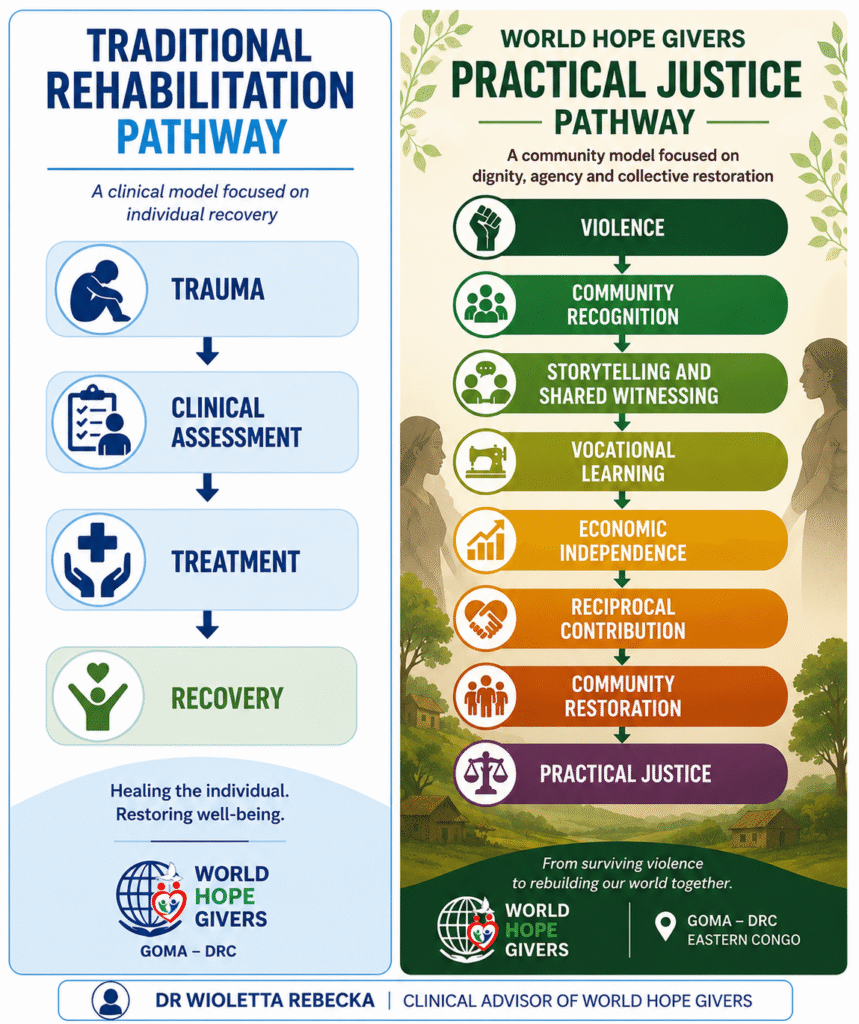
Figure 1
Participants
The study included 22 young women participating in the World Hope Givers rehabilitation program in Goma, North Kivu. Participants ranged in age from 17 to 27 years. All had experienced profound consequences of prolonged armed conflict, including forced displacement, conflict-related sexual violence, orphanhood, family separation, severe poverty, or prolonged street-connected living.
Participants originated from multiple conflict-affected territories across North and South Kivu, including Masisi, Rutshuru, Walikale, Kabare, Minova, Nyabyondo, and surrounding communities, before arriving in Goma through repeated displacement. Several participants were single mothers caring for children born during conflict or subsequent exploitation, while others had experienced abandonment, interrupted education, or prolonged economic dependence. All women were enrolled in the WHG vocational rehabilitation program at the time of the study.
Participants were identified through WHG community outreach activities and humanitarian case management. Inclusion reflected documented vulnerability associated with armed conflict and participation in the rehabilitation program rather than statistical representativeness.
Oral History and Collaborative Knowledge Production
Life histories were documented using an oral history approach that recognized survivors as custodians of historical and community knowledge. The interviews explored experiences before, during, and after displacement, including violence, survival strategies, family relationships, motherhood, community participation, vocational learning, and future aspirations.
Oral history was selected because it preserves the continuity between individual biography and collective history. Participants narrated their experiences within the broader social, political, and cultural realities of Eastern Democratic Republic of the Congo, allowing rehabilitation to be understood as a community process rather than solely an individual experience.
Knowledge production continued beyond the interview itself. Throughout analysis and manuscript preparation, survivor co-authors participated in reviewing thematic interpretations, discussing culturally appropriate language, clarifying contextual meanings, and confirming the representation of their experiences. Their contributions directly informed the analytical framework presented in this article.
Participatory Co-authorship
Participation did not conclude with the documentation of testimony. Women contributing to this study remained actively involved throughout the interpretation and dissemination phases of the project. Survivors reviewed preliminary themes, discussed emerging interpretations with the research team and WHG practitioners, suggested modifications to analytical language, and confirmed that the final manuscript accurately reflected their lived experiences and community realities.
In recognition of these intellectual contributions, participating women are included as co-authors of this article. Co-authorship acknowledges their role as contributors to conceptual development and interpretation, consistent with Article 3 of the Global Charter of Survivors of Torture, which emphasizes meaningful survivor participation throughout rehabilitation and knowledge production.
Data Analysis
Data were analyzed using participatory thematic analysis (Braun & Clarke, 2022). Initial coding identified recurring experiences across the oral histories, including violence, displacement, recognition, storytelling, shared witnessing, vocational learning, economic participation, reciprocal contribution, and community restoration.
Themes were subsequently refined through collaborative interpretation involving survivor co-authors, World Hope Givers practitioners, and the research team. This iterative analytical process ensured that conceptual categories reflected local understandings of rehabilitation and community life rather than externally imposed classifications.
The final analytical framework demonstrated that these experiences formed a coherent relational sequence corresponding to the operational stages of the WHG rehabilitation program. This empirical pattern subsequently informed the development of the concept of Practical Justice.
Ethical Framework
The study was conducted in accordance with principles of voluntary participation, informed consent, confidentiality, and trauma-informed practice. Participation in both research and publication was based upon informed consent to collaborate, including consent to review narratives, contribute to interpretation, and participate as co-authors where appropriate.
Ethical responsibility was understood as an ongoing relational commitment rather than a single procedural event. Decisions concerning participation, interpretation, authorship, and publication remained collaborative throughout the project.
The methodological framework also sought to avoid the dislocation of meaning described by Rebecka (2026), whereby survivors’ experiences become detached from their historical, political, and community contexts through extractive research practices. Instead, the research process itself reflected the principles of Practical Justice by recognizing survivors as collaborators, knowledge holders, and contributors to scientific theory. Through this approach, research became part of the rehabilitation process, supporting the restoration of dignity, agency, reciprocal responsibility, and community participation while generating knowledge grounded in local experience.
5. Findings
The findings are organized around four interconnected themes. The analysis does not present the women’s histories as separate biographies. It identifies recurring patterns across narratives and shows how the WHG model transforms experiences of violence, displacement, rejection, and survival into recognition, learning, contribution, and community restoration. Initials are used in the analytical text to protect dignity while preserving the specificity of each story.
Theme 1. Violence Destroys Relational Identity
Across the narratives, conflict-related sexual violence, displacement, poverty, and street survival appear as processes that break the social relationships through which personhood is sustained. The harm described by participants is not limited to bodily violation. Violence repeatedly destroys family protection, community recognition, economic security, and the possibility of being seen as a valued person. In this sense, violence attacks relational identity.
B.B.B., an 18-year-old displaced survivor from Kabare, entered Goma in conditions of extreme insecurity and poverty. Her narrative describes how displacement made her dependent on minimal financial support from a man in the neighborhood. This dependency became a context of exploitation, pregnancy, abandonment, and family pressure. After the abuse was disclosed, the alleged perpetrator disappeared, while her own family accepted an informal payment without securing assistance for her. The result was not only sexual violence but a collapse of protection by family and community. WHG later identified her as being in urgent need of support and enrolled her in tailoring and sewing training for socio-economic reintegration.
A.A., a 22-year-old displaced survivor from Rutshuru, also experienced violence through the combined forces of war, displacement, dependency, pregnancy, and abandonment. After fleeing clashes between M23 and FARDC supported by Wazalendo, she became vulnerable to manipulation by a married man. When pregnancy followed and the man refused responsibility, her parents rejected and threatened her, forcing her to leave the family home. Her story shows how conflict-related vulnerability continues after the original displacement. The body survives the conflict, but belonging is broken.
N.S.E., an 18-year-old street-connected young woman, experienced another form of relational collapse. Her family’s economic stability disappeared after bombardments in Goma forced the closure of her mother’s workplace. With basic survival threatened, she left home and moved to the streets, where she was exposed to begging, theft, sexual exploitation, and detention during the “Zero Children on the Streets” operation. Her pathway shows how war destroys the economic and social conditions that keep children and young women connected to family life. Street survival becomes a symptom of broken community protection.
S.C.S. and S.C.B., two sisters, also illustrate the collapse of family protection under extreme poverty. Their mother was absent, their parents’ alcoholism destabilized the household, and schooling was interrupted. They moved to the streets seeking survival, where they faced rape, begging, theft, hard labor, arrest, and detention before being referred to WHG-supported care. Their narratives demonstrate that street-connected life is not a personal failure. It is the social outcome of abandonment, poverty, insecurity, and the disappearance of protective adult networks.
P.M.M., an 18-year-old motherless young woman, fled mistreatment by her father’s second wife. Her search for safety led her to street life, where she encountered insecurity, hunger, forced labor, sexual exploitation, and theft as survival strategies. Her story shows that the “street” is not only a place. It is a condition produced when family relationships become violent and community systems fail to offer protection. WHG’s identification of her case became the first step toward re-entering a social environment organized around care, food assistance, medical support, psychosocial support, and vocational learning.
D.K.F., a 27-year-old survivor from Masisi, fled after an armed group member attempted to force her into marriage. Her narrative links displacement to the attempted seizure of bodily and marital autonomy. Since leaving her home area, she lived in economic insecurity without stable support. N.A., a 22-year-old survivor from Walikale, became pregnant following a relationship with a man who later joined Wazalendo and was killed during clashes with M23. She was left alone with a child, facing poverty, social rejection, and psychosocial distress. S.S., a 19-year-old from Masisi, was raped by two armed men while going to farm work near Kalake and the Nyiragongo area. She became pregnant and faced rejection by peers and family, with damaged self-esteem and loss of confidence in the future.
F.J., a 20-year-old displaced survivor from Masisi, was raped by armed bandits while traveling to buy sweet potatoes in Nyakagina, an area marked by armed groups including Mai-Mai, FDLR, and Nyatura. After the assault, she developed intense fear of returning to the area, restricted mobility, and family rejection. Her narrative shows the layered character of conflict-related sexual violence: armed insecurity, bodily violation, fear, loss of movement, family rejection, and isolation are part of one continuum of harm.
Across these narratives, violence destroys more than safety. It destroys the relational conditions through which a girl or woman remains a daughter, sister, mother, learner, neighbor, and community member. The repeated pattern is clear: rape leads to pregnancy and rejection; displacement leads to dependency and exploitation; poverty leads to street survival; family breakdown leads to homelessness; armed conflict leads to social invisibility. Violence breaks belonging.
Theme 2. Storytelling as Collective Restoration
The second theme concerns storytelling as a form of collective restoration. In the WHG model, storytelling does not function as individual psychotherapy in a Western clinical sense. It functions as community witnessing. The women’s histories are heard, organized, believed, and connected to a rehabilitation pathway. This process restores voice because it places the survivor back inside a listening community.
The WHG document itself is part of this witnessing practice. Each woman’s history is recorded not as a diagnostic file but as a social and humanitarian narrative. The text documents age, origin, displacement, family situation, violence, vulnerability, and the pathway into WHG support. This format gives the women’s experiences a public and relational meaning: the story explains why care is needed, what social conditions produced vulnerability, and how reintegration can begin.
For B.B.B., storytelling begins when she “found the courage to report the abuse.” This moment is crucial because it marks a movement from silence to speech. Yet the first response failed her: the alleged perpetrator fled, and her family accepted an informal payment without ensuring her protection. WHG’s later recognition gives the story a different social meaning. Her experience is no longer handled only as a private family matter or informal settlement. It becomes evidence of vulnerability requiring collective response, vocational support, and restoration of dignity.
A.A.’s story similarly demonstrates how telling and being recognized interrupt isolation. After pregnancy and abandonment, she was rejected by her parents and forced to leave home. Her referral to WHG transformed her situation from family expulsion into community-recognized vulnerability. The story became the basis for her inclusion in a socio-economic reintegration program. The significance is not simply that WHG provided services. WHG listened to the social meaning of her situation: displacement, manipulation, pregnancy, abandonment, rejection, and precarious refuge with a sister formed a coherent pattern of harm requiring restoration.
For N.S.E., S.C.S., S.C.B., P.M.M., and A.B.E., storytelling also counters the stigma attached to street life. Street-connected girls are often perceived through moralizing categories: delinquency, theft, sex slavery, disorder, or family disobedience. Their oral histories show a different reality. Their street survival emerged from bombardment, parental incapacity, orphanhood, abandonment, mistreatment, food insecurity, and the collapse of care. The act of documenting their stories therefore restores social meaning. It replaces blame with context. It shows that the street was not chosen freely; it became a survival space after the breakdown of protective relationships.
This is especially important in relation to girls who were arrested or detained during the “Zero Children on the Streets” operation. N.S.E. was detained for one month; S.C.S. and S.C.B. were detained for three weeks; A.B.E. was detained for two weeks. Their stories reveal that state removal from the streets did not address the social conditions that produced homelessness. WHG’s role became significant because referral to care allowed their stories to be heard within a rehabilitation framework instead of a punitive framework.
Storytelling also restores identity by placing suffering inside a collective structure. When F.J. described rape during displacement and subsequent family rejection, her experience could have remained an isolated story of shame. Within WHG, it became part of a shared pattern of survival among women exposed to armed groups, sexual violence, and displacement. When S.S. described rape by armed men while going to farm work and subsequent rejection by peers and family, her story also entered a shared space where the harm was recognized as part of the conflict environment and not as her personal failure.
This theme is central to Practical Justice. Recognition begins when the community agrees to hear what violence has done. Shared witnessing transforms stories of shame into stories of survival, responsibility, and restoration. In this model, being believed is not only emotional support. It is the first social repair. The survivor’s voice returns to the community, and the community becomes responsible for responding.
Theme 3. Learning Sewing as Restoration of Agency
The third theme concerns vocational learning, especially tailoring and sewing, as a mechanism for restoring agency. The WHG narratives repeatedly describe tailoring and sewing not only as income-generating activity but as a structured path toward dignity, competence, self-reliance, and future planning. Sewing becomes symbolic because it reverses the social position created by violence.
Before entering WHG, many participants were described through conditions of dependency: no means of subsistence, pregnancy without support, family rejection, street survival, interrupted schooling, and lack of stable shelter. The sewing program introduces a different daily structure. It creates routine, skill acquisition, peer contact, bodily engagement, and future orientation. A woman who was treated as a burden begins to become a learner. A learner becomes a worker. A worker can become a provider. A provider can re-enter community life as someone with value.
For B.B.B., tailoring and sewing were explicitly identified as the route toward socio-economic reintegration, empowerment, and improved living conditions. The significance is that her pathway after abuse did not end with pregnancy, threats, and family pressure. WHG connected her to a skill-based future. Sewing becomes a form of agency because it creates practical capacity where violence produced dependency.
A.A.’s enrollment in tailoring and sewing similarly aimed to strengthen economic independence and sustainably improve living conditions. Her life history had been marked by displacement from Rutshuru, manipulation, pregnancy, abandonment, parental rejection, and insecure refuge. Sewing introduces the possibility of independence from the relationships that exploited or rejected her. In this context, economic independence is not only financial. It is relational protection.
C.K., a 22-year-old displaced woman from Bweremana in Masisi territory, carried responsibility for a family of six because her chronically ill mother could not work. Her vulnerability was linked to the burden of care and lack of income. WHG enrolled her in psychosocial support and socio-economic reintegration at the ORLASTRAZ/WHG center, with the stated aim of promoting women’s empowerment and the restoration of human dignity within the community. This narrative makes clear that tailoring is not an isolated technical skill. It is tied to family survival, dignity, and the ability to fulfill responsibility within the household.
S.A.M., a 21-year-old displaced woman from Kabare, arrived in Goma after armed conflict. Her family was initially received by relatives, but this support collapsed when income was lost. WHG’s identification campaign led to her inclusion in tailoring and sewing training intended to strengthen economic independence. Her story shows that the program responds not only to sexual violence but also to the economic destruction created by war and displacement. Sewing becomes a response to the loss of livelihood and the instability of dependent hospitality.
For street-connected participants, sewing carries an even stronger symbolic meaning. N.S.E., S.C.S., S.C.B., P.M.M., and A.B.E. had survived through begging, theft, sexual exploitation, forced labor, and exposure to violence. WHG-supported care connected them to food, medical assistance, clothing, psychosocial support, and socio-economic reintegration through tailoring and sewing. This transition matters because it replaces survival economies with structured learning. The hand that begged, stole, or labored under coercion becomes the hand that makes, repairs, produces, and earns.
D.K.F. was selected for income-generating activities after displacement and forced marriage threats. N.A. entered training after being left alone with a child and facing social rejection. N.S., a 26-year-old mother of one, lived under threats from her father after an unstable union and dowry-related exploitation; WHG enrolled her in tailoring, sewing, and psychosocial support to strengthen resilience and independence. M.K.C., a 23-year-old displaced mother of two, had been manipulated through small financial assistance and left without support from the children’s father; her narrative describes social isolation, loss of self-confidence, and discouragement about the future. For these participants, vocational training addresses the social meaning of economic dependency. It creates a path out of relationships organized around exploitation.
F.J.’s narrative gives the clearest direct evidence of the psychological meaning of vocational training. After rape, fear, restricted mobility, and family rejection, she entered WHG’s socio-economic reintegration program. The document records that she expressed satisfaction and hope, stating that the program strengthened her confidence in the future and her ability to build a better life. This statement links sewing directly to future orientation. It is not only learning a trade. It is recovering the ability to imagine a life after violence.
S.S., after rape by two armed men, pregnancy, rejection, loss of self-esteem, and diminished confidence, was enrolled in tailoring and sewing with psychosocial support to promote empowerment and personal recovery. Her case reinforces the same pattern: vocational learning repairs agency where sexual violence and rejection damaged self-worth.
Across the narratives, sewing is practical and symbolic at the same time. Practically, it offers income. Symbolically, it reorders identity. The repeated movement can be summarized as:
This movement is the heart of Practical Justice. Justice is experienced through restored capacity: the capacity to act, to learn, to earn, to support children, to plan, to participate, and to be recognized as socially useful.
Theme 4. Giving Back to the Community
The fourth theme is the most original because it shows that the final goal of the WHG model is not employment alone. The deeper goal is the restoration of social usefulness. In Ubuntu and broader Bantu relational ethics, the person is not restored only by receiving support. The person is restored by becoming able to contribute again. Practical Justice becomes visible when survivors move from being cared for to caring for others.
The available narratives are still mostly written at the point of enrollment or early rehabilitation, so the “giving back” theme appears as an emerging trajectory rather than a fully completed outcome for every participant. Still, the pattern is clear. WHG does not define recovery only as symptom reduction. The program links psychosocial support, vocational training, economic independence, and community restoration. Its purpose is to allow women to become active participants in community life.
C.K.’s case illustrates this clearly. Her life history shows that she carried responsibility for a family of six while her mother was chronically ill. Her enrollment in WHG was not only for her own recovery. By strengthening her capacity for work, the program potentially strengthens an entire household. Her restored agency becomes family support. Her learning becomes community responsibility.
N.S.E., S.C.S., S.C.B., P.M.M., and A.B.E. show another pathway into giving back. Their previous street survival placed them outside ordinary community roles. They were exposed to exploitation, arrest, hunger, and stigma. WHG-supported care repositions them inside a community of learning and support. The long-term significance is that girls who had been treated as problems in public space are recognized as young women with futures, capacities, and potential responsibilities. This is a major shift from social exclusion to social participation.
For young mothers, giving back begins with the ability to care for children with dignity. B.B.B. was a single mother responsible for a child. A.A. gave birth after abandonment by the father. N.A. was left alone with one child after the father joined an armed group and was killed. M.K.C. cared for two children without support from their father. E.F., a 20-year-old displaced woman from Minova, carried responsibility for three children after the death of her father and family breakdown. For these women, economic independence is directly connected to the capacity to provide care. Supporting a child becomes one form of community restoration because it interrupts the transmission of abandonment, poverty, and shame to the next generation.
F.J.’s statement that the program strengthened her confidence in the future and her ability to build a better life is especially important for this theme. The phrase “build a better life” implies more than personal survival. It suggests reconstruction. It suggests the possibility of becoming a person who makes, supports, plans, and participates. In the Practical Justice framework, this is the beginning of reciprocal contribution: support received from WHG becomes capacity that can later be returned to family, peers, children, and community.
S.S.’s narrative also shows why giving back is central. After rape, pregnancy, peer rejection, family neglect, loss of self-esteem, and diminished confidence, WHG enrolled her in tailoring and sewing with psychosocial support. The program aimed at empowerment and personal recovery. Yet empowerment in this context is relational. A woman who regains confidence and a practical skill becomes less dependent on those who rejected or exploited her. She becomes able to participate in the social world with a new role.
Giving back should therefore be understood as a gradual process with several levels. At the first level, the survivor gives back to herself by reclaiming dignity and refusing the identity imposed by violence. At the second level, she gives back to her children or household by becoming able to provide. At the third level, she gives back to peers by participating in a community of shared learning and witnessing. At the fourth level, she gives back to the wider community by becoming visible as a worker, contributor, and bearer of knowledge.
This theme is where Practical Justice becomes most distinct from conventional rehabilitation. A standard rehabilitation model might end at stabilization, skill acquisition, or income generation. The WHG model continues toward reciprocal contribution. The central question becomes: how can a survivor who received support become someone who supports others?
This movement reflects the Ubuntu/Bantu ethical logic of relational personhood: “I am because we are.” The survivor is restored through community, and the community is restored through the survivor’s return as a valued participant. Practical Justice is therefore not an abstract theory. It is enacted when the women who were displaced, rejected, abandoned, exploited, or silenced become learners, workers, mothers, mentors, contributors, and co-authors of knowledge.
Taken together, the four themes show a coherent rehabilitation pathway. Violence destroys relational identity. Storytelling restores voice and recognition. Sewing restores agency and future orientation. Giving back restores social usefulness and reciprocal belonging. This pathway demonstrates that justice in the WHG model is lived through community restoration. It is not limited to the courtroom. It appears in everyday practices through which women recover dignity, rebuild capacity, and return to community life as active contributors.
6. Discussion
The findings demonstrate that rehabilitation following conflict-related sexual violence extends beyond the reduction of psychological distress or the provision of humanitarian assistance. The experiences documented through WHG indicate that sustainable rehabilitation develops through the restoration of social relationships, meaningful participation, economic agency, and reciprocal contribution within community life. These interconnected processes form the basis of Practical Justice, a concept proposed in this article to explain how justice becomes embedded in everyday social practices following organized violence.
Contemporary rehabilitation frameworks have significantly advanced the care of survivors of torture and conflict-related sexual violence through multidisciplinary approaches integrating medical care, psychological treatment, legal assistance, and social services (International Rehabilitation Council for Torture Victims [IRCT], 2026; World Health Organization [WHO], 2020). These interventions remain fundamental to protecting dignity and addressing the immediate consequences of violence. The present findings suggest, however, that rehabilitation continues beyond the completion of clinical interventions. Recovery evolves through rebuilding the social conditions that allow survivors to resume meaningful participation within their families, communities, and local economies.
Within many Western rehabilitation models, the primary sequence of intervention begins with traumatic exposure, followed by assessment, treatment, symptom reduction, and functional recovery. This model reflects substantial evidence supporting trauma-informed clinical care and has contributed significantly to international standards for rehabilitation (Herman, 1992; WHO, 2020). Nevertheless, the narratives analyzed in this study illustrate that many survivors continued to describe themselves through disrupted relationships, family rejection, displacement, economic dependency, and loss of community identity long after the immediate traumatic event. Clinical recovery alone could not fully restore the relational dimensions of life that conflict had destroyed.
The WHG rehabilitation model follows a different trajectory. Rehabilitation begins with community recognition of vulnerability and proceeds through collective acceptance, storytelling, shared witnessing, vocational learning, economic participation, reciprocal contribution, and community restoration. These stages do not function as isolated interventions. They represent interconnected social processes through which women gradually reconstruct identity, dignity, and belonging. The Practical Justice Framework developed from these observations conceptualizes rehabilitation as a relational continuum extending from violence to renewed participation in community life.
This distinction reflects different understandings of justice. Within international legal frameworks, justice is generally measured through accountability, prosecution, reparations, and institutional protection of rights (de Greiff, 2006; United Nations, 2014). These mechanisms remain indispensable for addressing conflict-related sexual violence and combating impunity. The findings presented here identify an additional dimension of justice that emerges independently of judicial outcomes. Women consistently described meaningful change through being recognized by others, sharing their stories, learning vocational skills, supporting their children, rebuilding livelihoods, and recovering valued positions within their communities. Justice therefore became visible through restored social participation as well as legal accountability.
This interpretation is consistent with Bantu philosophies of relational personhood, where human dignity develops through reciprocal relationships and shared responsibility (Mbiti, 1969; Bujo, 2001; Ramose, 1999). Violence disrupted these relationships through displacement, family rejection, exploitation, and social exclusion. Rehabilitation gradually reconstructed them through collective participation in the WHG program. Community members, practitioners, vocational instructors, and survivors collectively participated in rebuilding the social fabric damaged by armed conflict. Rehabilitation therefore operated simultaneously at individual, family, and community levels.
The findings also extend current interpretations of Article 3 of the Global Charter of Survivors of Torture, which emphasizes meaningful survivor participation throughout rehabilitation (IRCT, 2026). Participation within WHG was expressed through multiple interconnected roles. Women entered the program as survivors requiring support. During rehabilitation they became learners, skilled workers, mothers rebuilding family stability, peer supporters, contributors to local economic life, and, within this study, co-authors participating in knowledge production. Survivor participation therefore became an evolving social process rather than a single opportunity to provide consultation.
This participatory pathway corresponds closely with the concept of agency. Trauma literature frequently describes agency as recovering control over one’s life following experiences of overwhelming violence (Herman, 1992; van der Kolk, 2014). The present findings suggest that agency develops through everyday practices embedded within community life. Learning tailoring, producing clothing, earning income, supporting children, planning for the future, and assisting other women represented repeated expressions of agency across participant narratives. These activities strengthened confidence because they altered survivors’ social position. Women who had previously depended upon humanitarian assistance gradually acquired the capacity to contribute to their households and communities.
Economic empowerment occupied a particularly important position within this process. Vocational learning functioned as considerably more than technical skills training. Sewing introduced routine, responsibility, competence, future planning, and economic identity. It altered how participants perceived themselves and how they were perceived within their communities. Financial independence reduced vulnerability to exploitation while simultaneously creating opportunities to fulfil family responsibilities. The ability to provide for children, support relatives, or establish small businesses became expressions of restored dignity as well as economic recovery.
These observations also contribute to current scholarship concerning collective trauma. Erikson (1976) argued that collective trauma damages the social tissues binding communities together, while Das (2007) demonstrated that recovery unfolds within ordinary everyday life. The WHG program illustrates how rehabilitation actively reconstructs these damaged social relationships through community participation. Storytelling, shared witnessing, vocational learning, and reciprocal contribution collectively rebuild the relational environment necessary for long-term recovery. Healing therefore occurs through participation in community life as much as through individual psychological adaptation.
The findings additionally strengthen the theoretical relationship between Dislocation of Meaning (Rebecka, 2026) and Practical Justice. Dislocation of Meaning explains how organized violence separates survivors from the political, historical, and communal contexts that originally gave meaning to their experiences. Practical Justice explains how those disrupted meanings may be reconstructed through recognition, participation, reciprocal responsibility, and community engagement. The two concepts therefore describe complementary stages of rehabilitation. One explains the fragmentation produced by organized violence; the other explains the relational processes through which meaning gradually returns.
Perhaps the most distinctive contribution emerging from the WHG model concerns the understanding of justice itself. Justice is commonly associated with institutions, legal decisions, criminal accountability, and punishment. The present findings suggest that survivors also experience justice through everyday opportunities to regain social value. Justice becomes visible when a woman rejected by her family is welcomed into a learning community. Justice appears when a survivor acquires the capacity to support her children independently. Justice develops when stories previously silenced are heard and believed. Justice expands as survivors become contributors to the well-being of others. These experiences do not replace legal accountability. They demonstrate that rehabilitation and justice develop simultaneously through community life.
The comparison between rehabilitation models may therefore be summarized conceptually.
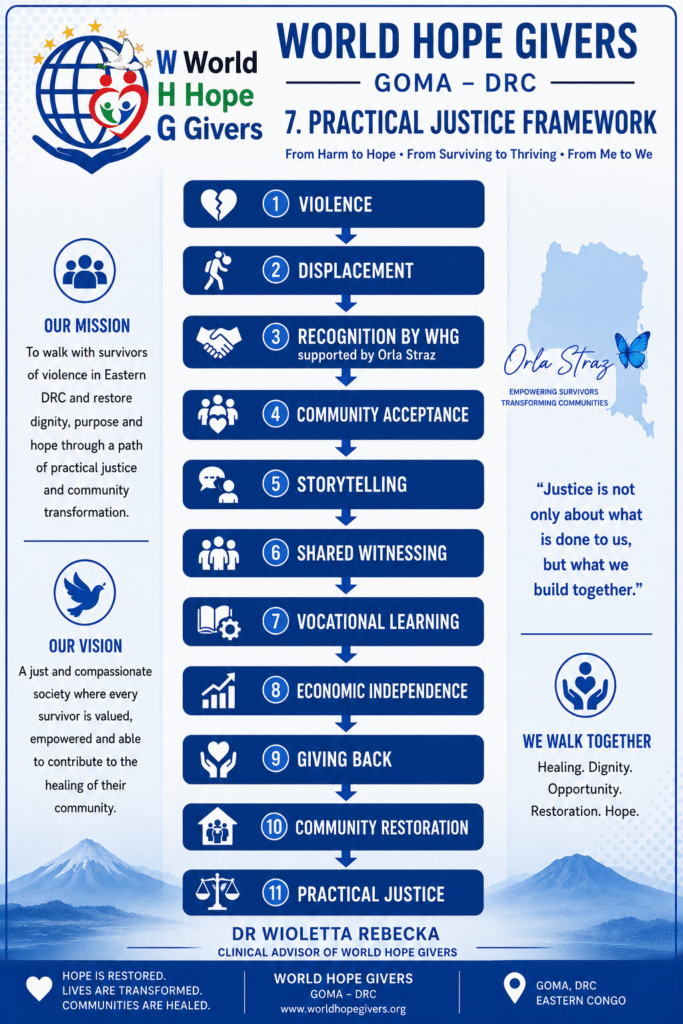
Figure 2
The second pathway broadens rehabilitation from an individual clinical process to a community process grounded in relational participation. Recovery becomes inseparable from belonging. Identity develops through contribution. Agency expands through meaningful work. Dignity grows through reciprocal relationships. Justice is experienced through rebuilding the social fabric that organized violence sought to destroy.
These findings suggest that rehabilitation programs operating in contexts of conflict-related sexual violence may benefit from integrating survivor participation, community recognition, vocational learning, and reciprocal contribution as interconnected components of long-term recovery. Such an approach remains fully compatible with multidisciplinary rehabilitation standards while incorporating culturally grounded understandings of relational personhood derived from Bantu philosophy. Practical Justice therefore provides a conceptual framework capable of connecting clinical rehabilitation, humanitarian practice, survivor participation, and community restoration within a coherent model of post-conflict recovery.
7. Limitations
Several limitations should be considered when interpreting the findings of this study. First, the research was conducted within a single community-based rehabilitation programs implemented by World Hope Givers (WHG) in Goma, Eastern Democratic Republic of the Congo. The findings therefore reflect one organizational context and one conflict-affected region. Rehabilitation programs operating within different cultural, political, or institutional environments may develop alternative pathways toward community restoration. The purpose of this study was not to establish universal effectiveness but to develop a conceptual framework grounded in empirical observation and participatory collaboration.
Second, the study employed purposive qualitative sampling involving twenty-two young women participating in the WHG program. The participants represented diverse experiences of conflict-related sexual violence, forced displacement, family rejection, street-connected living, and extreme socioeconomic vulnerability. Although the narratives revealed consistent patterns across individual life histories, the findings should not be interpreted as statistically representative of all survivors of conflict-related sexual violence in the Democratic Republic of the Congo or other conflict settings. Their value lies in analytical depth, contextual understanding, and theory generation.
Third, the research focused exclusively on women participating in an active rehabilitation programmed. Women who remained inaccessible because of continuing insecurity, severe psychological distress, geographic isolation, disability, or ongoing control by armed groups were not represented within the present study. Future research should explore whether the Practical Justice framework is similarly applicable among survivors who have not yet entered community-based rehabilitation.
The collaborative methodology adopted in this study also presents methodological considerations. Survivor participation through co-authorship, collaborative interpretation, and review of analytical themes intentionally challenges conventional distinctions between researcher and participant. This approach reflects the principles of Article 3 of the Global Charter of Survivors of Torture and Ubuntu-informed knowledge production while simultaneously requiring researchers to remain attentive to issues of shared authority, representation, and ongoing informed consent throughout the research process (Chilisa, 2020; Smith, 2021). These characteristics should be understood as methodological commitments rather than methodological weaknesses.
The concept of Practical Justice emerged inductively through prolonged field observations, participatory collaboration, and analysis of survivor narratives within one rehabilitation program. Although the framework is theoretically informed by Bantu philosophies of relational personhood and by the concept of Dislocation of Meaning (Rebecka, 2026), further research is required to examine its applicability within other cultural settings, rehabilitation centers, and post-conflict societies. Comparative studies involving different regions, survivor populations, and humanitarian organizations would contribute to refining the theoretical boundaries and practical implementation of the framework.
Finally, this study focused primarily on rehabilitation after conflict-related sexual violence. Practical Justice may also have relevance for survivors of torture, trafficking, forced displacement, and other forms of organized violence. The transferability of the framework to these contexts remains an important direction for future interdisciplinary research.
8. Conclusion
This article introduced Practical Justice as a culturally grounded framework for understanding rehabilitation following conflict-related sexual violence in Eastern Democratic Republic of the Congo. Developed through participatory collaboration with World Hope Givers (WHG), survivor co-authors, and local practitioners, the framework expands contemporary rehabilitation theory by demonstrating that recovery unfolds through the restoration of relationships, community participation, meaningful work, and reciprocal contribution alongside medical, psychological, and legal interventions.
The findings demonstrate that organized violence disrupts more than physical integrity or psychological well-being. Conflict-related sexual violence fractures the relational foundations through which personhood is sustained, including family relationships, community belonging, economic participation, and social identity. The rehabilitation pathway observed within WHG responds to these interconnected forms of disruption through community recognition, collective storytelling, shared witnessing, vocational learning, economic independence, reciprocal contribution, and community restoration. Together, these processes create conditions in which survivors gradually recover dignity, agency, and meaningful participation in collective life.
Grounded in Bantu understandings of relational personhood, the study demonstrates that rehabilitation is inseparable from community life. The principle commonly expressed through the Ubuntu philosophy—”I am because we are“—is reflected throughout the WHG model, where recovery is sustained through reciprocal relationships and shared responsibility. Within this perspective, survivors are recognized not only as recipients of humanitarian assistance but also as learners, workers, parents, community members, contributors, and co-producers of knowledge. Their participation extends from rehabilitation to the reconstruction of the social fabric affected by armed conflict.
The study also contributes to the growing international emphasis on survivor participation articulated in Article 3 of the Global Charter of Survivors of Torture. Survivor participation is conceptualized as an ongoing process that includes collaboration in rehabilitation, interpretation of lived experience, knowledge production, and community rebuilding. This understanding moves beyond consultation by recognizing survivors as active partners in shaping rehabilitation practices and future responses to organized violence.
The concept of Practical Justice represents the principal theoretical contribution of this article. Building upon the concept of Dislocation of Meaning (Rebecka, 2026), Practical Justice explains how meaning, dignity, and social identity are reconstructed through everyday community practices following organized violence. While criminal accountability remains essential for addressing violations of international law, the findings demonstrate that justice is also experienced through recognition, restored relationships, meaningful work, economic participation, and opportunities to contribute to others. Community restoration therefore becomes an essential dimension of rehabilitation and an expression of justice in contexts where formal judicial processes may remain inaccessible for prolonged periods.
The WHG model illustrates that rehabilitation and justice are not separate processes. They develop together through community participation. A woman who regains the confidence to tell her story, acquires vocational skills, supports her children, contributes economically, and becomes recognized within her community experiences a form of justice that is lived in everyday social life. This understanding does not diminish the importance of legal accountability. It broadens the concept of justice by acknowledging the relational processes through which survivors reclaim their place within society.
The implications extend beyond Eastern Democratic Republic of the Congo. The Practical Justice framework offers rehabilitation centers, humanitarian organizations, clinicians, researchers, and policymakers a transferable conceptual model for integrating survivor participation, community responsibility, vocational empowerment, and culturally grounded understandings of personhood into post-conflict rehabilitation. Although its practical implementation will necessarily reflect local histories and cultural traditions, the central principle remains consistent: sustainable rehabilitation emerges when survivors regain opportunities not only to survive violence but also to strengthen the communities that sustain human dignity.
By integrating African relational philosophy, survivor co-authorship, non-extractive methodology, and empirical observations from World Hope Givers, this article proposes that Practical Justice constitutes a new theoretical framework for post-conflict rehabilitation. It demonstrates that justice is not experienced exclusively through courtrooms or legal judgments. Justice is also created through everyday acts of recognition, shared responsibility, restored agency, and reciprocal contribution that enable survivors to move from violence toward belonging, from exclusion toward participation, and from surviving toward rebuilding the collective future.
References
Baaz, M. E., & Stern, M. (2013). Sexual violence as a weapon of war? Perceptions, prescriptions, problems in the Congo and beyond. London: Zed Books.
Braun, V., & Clarke, V. (2022). Thematic analysis: A practical guide. SAGE.
Bujo, B. (2001). Foundations of an African ethic: Beyond the universal claims of Western morality. Crossroad Publishing.
Chilisa, B. (2020). Indigenous research methodologies (2nd ed.). SAGE.
Das, V. (2007). Life and words: Violence and the descent into the ordinary. University of California Press.
de Greiff, P. (Ed.). (2006). The handbook of reparations. Oxford University Press.
Erikson, K. T. (1976). Everything in its path: Destruction of community in the Buffalo Creek flood. Simon & Schuster.
Eze, M. O. (2010). Intellectual history in contemporary South Africa. Palgrave Macmillan.
International Rehabilitation Council for Torture Victims. (2026). Charter of rights of victims and survivors of torture and other cruel, inhuman or degrading treatment or punishment.
Herman, J. L. (1992). Trauma and recovery. Basic Books.
Kagame, A. (1956). La philosophie bantu-rwandaise de l’être. Académie Royale des Sciences Coloniales.
Kelly, J. T., Betancourt, T. S., Mukwege, D., Lipton, R., & VanRooyen, M. J. (2011). Experiences of female survivors of sexual violence in eastern Democratic Republic of the Congo: A mixed-methods study. Conflict and Health, 5, Article 25. https://doi.org/10.1186/1752-1505-5-25
Kleinman, A., Das, V., & Lock, M. (Eds.). (1997). Social suffering. University of California Press.
Letseka, M. (2012). In defense of Ubuntu. Studies in Philosophy and Education, 31(1), 47–60. https://doi.org/10.1007/s11217-011-9267-2
Marovah, T., & Mutanga, O. (2024). Decolonizing participatory research: Can Ubuntu philosophy contribute something? International Journal of Social Research Methodology, 27(5), 501–516. https://doi.org/10.1080/13645579.2023.2214022
Mbiti, J. S. (1969). African religions and philosophy. Heinemann.
Metz, T. (2011). Ubuntu as a moral theory and human rights in South Africa. African Human Rights Law Journal, 11(2), 532–559.
Mukwege, D. (2021). The power of women: A doctor’s journey of hope and healing. Flatiron Books.
Portelli, A. (1997). The battle of Valle Giulia: Oral history and the art of dialogue. University of Wisconsin Press.
Ramose, M. B. (1999). African philosophy through Ubuntu. Mond Books.
Rebecka, W. (2026). Dislocation of meaning: When psychology becomes an oppression. Psychology, 17(1), 17–54. https://doi.org/10.4236/psych.2026.171002
Shutte, A. (2001). Ubuntu: An ethic for a new South Africa. Cluster Publications.
Smith, L. T. (2021). Decolonizing methodologies: Research and Indigenous peoples (3rd ed.). Zed Books.
Teitel, R. G. (2000). Transitional justice. Oxford University Press.
United Nations. (2014). Guidance note of the Secretary-General: Reparations for conflict-related sexual violence. United Nations.
van der Kolk, B. A. (2014). The body keeps the score: Brain, mind, and body in the healing of trauma. Viking.
World Health Organization. (2020). Clinical management of rape and intimate partner violence survivors: Developing protocols for use in humanitarian settings. World Health Organization.