From Prisons to Algorithms: Vietnam and the Evolution of Political Control in the Digital Age

In 2009, I was arrested for the first time after participating in protests against the bauxite mining project in Vietnam’s Central Highlands and speaking out about Vietnam’s sovereignty over the Paracel and Spratly Islands. Seven years later, I was arrested again and sentenced to ten years in prison for my writings and advocacy on behalf of human rights and freedom of expression.
When I walked out of prison in 2018 and was forced to leave Vietnam to begin a life in exile in the United States, I believed that imprisonment was the government’s most effective tool of repression. Looking back over the past two decades, however, I have come to understand that what has changed is not the state’s objective, but the methods it uses to achieve it.
The Communist Party of Vietnam has not remained passive in the face of a growing human rights movement and an emerging civil society. Instead, it has continuously adapted, learned, and modernized its instruments of control as Vietnamese society has become increasingly connected to the outside world. From the imprisonment of independent bloggers to the containment of civil society organizations and, more recently, the use of legislation, technology, and digital platforms to restrict public discourse, Vietnam has become a striking example of the transition from traditional repression to digital authoritarianism.
From Independent Bloggers to the Emergence of Civil Society
The development of contemporary civil society in Vietnam is closely tied to the rise of the internet. In the early 2000s, online access opened a new public sphere beyond the complete control of state-run media. For the first time, ordinary citizens could exchange information, discuss social and political issues, and connect with one another without relying exclusively on official channels.
Concerns about national sovereignty amid China’s growing influence in the South China Sea fueled many of the first public discussions and civic initiatives on the internet. The establishment of the Free Journalists Club marked an important milestone in the history of citizen journalism in Vietnam. The government’s response, however, was swift. Leading members of the club, along with many independent bloggers, were subjected to harassment, arrest, and imprisonment.
For many families, an arrest meant far more than the loss of an individual’s freedom. Relatives often faced financial hardship, social stigma, psychological pressure, and years of disruption to their education, employment, and daily lives. These consequences rarely appear in court verdicts, yet they represent some of the most painful and enduring effects of political repression.
Human Stories Behind the Statistics
International reports often describe Vietnam’s human rights situation through numbers: the number of arrests, the number of prisoners of conscience, or the number of bloggers sentenced to prison. Behind every statistic, however, is a human being, a family, and a community whose lives have been profoundly affected.
Journalist Nguyen Van Hai, better known by his pen name Dieu Cay, was imprisoned after speaking out about national sovereignty and freedom of expression. Journalist Ta Phong Tan lost her mother while she was in prison; her mother set herself on fire in protest of the treatment her daughter endured. Human rights lawyer Nguyen Van Dai spent years behind bars before ultimately being forced into exile.
I witnessed similar consequences within my own family. During my imprisonment, my daughter required psychological support after witnessing my arrest in handcuffs. For seven months before my trial in 2017, I was held in solitary confinement and received almost no information about my family. I was denied access to legal counsel throughout the investigation. At trial, the proceedings were so perfunctory that many observers questioned whether the right to a meaningful defense had truly been respected.
For many political prisoners in Vietnam, punishment does not begin with a verdict. It begins during the months of isolation before trial, when families often have little or no information about where their loved ones are being held or what condition they are in.
This is why freedom of expression in Vietnam is not simply about the right to speak. It is also about the right to live an ordinary life without sacrificing one’s freedom, one’s family, or one’s future for expressing peaceful opinions.
Internationalizing the Human Rights Struggle
The period between 2009 and 2013 marked an important turning point as domestic activists began connecting with international human rights mechanisms.
The emergence of Statement 258 and the Vietnamese Bloggers Network created some of the first bridges between Vietnam’s domestic civil society movement and international human rights organizations, democratic embassies, and United Nations institutions.
When Vietnam campaigned for a seat on the United Nations Human Rights Council in 2013, activists sought to use the government’s own international commitments to advance demands for freedom of expression, freedom of association, and broader civil rights. For the first time, issues that had long been dismissed as Vietnam’s “internal affairs” became part of international conversations about human rights and democratic accountability.
Reshaping Civic Space
As independent networks expanded and strengthened their international connections, the Vietnamese government began to adjust its strategy.
On one hand, independent political activists were increasingly isolated through surveillance, travel restrictions, administrative harassment, and criminal prosecutions. On the other hand, the state allowed certain social organizations to work in areas such as environmental protection, gender equality, community development, and public welfare—provided that they operated within carefully defined political boundaries.
This approach helped create the image of a developing civil society while ensuring that issues related to political power, freedom of expression, and freedom of association remained outside acceptable public debate.
For a time, this strategy appeared successful. International donors and development agencies found local partners with whom they could work, while the government maintained strict control over political discourse. Yet beneath the surface, the space for genuinely independent civic participation remained extremely limited.
Eventually, even this restricted space began to shrink.
When Even Environmental Advocacy Becomes a Target
For many years, environmental organizations were regarded as one of the few relatively safe components of Vietnamese civil society. Groups working on climate change, renewable energy, sustainable development, and environmental protection often collaborated with international organizations and development agencies.
In recent years, however, the arrests of environmental advocates such as Hoang Thi Minh Hong and Dang Dinh Bach demonstrated how quickly even this limited civic space could disappear.
What made these cases particularly significant was that neither individual was advocating for political regime change. Their work focused on environmental sustainability, public policy, and social responsibility, which are issues that the international community broadly supports and encourages.
These arrests took place at a time when Vietnam was receiving significant international support through climate initiatives and energy-transition programs. As a result, they raised important questions about the ability of independent civil society to participate meaningfully in internationally funded programs when individuals promoting transparency and accountability themselves became targets of prosecution.
For many international observers, the prosecution of environmental advocates while Vietnam simultaneously sought global climate financing raised serious concerns about transparency, accountability, and civic participation in the country’s energy transition.
The consequences extended far beyond the individuals involved. Following these cases, many organizations reduced their activities, avoided sensitive topics, or imposed new limits on research and policy advocacy. As a result, society lost independent voices capable of providing early warnings about environmental risks, public health concerns, and unsustainable development policies.
The weakening of civil society ultimately affects not only activists but also ordinary citizens whose ability to protect their communities, their rights, and their environment becomes increasingly constrained.
The Rise of Digital Authoritarianism
After significantly reducing independent civic activity in physical spaces, the Vietnamese state shifted its attention to the digital sphere.
Unlike China, Vietnam did not seek to build a completely separate internet isolated from the rest of the world. Instead, it adopted a different model—one that allows global technology platforms to operate while subjecting them to increasing legal, political, and economic pressure.
The adoption of the Cybersecurity Law in 2018 marked a major turning point in this process. Through requirements related to data management, content moderation, and corporate compliance, the government acquired new tools capable of influencing how information is distributed and controlled online.
At the same time, state-supported online networks and cyber units expanded their activities. Independent journalists, activists, and ordinary social media users increasingly found themselves subjected to coordinated reporting campaigns, online harassment, disinformation efforts, and attacks on their personal reputations.
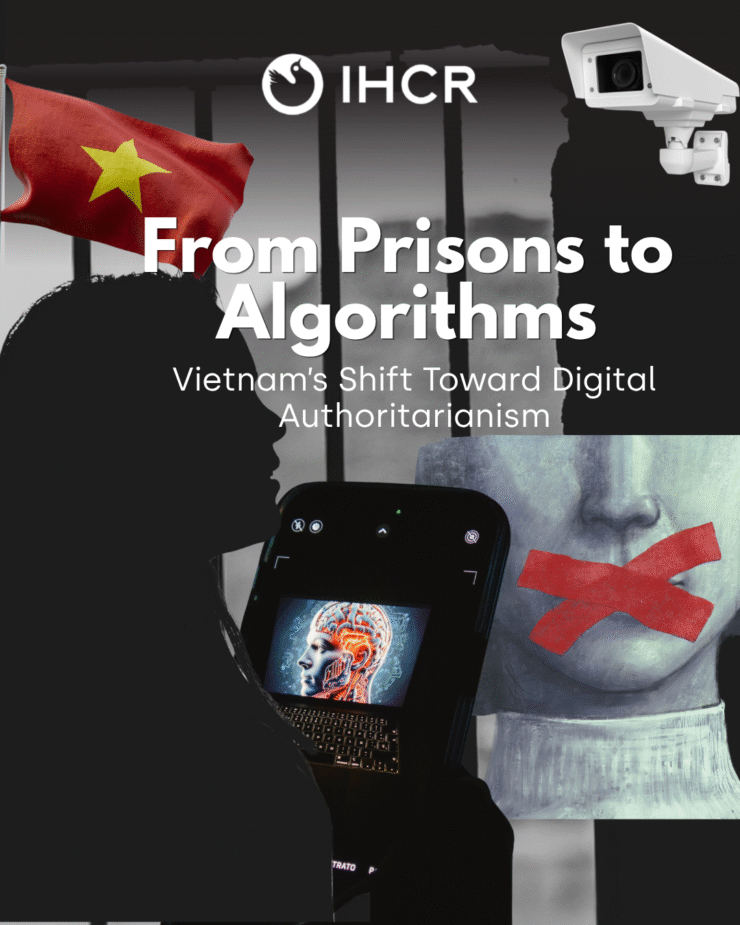
If prison once symbolized the state’s power to silence dissent, algorithms, data systems, and digital platforms have increasingly become the new instruments of control.
The challenge posed by digital authoritarianism is fundamentally different from traditional repression. It is often less visible. Content may disappear without explanation. Accounts may be restricted without transparency. Public conversations may be shaped not only through direct censorship, but also through pressure, intimidation, and the manipulation of digital spaces.
As a result, many citizens begin to censor themselves long before the state needs to intervene directly.
The shrinking of digital civic space is therefore not merely a technological issue. It is a human rights issue that affects freedom of expression, access to information, and citizens’ ability to participate meaningfully in public life.
Exile Does Not Mean Complete Freedom
When I arrived in the United States in 2018 after being released from prison and forced to leave Vietnam, many people assumed that the story of repression had ended.
In the digital age, however, exile no longer guarantees freedom from control.
Vietnamese activists living abroad frequently face online smear campaigns, attacks on their reputations, and efforts to isolate them from audiences inside Vietnam. Social media accounts may be targeted through coordinated reporting campaigns, online communities may be disrupted by organized disinformation efforts, and independent voices may find their reach restricted in ways that are often difficult to detect or challenge.
In recent years, some Vietnamese journalists, bloggers, and commentators living in North America have also faced cross-border legal disputes related to their reporting or investigations involving influential Vietnamese corporations, including cases connected to Vingroup and VinFast. Such cases have sparked broader debates about the potential “chilling effect” these actions may have on freedom of expression within the Vietnamese diaspora.
For many Vietnamese living in exile, the greatest challenge is no longer avoiding arrest. It is maintaining meaningful connections with audiences inside Vietnam while navigating an increasingly controlled digital environment.
This reflects a broader reality of the twenty-first century: repression no longer stops at national borders. In a world connected by technology, efforts to silence dissent can extend far beyond the territory of the state itself.
International Responses and Their Limitations
The international community has repeatedly expressed concern about Vietnam’s human rights record. Organizations such as the United Nations, Human Rights Watch, Amnesty International, and numerous democratic governments have documented arrests of dissidents, restrictions on freedom of expression, and the shrinking space available to independent civil society.
At the same time, Vietnam has become an increasingly important economic and strategic partner for many countries. It plays a growing role in global supply chains, regional security arrangements, and international climate initiatives.
This reality creates a persistent contradiction. While democratic governments regularly voice concerns about human rights, economic, commercial, and geopolitical interests often make it difficult for those concerns to translate into sustained and effective pressure.
The gap between international commitments and practical action remains one of the greatest obstacles to improving human rights conditions in Vietnam today.
Recommendations
Protecting civic space and fundamental freedoms in Vietnam requires sustained engagement from both domestic and international actors.
The international community should:
- Continue calling for the release of prisoners of conscience and detained human rights defenders.
- Encourage legal reforms that bring Vietnamese laws into compliance with international standards on freedom of expression, freedom of association, and peaceful assembly.
- Support independent environmental advocates, journalists, and civil society organizations.
- Require greater transparency from global technology companies regarding government requests to remove content or restrict online activity.
- Integrate digital rights and freedom of expression into trade negotiations, diplomatic dialogues, and development partnerships with Vietnam.
- Expand support networks for independent journalists, civil society actors, and members of the Vietnamese diaspora who continue to advocate for democratic values and human rights.
Meaningful progress will not come from isolation, but from sustained accountability, international solidarity, and the protection of independent civic participation.
I have experienced interrogation rooms, prison cells, and life in exile. Yet what concerns me most is not what happened to me personally.
What concerns me more is that a new generation of Vietnamese citizens is growing up in an environment where censorship is becoming increasingly invisible. What was once achieved through prison walls and physical coercion can now be accomplished through algorithms, data control, and the manipulation of online public spaces.
The struggle for freedom of expression in Vietnam is no longer solely a struggle against imprisonment. It is increasingly a struggle to protect the right to speak, to be heard, and to exist within the public sphere of the twenty-first century.
If the international community is committed to protecting human dignity, preventing conflict, and promoting sustainable peace, then safeguarding space for independent voices must be an essential part of that effort.
When the right to speak the truth is taken away, a society loses more than freedom. It loses its ability to recognize mistakes, correct injustices, and resolve conflicts peacefully.
This is not only Vietnam’s challenge. In a world increasingly shaped by data, algorithms, and digital platforms, every society must confront the same question: Will technology expand human freedom, or will it become a tool for refining ever more sophisticated forms of control?
The answer will help determine not only the future of freedom in Vietnam, but also the future of human dignity in the digital age.